

A Body Fat Calculator is designed to estimate the percentage of your total body weight that comes from fat tissue. Unlike body weight alone, body fat percentage gives a better picture of body composition because it helps distinguish fat mass from lean mass such as muscle, bone, organs, and water.
Body fat is not automatically harmful. The body needs a certain amount of fat to support normal hormonal function, protect internal organs, provide insulation, and store energy for daily physiological needs. This minimum level is often called essential fat, while the rest is generally referred to as storage fat.
Body Fat Categories
Body fat ranges are usually interpreted differently for men and women because the body’s biological needs are not identical. In general, women require a higher essential fat level than men, and healthy ranges also differ by sex and age.
American Council on Exercise Body Fat Categories
Jackson & Pollock Ideal Body Fat Percentages
These values should be treated as reference points, not as absolute rules. A person’s training status, genetics, age, muscle mass, and overall health all influence how body fat should be interpreted.
Body Fat, Overweight, and Obesity
Excess body fat can gradually lead to overweight and eventually obesity when calorie intake remains higher than energy expenditure for long periods. That said, a person can be labeled overweight by body weight or BMI without actually carrying too much fat, especially if they have high muscle mass, dense bones, or a larger athletic build.
Fat distribution also matters. Abdominal fat, especially fat stored deep around the organs, is generally considered more concerning than fat stored in less risky areas of the body. Men and women also tend to store fat differently, and these patterns can shift with age and hormonal changes.
Health Effects of Excess Body Fat
Too much body fat can affect both physical and metabolic health. It is commonly associated with a lower quality of life, poorer mental well-being, sleep-related breathing problems, and a higher risk of long-term diseases such as cardiovascular disease, stroke, diabetes, and some forms of cancer.
Body fat is also hormonally active, which means it does more than simply store energy. Excess fat, especially around the abdomen, can influence hormone balance, worsen insulin response, and contribute to unhealthy cholesterol patterns, including higher LDL and lower HDL levels.
How Body Fat Is Measured
There are several ways to estimate body fat percentage, and no simple calculator can provide a perfectly exact value. Some methods rely on tape measurements, some use BMI, and others use special devices or laboratory techniques.
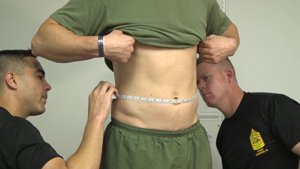
One common field method is the U.S. Navy method, which estimates body fat from circumference measurements. For men, the key measurements are usually waist, neck, and height. For women, the method usually includes waist, neck, hip, and height.
To improve accuracy, the tape should be placed consistently each time. Men usually measure the waist around the navel, while women generally measure the waist at its narrowest point and the hips at the widest point. The neck is typically measured just below the larynx with the tape slightly angled downward toward the front.
Body Fat Formulas
For men, circumference-based body fat equations use waist, neck, and height. For women, the equations include waist, hip, neck, and height. These formulas are practical and widely used, but they still provide only an estimate because they are built from generalized assumptions.
When body fat percentage is known, two more useful values can be calculated:
In this case, FM means fat mass and LM means lean mass. These two outputs can be very helpful because they show how much of the body is fat and how much is non-fat tissue.
BMI-Based Method
Another way to estimate body fat is to use BMI together with age and sex. This method is simpler because it only needs height, weight, age, and sex, but it is less personalized than circumference-based methods.
The common adult equations are:
For adult males:
For adult females:
There are also separate formulas for boys and girls because body composition changes during growth and development.
For boys:
For girls:
Practical Note
A body fat calculator should be used as a guidance tool rather than a medical diagnosis. The most useful approach is to track measurements consistently over time and combine them with other indicators such as waist size, strength progress, body weight trends, sleep quality, and general health.
