
How to Use a Calorie Deficit Calculator to Lose Weight Fast
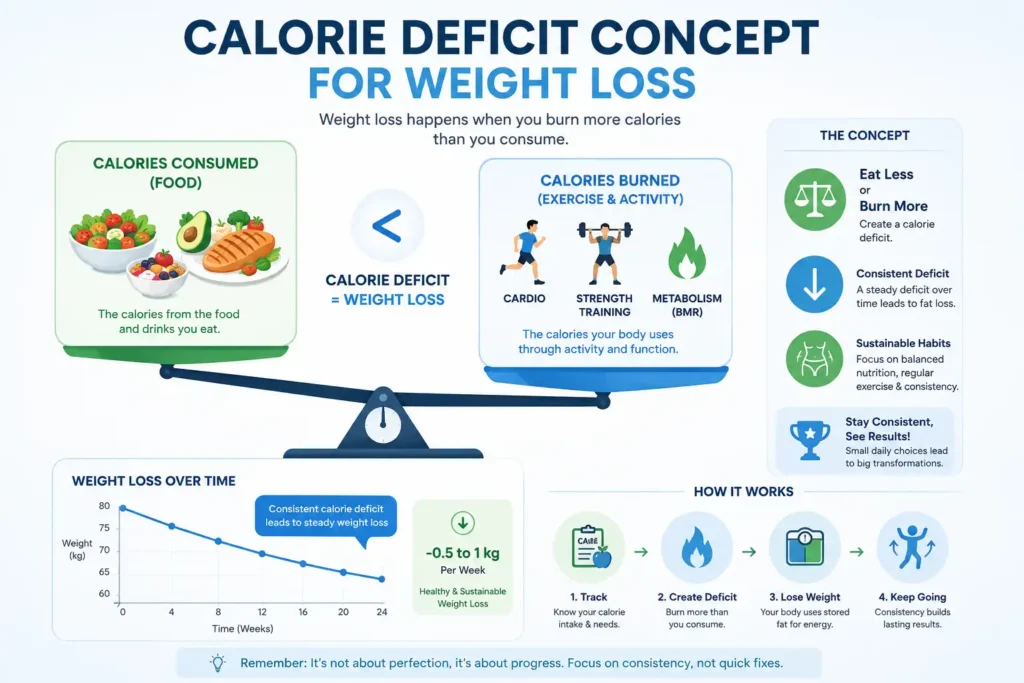
Losing weight does not have to feel confusing or extreme. A calorie deficit calculator can give you a clear starting point, showing how many calories your body needs and how much to reduce for steady fat loss. Health sources agree that weight loss works best when you eat fewer calories than you burn, and a moderate deficit is usually the safest approach for most adults.
If you are tired of guessing, this guide will show you how to use a calorie deficit calculator step by step, how to avoid common mistakes, and how to combine the results with simple habits that actually support fast-but-safe progress.
Table of Contents
- What a calorie deficit means
- How a calorie deficit calculator works
- Step-by-step guide to using it
- How big your deficit should be
- Best foods and habits for faster results
- Mistakes to avoid
- Tools on FitCalculatorAI.com
- Conclusion
What a calorie deficit means
A calorie deficit happens when you consume fewer calories than your body uses for energy. Your body then starts using stored energy, which can lead to weight loss over time. This is the basic principle behind almost every effective fat-loss plan, whether you use meal tracking, intermittent fasting, or structured meal plans.
The important part is consistency. A small daily deficit repeated over weeks is far more effective than a harsh crash diet that you cannot maintain. That is why calculators are helpful: they turn a vague goal like “eat less” into a realistic daily target.
How the calculator works
A calorie deficit calculator usually starts by estimating your maintenance calories, also called your total daily energy needs. It looks at key details such as age, sex, height, weight, and activity level to estimate how many calories you burn each day. Once you know maintenance calories, the calculator subtracts a chosen amount to create a deficit.
For example, if your maintenance level is 2,300 calories and you reduce by 500 calories, your target becomes 1,800 calories per day. Many health sources suggest a reduction of around 500 to 600 calories a day as a practical starting point for weight loss. This is why a calculator is so useful: it removes guesswork and helps you set a target based on your own body, not generic advice.
Step-by-step guide
Enter your body details
Start by inputting your age, sex, height, and weight. These numbers matter because they influence how many calories your body uses at rest and during daily activity. If the calculator asks for body fat percentage or activity level, use the most accurate answer you can give.
- Choose your activity level
Most calculators offer options such as sedentary, lightly active, moderately active, or very active. Be honest here. If you overestimate activity, your calorie target may be too high and fat loss may slow down. Mayo Clinic notes that activity estimates are a starting point and should be adjusted as your lifestyle changes.
- Set your weight-loss goal
Next, decide how quickly you want to lose weight. A safe and sustainable rate is usually about 0.5 to 1 kg, or 1 to 2 pounds, per week. Faster loss is not always better, because it can increase hunger, reduce energy, and make the plan harder to stick with.
- Review your calorie target
Once the calculator gives you a target, compare it with your current eating habits. If your normal intake is far above your target, do not try to cut everything overnight. Start with a manageable reduction and build consistency first. Many people do better when they begin with a 300 to 500 calorie cut, then adjust after 2 to 3 weeks based on progress.
- Track and adjust
A calculator gives you a strong estimate, but your real results matter more. Track your body weight, waist size, energy, and hunger for at least 2 weeks. If weight is not moving, you may need a smaller calorie intake or more movement. If you are losing too quickly or feeling drained, your deficit may be too aggressive.
How fast should you lose
The phrase “lose weight fast” is tempting, but the best results usually come from a controlled pace. NHS guidance and other health sources commonly recommend a daily calorie reduction of about 600 calories for weight loss, with a weekly loss rate around 1 to 2 pounds for many adults. That pace is fast enough to see progress, but not so extreme that it becomes unsustainable.
Here is a simple rule:
- Small deficit: slower but easier to maintain.
- Moderate deficit: best balance for most people.
- Large deficit: may produce quick results, but often increases hunger and fatigue.
If you want your weight loss to last, choose the option you can repeat on busy workdays, weekends, and social events. That is usually better than chasing the biggest number on the calculator.
Best habits for faster results
A calorie deficit works best when your daily habits support it. You do not need a perfect diet, but a few smart habits can make the process much easier.
Focus on protein and fiber
Protein helps preserve muscle during weight loss, and fiber helps you feel fuller for longer. Build meals around lean protein, vegetables, fruit, legumes, and whole grains. This can make a calorie deficit feel less restrictive.
Drink fewer liquid calories
Sugary drinks, fancy coffees, and alcohol can quietly add a lot of calories. CDC guidance also notes that replacing sugary drinks with water can help reduce caloric intake. If you want an easier deficit, this is one of the fastest places to start.
Use portion control
Portion sizes can drift upward without you noticing. Weighing food for a short period can teach you what normal portions really look like. NHS guidance also recommends checking labels and keeping a food diary to stay aware of your intake.
Move more every day
You do not need extreme workouts to lose fat. Walking, strength training, cycling, and short home sessions all help increase calorie burn. Exercise also helps protect muscle, which is important if you want your weight loss to look leaner and feel stronger.
Common mistakes to avoid
Many people fail with calorie deficits because they make the plan too complicated or too aggressive. Avoid these mistakes if you want better results.
- Cutting calories too low too quickly.
- Ignoring snacks, sauces, and drinks.
- Trusting exercise calories too much.
- Overestimating activity level.
- Changing your plan every few days.
- Comparing your progress to someone else’s.
A useful mindset is to treat your calculator result as a starting point, not a final truth. Your body will tell you whether the plan is working through weekly trends, not day-to-day fluctuations.
FitCalculatorAI tools to use
A calorie deficit calculator becomes even more powerful when you use it alongside other tools on FitCalculatorAI.com. For better accuracy and better results, start with these related calculators:
- BMI Calculator to understand your current weight category.
- BMR Calculator to estimate the calories your body burns at rest.
- TDEE Calculator to estimate your total daily energy expenditure.
- Calorie Calculator to check daily intake needs.
- Body Fat Calculator to track body composition, not just scale weight.
- Macro Calculator to set protein, carbs, and fat targets.
If you are building a weight-loss plan, these tools work together well. For example, you can use the BMR Calculator first, then the TDEE Calculator, and finally the calorie deficit calculator to set your daily fat-loss target.
Smart tools that help
You do not need expensive gear, but a few tools can make weight loss easier to follow. A fitness tracker or smartwatch can help you monitor steps, workouts, and activity trends. A food scale and meal prep containers can also make portion control simpler and more repeatable.
These are not magic solutions. Still, they reduce friction, and lower friction often means better consistency. For many people, consistency is what finally drives results.
A simple example
Let’s say your TDEE is 2,400 calories. If you choose a 500-calorie deficit, your daily target becomes 1,900 calories. If you stay close to that target most days, you may start losing around 1 pound per week on average, depending on your body and activity level.
That is the real advantage of a calorie deficit calculator. It turns a vague goal into a practical daily number you can follow.
Why this method works
This approach works because it combines science with simplicity. Health organizations such as the CDC, NHS, Mayo Clinic, and NIDDK all emphasize calorie balance, activity, and individualized planning when it comes to weight management. A calculator helps you personalize the process instead of relying on one-size-fits-all rules.
It also helps you avoid extremes. Instead of starving yourself or guessing portions, you get a structured target that you can adjust based on real progress.
Conclusion
Using a calorie deficit calculator is one of the easiest ways to start losing weight fast without making the process overly complicated. It gives you a realistic calorie target, helps you create a safe deficit, and makes it easier to stay consistent over time. If you combine that target with better food choices, more daily movement, and the right tools, you can make steady progress without burning out.
FAQ
- What is the best calorie deficit for weight loss?
A moderate deficit of about 500 to 600 calories per day is a common starting point for many adults.
- Can I lose weight faster with a bigger deficit?
Yes, but aggressive deficits can be harder to maintain and may increase hunger, fatigue, and the risk of muscle loss.
- Do I need to count calories every day?
Not always, but calorie tracking can help you learn your habits and stay on target, especially at the beginning.
- Why is my calorie deficit not working?
You may be underestimating food portions, overestimating activity, or not giving the plan enough time. Small weekly trends matter more than single weigh-ins.
- Should I use a calorie deficit calculator with a workout plan?
Yes. Pairing calorie control with strength training and daily movement usually improves fat loss and helps preserve muscle.