
How Much Protein Do You Need to Build Muscle?
If you’re trying to build muscle, get stronger, or improve your body composition, protein is one of the most important parts of your nutrition plan.
But how much protein do you actually need?
You may have heard everything from “eat 1 gram per pound” to “you need protein at every meal.” Others recommend extremely high-protein diets.
The reality is simpler.
For many adults who regularly perform resistance training, a daily intake around 1.6 grams of protein per kilogram of body weight is a useful evidence-based target for maximizing muscle-building benefits. Research also suggests that going substantially above this level does not necessarily produce additional gains in lean mass for most healthy adults following resistance training.
However, your ideal protein intake can vary depending on your body weight, training, age, goals, calorie intake, and overall diet.
In this guide, we’ll explain exactly how to calculate your protein needs, how much protein to eat per meal, whether you need protein powder, and how to build a high-protein diet without making nutrition unnecessarily complicated.
Quick answer: If your goal is muscle growth and you are resistance training, a practical target for many people is approximately 1.6 g of protein per kg of body weight per day.
Quick Protein Calculator
The easiest way to estimate your daily protein requirement is to start with your body weight.
Basic formula
Body weight (kg) × protein target (g/kg) = daily protein target
For someone weighing 70 kg:
70 × 1.6 = 112 g of protein per day
For someone weighing 80 kg:
80 × 1.6 = 128 g per day
For someone weighing 90 kg:
90 × 1.6 = 144 g per day
For a personalized estimate based on your body weight and fitness goal, use our Protein Calculator.
How Much Protein Do You Need Per Day?
There isn’t one protein number that works for everyone.
Your needs depend on what you’re trying to accomplish.
General guide
| Goal | Approximate Protein Target |
|---|---|
| General health | ~0.8 g/kg/day minimum reference |
| Regular exercise | ~1.2–1.6 g/kg/day |
| Muscle building | ~1.6 g/kg/day |
| Cutting while resistance training | ~1.6–2.2 g/kg/day can be practical |
| Older adults doing resistance training | Often higher than the basic minimum |
These are general ranges, not medical prescriptions.
For muscle growth, research supports the importance of adequate total protein combined with resistance training. A large meta-analysis found that protein supplementation increased gains in fat-free mass and strength during prolonged resistance training, with benefits generally leveling off around 1.6 g/kg/day of total protein intake.
Another systematic review found that higher protein intake produced small additional improvements in lean body mass and some measures of strength in healthy adults participating in resistance exercise.
Protein Calculator: How to Calculate Your Protein Needs

You don’t need a complicated formula.
Step 1: Find your body weight
Use your current body weight in kilograms.
If you know your weight in pounds:
Weight in pounds ÷ 2.205 = weight in kilograms
For example:
180 lb ÷ 2.205 ≈ 81.6 kg
Step 2: Choose your protein target
For someone focused on building muscle, you could start around:
1.6 g/kg/day
Step 3: Multiply
81.6 × 1.6 = 131 g protein/day
So an 81.6 kg person could use approximately 130 g of protein per day as a practical muscle-building target.
For an easier personalized calculation, use the FitCalculatorAI Protein Calculator.
How Much Protein Do You Need to Build Muscle?
If your primary goal is muscle hypertrophy, protein intake should work together with progressive resistance training.
Protein alone won’t magically build significant muscle.
Your body needs:
- Resistance training
- Adequate protein
- Enough total calories
- Carbohydrates and fats
- Sleep and recovery
- Consistency over time
Research consistently supports resistance training as a key component of muscle growth. A systematic review of resistance-training prescriptions found that resistance exercise improves both strength and hypertrophy compared with no resistance training.
Think of protein as raw material, not the entire construction process.
Is 1 Gram of Protein Per Pound Necessary?
Not necessarily.
A popular recommendation in bodybuilding is approximately:
1 gram of protein per pound of body weight
For an 80 kg person, that’s approximately 176 lb, meaning about 176 grams of protein per day.
That’s considerably higher than 1.6 g/kg:
80 × 1.6 = 128 g/day
For many people, eating 176 g instead of 128 g won’t automatically produce more muscle.
The evidence from a large meta-analysis suggests that protein intake above approximately 1.6 g/kg/day does not provide additional resistance-training-related gains in fat-free mass for most healthy adults.
That doesn’t mean higher protein intakes are automatically harmful or useless. It means more isn’t necessarily better.
How Much Protein Should You Eat Per Meal?
Your total daily protein intake is extremely important, but distributing protein throughout the day can make it easier to reach your target.
Instead of eating almost all your protein at dinner, try spreading it across several meals.
For example, someone targeting 120 g/day could eat:
- Breakfast: 30 g
- Lunch: 30 g
- Snack: 20 g
- Dinner: 40 g
Total:
120 g protein
This approach can also make a high-protein diet easier to follow because you’re not trying to consume an enormous amount of protein in one meal.
What Is the Best Protein Timing for Muscle Growth?
You may have heard about the famous “30-minute anabolic window.”
The idea that you must drink a protein shake immediately after your workout or lose your gains is overstated.
What matters most is achieving your overall daily protein intake consistently.
Having a protein-containing meal or snack around your workout can be convenient, but you don’t need to panic if you don’t drink a shake immediately after your final set.
A 2023 network meta-analysis examined protein timing and different protein types in adults undergoing resistance training, reflecting the broader research interest in how protein timing affects muscle outcomes.
The practical approach:
Hit your daily protein target first. Then optimize timing if you want to.
Best High-Protein Foods for Muscle Building
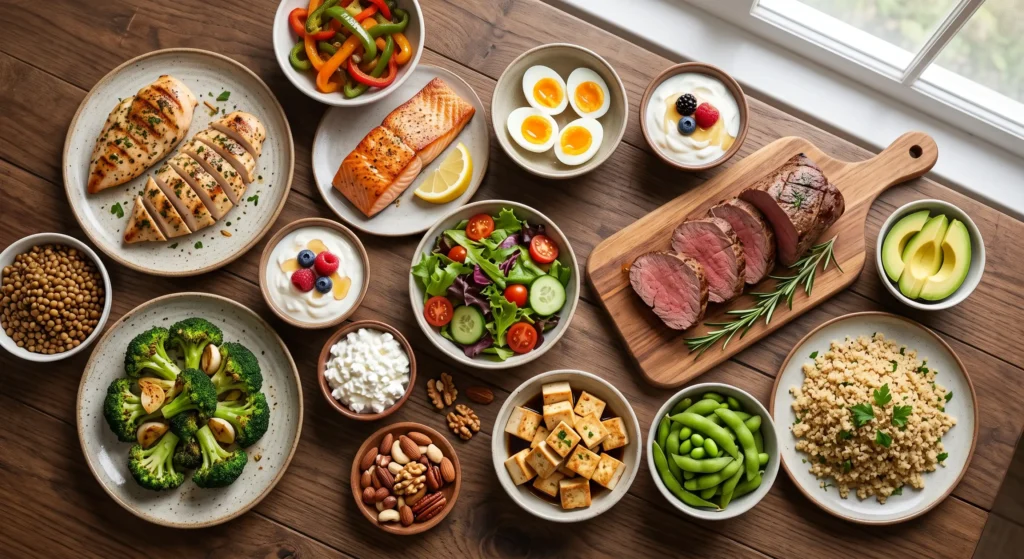
You don’t need supplements to build muscle.
You can get plenty of protein from whole foods.
Animal-Based Protein Sources
Some high-protein options include:
- Chicken breast
- Turkey
- Lean beef
- Eggs
- Tuna
- Salmon
- Sardines
- Greek yogurt
- Cottage cheese
- Milk
These foods can make it relatively easy to reach a high-protein target.
Plant-Based Protein Sources
If you follow a vegetarian or vegan diet, you still have plenty of options.
Consider:
- Lentils
- Chickpeas
- Beans
- Tofu
- Tempeh
- Edamame
- Soy milk
- Peas
- Quinoa
- Nuts and seeds
A varied plant-based diet can provide substantial protein, although the protein content and amino-acid profile differ between foods.
Is Whey Protein Good for Building Muscle?
Yes.
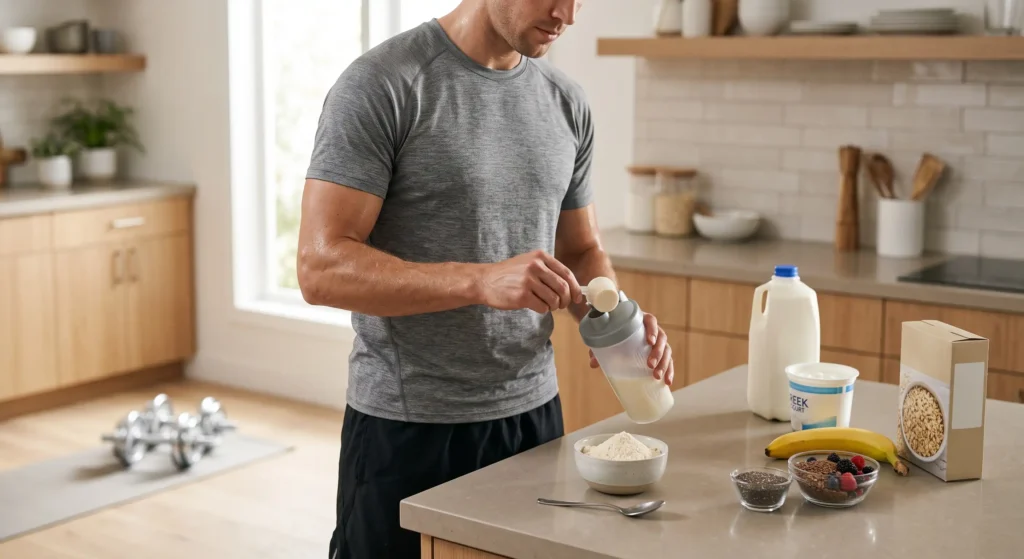
Whey protein is a convenient source of high-quality protein, particularly for people who struggle to reach their daily protein target through food.
It isn’t magic.
Whey protein essentially provides protein in a convenient format.
Recent research continues to investigate different protein supplements alongside resistance training. A 2026 systematic review and meta-analysis examining whey and soy protein supplementation in young adults performing resistance training evaluated effects on lean body mass, strength, and amino-acid availability.
When whey protein can be useful
Whey may be convenient if:
- You don’t have time to cook
- You struggle to eat enough protein
- You need a portable snack
- You want protein after training
- You have difficulty meeting your protein target with normal meals
But if you already reach your protein target through food, you don’t necessarily need a protein supplement.
Whey Protein vs Whole Foods
Which is better?
There isn’t a simple winner.
Whole foods
Advantages:
- Protein
- Vitamins and minerals
- Other nutrients
- Greater food variety
- Usually more filling
Whey protein
Advantages:
- Convenient
- Easy to measure
- Quick to prepare
- High protein per serving
- Useful around busy schedules
For most people, a combination works well.
For example:
Food first + whey when convenient.
How Much Protein Do You Need When Losing Weight?
Protein becomes particularly important when you’re trying to lose body fat while maintaining muscle.
When you’re in a calorie deficit, resistance training and adequate protein can help support lean mass.
A practical approach for many active adults is to keep protein relatively high while controlling total calorie intake.
For example:
Calories → determine the energy deficit
Protein → helps support lean mass
Carbohydrates → support training and activity
Dietary fat → supports overall nutrition and hormone-related functions
Use our:
to create a more complete picture of your nutrition goals.
Protein for Muscle Gain vs Fat Loss
Your protein target may stay relatively high whether you’re trying to gain muscle or lose fat.
The major difference is your total calorie intake.
Muscle gain
Usually involves:
Adequate protein + resistance training + sufficient calories
Fat loss
Usually involves:
Adequate protein + resistance training + calorie deficit
This is why protein shouldn’t be considered separately from your total calorie and macronutrient intake.
Can You Build Muscle Without Protein Powder?
Absolutely.
Protein powder is a supplement, not a requirement.
You can build muscle using foods such as:
Breakfast:
Eggs + Greek yogurt + whole-grain toast
Lunch:
Chicken + rice + vegetables
Snack:
Greek yogurt + fruit
Dinner:
Salmon + potatoes + vegetables
This can provide substantial protein without a single scoop of whey.
The main question isn’t:
“Do I take protein powder?”
It’s:
“Am I consistently getting enough total protein?”
How Much Protein Do Women Need to Build Muscle?
Women need protein just like men do, and the appropriate target is influenced primarily by body weight, activity, age, and goals rather than simply sex.
A woman who weighs 60 kg and performs resistance training might use:
60 × 1.6 = 96 g protein/day
A 70 kg woman:
70 × 1.6 = 112 g/day
A 80 kg woman:
80 × 1.6 = 128 g/day
These numbers are examples, not universal prescriptions.
How Much Protein Do Men Need to Build Muscle?
The same basic calculation can be used.
For example:
70 kg man
70 × 1.6 = 112 g/day
80 kg man
80 × 1.6 = 128 g/day
90 kg man
90 × 1.6 = 144 g/day
Your target should be based on your individual circumstances rather than assuming that every man needs 200+ grams of protein every day.
Do Older Adults Need More Protein?
Protein requirements can become more important with age because maintaining muscle mass and physical function becomes increasingly important.
Research in healthy older adults has found benefits associated with higher protein intake combined with resistance training, although the ideal amount can vary between individuals.
Older adults should also consider their overall health, medications, kidney function, appetite, and dietary needs when making major changes to protein intake.
If you have a medical condition or have been advised to restrict protein, speak with a qualified healthcare professional before substantially increasing your intake.
10 High-Protein Foods to Add to Your Diet
Here are some practical protein-rich foods:
- Chicken breast
- Eggs
- Greek yogurt
- Tuna
- Salmon
- Lean beef
- Cottage cheese
- Lentils
- Tofu
- Milk
Rather than relying on a single food, build variety into your diet.
How to Reach Your Protein Goal Every Day
If you’re struggling to reach your target, don’t try to fix everything at once.
Use a simple strategy.
1. Start breakfast with protein
Instead of a breakfast based mainly on carbohydrates, include eggs, Greek yogurt, milk or another protein source.
2. Make lunch protein-centered
Choose chicken, fish, lean meat, tofu, beans or another substantial protein source.
3. Keep a protein snack available
Greek yogurt, cottage cheese, milk or a protein shake can be convenient options.
4. Include protein at dinner
Build your dinner around a quality protein source.
5. Track your intake for a few days
You don’t have to track forever.
Tracking temporarily can teach you what 100, 120 or 150 grams of protein actually looks like in real food.
Example 120-Gram Protein Day
Here’s an example of how someone could reach approximately 120 g.
Breakfast
3 eggs + Greek yogurt
≈ 30 g protein
Lunch
Chicken breast + rice + vegetables
≈ 35 g
Snack
Greek yogurt + milk
≈ 20 g
Dinner
Salmon + potatoes + vegetables
≈ 35 g
Total ≈ 120 g
Actual protein amounts depend on portion sizes and the specific foods you choose.
Common Protein Mistakes
Mistake 1: Eating huge amounts of protein
More protein isn’t automatically better.
Once you’re consistently meeting an appropriate target, increasing protein dramatically may offer little additional benefit for muscle growth.
Mistake 2: Ignoring calories
You can eat plenty of protein and still fail to reach your fitness goal if your total calorie intake doesn’t match your objective.
Mistake 3: Thinking protein builds muscle by itself
Resistance training provides the stimulus for muscle growth.
Protein supports the process.
Mistake 4: Depending entirely on supplements
Protein powder can be useful, but whole foods should remain an important part of a balanced diet.
Mistake 5: Forgetting consistency
One high-protein day won’t transform your physique.
Your average intake over weeks and months matters much more.
Protein, Calories and Macros: The Bigger Picture

Protein is only one part of your nutrition strategy.
For a complete approach, consider your:
Calories → How much energy you consume
Protein → Supports muscle maintenance and growth
Carbohydrates → Important fuel for many forms of training
Fat → Important source of energy and essential fatty acids
This is why calculating protein separately can be useful, but combining it with calorie and macro calculations can give you a much clearer picture.
Calculate Your Nutrition Goals
Protein Calculator
Estimate your daily protein target.
Calorie Calculator
Estimate your daily calorie needs.
Macro Calculator
Create a personalized protein, carbohydrate and fat breakdown.
TDEE Calculator
Estimate your total daily energy expenditure.
Frequently Asked Questions
How much protein do I need to build muscle?
For many adults performing resistance training, around 1.6 g/kg/day is a useful evidence-based target. Individual needs can vary based on age, training, body composition, calorie intake and goals.
Is 100 grams of protein enough to build muscle?
It depends on your body weight and training.
For a 60 kg person, 100 g is about 1.67 g/kg, which can be sufficient for a muscle-building diet.
For someone weighing 100 kg, 100 g is only 1 g/kg, which may be relatively low for maximizing muscle-building nutrition.
Is 150 grams of protein too much?
Not necessarily for every person. Whether 150 g is appropriate depends on body weight, training, diet and health status.
For an 80 kg person, 150 g equals approximately 1.88 g/kg/day.
Do I need protein immediately after my workout?
No. The most important priority is reaching an appropriate total daily protein intake. Having protein around training can be convenient, but you don’t need to obsess over a very narrow post-workout window.
Can I build muscle with plant protein?
Yes. Plant-based diets can provide adequate protein when they include a variety of protein-rich foods and sufficient total protein.
Is whey protein necessary?
No. Whey is simply a convenient protein source. You can meet your protein needs entirely through whole foods.
What is the best protein for muscle growth?
There isn’t one universally “best” protein for everyone. Whey, dairy proteins, eggs, meat, fish and appropriately planned plant proteins can all contribute to your overall protein intake.
Should I eat protein on rest days?
Yes. Muscle recovery doesn’t stop when you leave the gym. Maintaining consistent protein intake on rest days can help you maintain an appropriate daily protein intake.
The Bottom Line
If you’re wondering “How much protein do I need to build muscle?”, don’t overcomplicate it.
For many healthy adults who perform resistance training, around 1.6 g of protein per kilogram of body weight per day is a strong starting point for a muscle-building nutrition plan. Research suggests that increasing protein beyond this level does not necessarily provide additional gains in lean mass for most people.
The bigger picture matters:
Eat enough protein.
Train consistently.
Consume appropriate calories.
Sleep and recover.
Repeat for months.
And remember: protein is only one piece of the puzzle.
Use the FitCalculatorAI Protein Calculator to estimate your target, then combine it with the Calorie Calculator and Macro Calculator to build a more complete nutrition plan.
Medical Disclaimer
This article is provided for educational and informational purposes only. It is not medical advice and should not replace advice from a physician, registered dietitian, or other qualified healthcare professional.
Individual protein requirements can vary, particularly for people with kidney disease, liver disease, metabolic conditions, pregnancy, eating disorders, or other medical conditions. If you have a medical condition or have been advised to modify your protein intake, consult an appropriate healthcare professional before making significant dietary changes.