
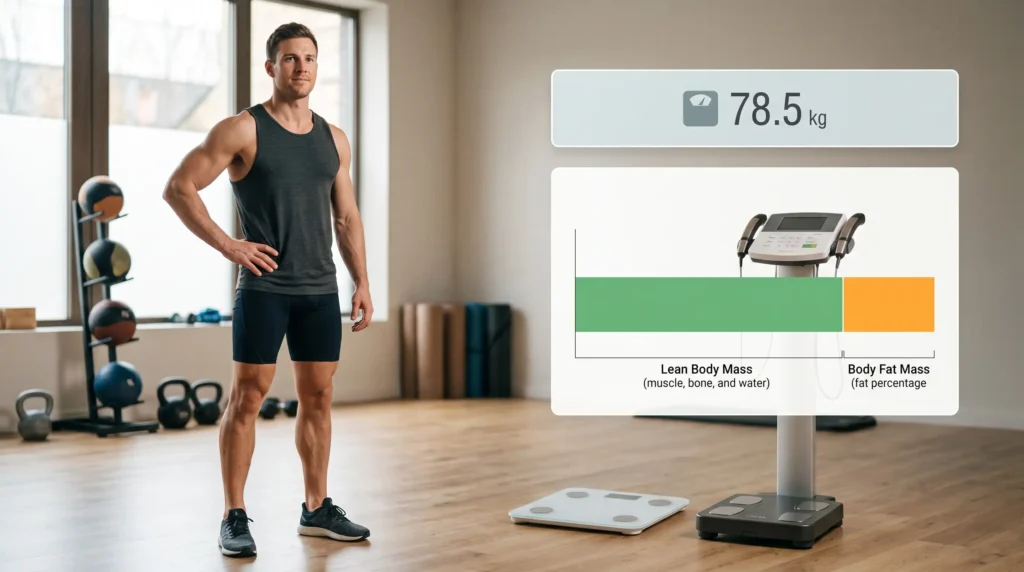
When people want to understand their body composition, BMI and FFMI are two measurements they may come across. Although both use your height and weight, they answer very different questions.
BMI (Body Mass Index) looks at your body weight in relation to your height. FFMI (Fat-Free Mass Index) goes a step further by estimating how much lean, fat-free mass you have relative to your height.
This difference can be especially important for people who exercise regularly, build muscle, or have a relatively low body-fat percentage.
In this guide, we’ll explain the difference between FFMI vs BMI, how each measurement works, their advantages and limitations, and when you should use one over the other.
What Is BMI?
Body Mass Index (BMI) is a simple calculation that compares your body weight with your height.
The standard formula is:
BMI = weight (kg) ÷ height² (m²)
For example, a person weighing 75 kg and measuring 1.75 m would have:
75 ÷ (1.75 × 1.75) = 24.5 BMI
BMI is commonly divided into the following categories for adults:
| BMI | General Category |
|---|---|
| Below 18.5 | Underweight |
| 18.5–24.9 | Normal weight |
| 25.0–29.9 | Overweight |
| 30.0+ | Obesity |
These categories are useful for population-level health screening, but BMI does not tell you what your body weight is made of.
Someone with a lot of muscle can have a high BMI without having a high amount of body fat.
What Is FFMI?
Fat-Free Mass Index (FFMI) is designed to estimate the amount of fat-free mass relative to your height.
Fat-free mass includes most of the body’s mass that isn’t fat, including:
- Muscle
- Bone
- Organs
- Water
- Connective tissue
A simplified FFMI calculation is:
FFMI = fat-free mass (kg) ÷ height² (m²)
To calculate fat-free mass, you first need an estimate of your body-fat percentage.
For example, if someone weighs 80 kg and has an estimated body-fat percentage of 15%:
Fat mass = 80 × 0.15 = 12 kg
Fat-free mass = 80 − 12 = 68 kg
That fat-free mass can then be used to calculate FFMI.
Because FFMI focuses on fat-free mass rather than total body weight, it provides a different perspective from BMI.
FFMI vs BMI: The Main Difference
The simplest way to understand the difference is:
BMI measures total body weight relative to height.
FFMI measures fat-free mass relative to height.
This means two people can have the same BMI but very different body compositions.
For example:
Person A
- Weight: 80 kg
- Height: 1.75 m
- Higher muscle mass
- Lower body fat
Person B
- Weight: 80 kg
- Height: 1.75 m
- Lower muscle mass
- Higher body fat
Both people have the same BMI because BMI only considers height and total weight.
Their FFMI, however, could be significantly different.
This is one of the biggest reasons bodybuilders, strength athletes, and people focused on body composition may find FFMI useful.
Why BMI Can Be Misleading for Muscular People
BMI doesn’t distinguish between muscle and fat.
Muscle tissue contributes to body weight just like fat does. Therefore, someone who has developed substantial muscle mass may fall into a higher BMI category even when their body-fat level is relatively low.
For example, a strength athlete could have a BMI above 25 while maintaining a relatively lean physique.
This doesn’t automatically mean that BMI is useless.
Instead, it means BMI should be interpreted in context.
A person’s:
- Waist circumference
- Body-fat percentage
- Muscle mass
- Fitness level
- Age
- Sex
- Overall health
can provide additional information.
Why FFMI Can Be Useful for Fitness
FFMI can be particularly interesting when your goal is muscle development and body composition.
Instead of asking:
“How much do I weigh for my height?”
FFMI helps answer a different question:
“How much fat-free mass do I have relative to my height?”
This makes it potentially useful for people who are:
- Strength training
- Bodybuilding
- Tracking muscle gain
- Cutting body fat
- Monitoring changes in body composition
- Comparing physique changes over time
However, FFMI should still be treated as an estimate rather than a perfect measurement of muscle.
BMI vs FFMI: Which One Is Better?
There isn’t one measurement that is universally better.
It depends on what you’re trying to understand.
| Goal | BMI | FFMI |
|---|---|---|
| General weight screening | ✅ | ❌ |
| Population health screening | ✅ | ❌ |
| Tracking muscle development | Limited | ✅ |
| Understanding lean mass | ❌ | ✅ |
| Comparing muscular physiques | Limited | More useful |
| Simple calculation | ✅ | More complex |
| Requires body-fat estimate | ❌ | ✅ |
For general health screening, BMI can be useful.
For people specifically interested in muscle mass and body composition, FFMI can provide additional information.
Can You Have a High BMI and Low Body Fat?
Yes.
This is one of the most important limitations of BMI.
A person with substantial muscle mass can weigh considerably more than someone of the same height with less muscle.
Since BMI doesn’t know whether that weight comes from muscle, fat, bone, or other tissues, it cannot determine body composition by itself.
That’s why you shouldn’t automatically assume:
High BMI = high body fat
or:
Normal BMI = optimal body composition
BMI is a screening measurement, not a complete assessment of your physique.
Can FFMI Replace BMI?
Not necessarily.
FFMI and BMI measure different things.
Replacing one with the other isn’t always appropriate because FFMI requires an estimate of body fat and focuses on fat-free mass.
A better approach can be to use multiple measurements together.
For example:
BMI + body-fat percentage + FFMI + waist measurement
can provide a more complete picture than any single number.
For someone focused on fitness, tracking changes over time can also be more useful than obsessing over one measurement.
How to Use BMI and FFMI Together
You can use BMI to understand your overall weight relative to height, while FFMI provides additional context about your fat-free mass.
For example, imagine someone whose weight increases during a resistance-training program.
Their BMI may increase because their body weight increased.
But if most of the additional weight comes from lean mass rather than fat, their FFMI may also increase.
This can help explain why scale weight alone isn’t enough to evaluate fitness progress.
A better tracking system might include:
- Body weight
- Body-fat percentage
- FFMI
- Waist circumference
- Strength performance
- Progress photos
- Training performance
Together, these measurements can show whether changes in body weight are likely associated with muscle gain, fat gain, or a combination of both.
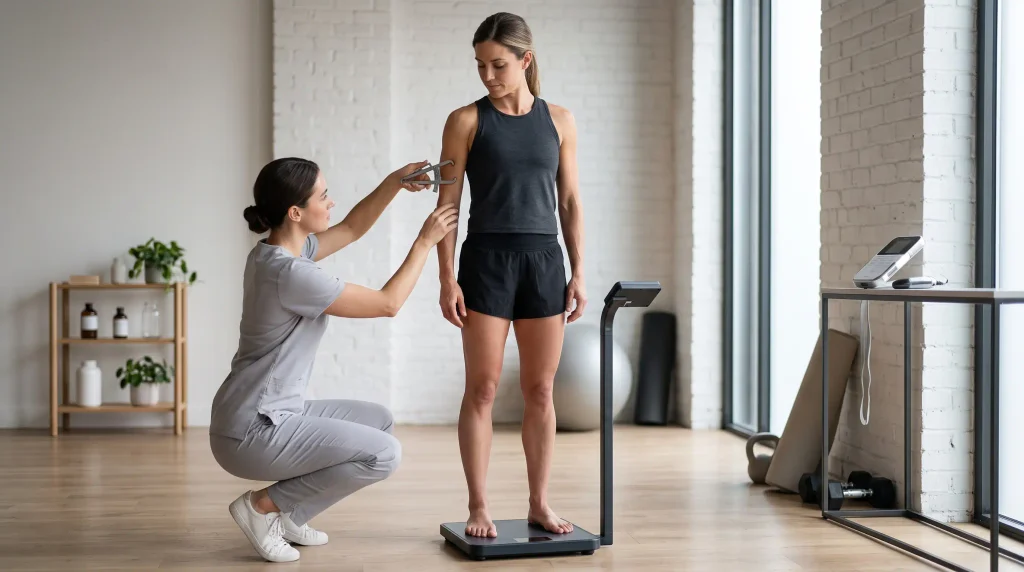
FFMI and Body Fat Percentage

FFMI depends heavily on your estimate of body-fat percentage.
This is important because body-fat measurements are not always perfectly accurate.
Different methods can produce different results, including:
- Bioelectrical impedance scales
- Skinfold measurements
- DEXA scans
- Hydrostatic weighing
- Visual estimates
If your body-fat estimate is inaccurate, your calculated fat-free mass—and therefore your FFMI—will also be inaccurate.
For this reason, FFMI is best viewed as an estimation and tracking tool, rather than a precise laboratory measurement.
FFMI Example
Let’s look at a simple example.
Imagine a person who weighs:
80 kg
Height:
1.80 m
Estimated body fat:
20%
First, calculate fat mass:
80 × 0.20 = 16 kg
Then calculate fat-free mass:
80 − 16 = 64 kg
Now calculate FFMI:
64 ÷ (1.80 × 1.80)
FFMI ≈ 19.8
The person’s BMI would be:
80 ÷ (1.80 × 1.80) ≈ 24.7
So the two numbers provide different information:
- BMI ≈ 24.7 → total body weight relative to height
- FFMI ≈ 19.8 → estimated fat-free mass relative to height
This demonstrates why BMI and FFMI shouldn’t be interpreted as interchangeable measurements.
Should Athletes Use BMI?
Athletes can still calculate BMI, but they should be careful about interpreting it.
For people with significant muscle mass, BMI may overestimate the health implications of their weight because it cannot distinguish muscle from fat.
For this reason, athletes may benefit from looking at additional measurements such as:
- Body-fat percentage
- Waist circumference
- FFMI
- Performance
- Training history
The appropriate metric also depends on the sport.
A long-distance runner, powerlifter, bodybuilder, and recreational lifter may have very different ideal body compositions.
FFMI vs BMI for Muscle Gain

If your primary goal is gaining muscle, FFMI can be particularly interesting because it focuses on fat-free mass.
Suppose your body weight increases by 5 kg.
That doesn’t automatically mean you’ve gained 5 kg of muscle.
The increase could include:
- Muscle tissue
- Fat
- Water
- Glycogen
- Food and digestive contents
Tracking FFMI alongside body weight and body-fat estimates can help provide more context.
For muscle-building programs, it’s usually better to evaluate progress over several weeks or months rather than reacting to individual changes on the scale.
Which Calculator Should You Use?
The right calculator depends on your goal.
Use a BMI Calculator if you want to:
- Calculate BMI quickly
- Compare weight and height
- Get a general weight-category screening value
Use an FFMI Calculator if you want to:
- Estimate fat-free mass relative to height
- Track physique development
- Monitor changes during muscle-building
- Compare changes in lean mass over time
Use a Body Fat Calculator if you want to:
- Estimate body-fat percentage
- Track changes in body composition
- Get the body-fat input needed for an FFMI calculation
For a more complete assessment, you can use these measurements together rather than relying on just one.
Common Mistakes When Comparing FFMI and BMI
1. Assuming BMI Measures Body Fat
It doesn’t.
BMI uses body weight and height but does not directly measure body-fat percentage.
2. Treating FFMI as an Exact Muscle Measurement
FFMI represents fat-free mass, not pure skeletal muscle.
Fat-free mass includes water, organs, bone, and other non-fat tissues.
3. Using an Inaccurate Body-Fat Estimate
Because FFMI depends on body-fat percentage, inaccurate body-fat data can significantly affect the result.
4. Comparing Numbers Without Considering Height
Both BMI and FFMI incorporate height, so the same body weight can produce different results for people of different heights.
5. Focusing on One Number
No single calculator can describe your entire health or physique.
Your measurements should be interpreted alongside your goals, activity level, training, and other health indicators.
How Often Should You Calculate FFMI?
You don’t necessarily need to calculate FFMI every day.
For people tracking muscle-building progress, checking it periodically—such as every 4–8 weeks—can be more useful.
Try to keep measurement conditions similar:
- Similar time of day
- Similar hydration
- Similar body-fat measurement method
- Similar weighing conditions
Consistency makes changes easier to interpret.
Frequently Asked Questions
Is FFMI better than BMI?
Not universally. BMI is useful for general weight screening, while FFMI provides more information about fat-free mass. For people focused on muscle and body composition, FFMI may be more informative.
Can muscular people have a high BMI?
Yes. Because BMI doesn’t distinguish muscle from fat, people with substantial muscle mass can have a higher BMI.
Does FFMI measure muscle mass?
Not directly. FFMI estimates fat-free mass relative to height. Fat-free mass includes muscle as well as water, bone, organs, and other non-fat tissues.
Do I need body-fat percentage to calculate FFMI?
Yes, if you’re calculating FFMI from body weight. You need an estimate of fat-free mass, which requires an estimate of body-fat percentage.
Can I use BMI and FFMI together?
Yes. They provide different information and can be used together to better understand weight and body composition.
Is FFMI useful for bodybuilding?
It can be useful as one tracking metric for bodybuilding and resistance training, particularly when monitoring changes in lean mass. However, it should not be treated as a definitive measure of muscle quality or overall health.
What is more important: BMI or body composition?
For understanding physique and fitness progress, body composition can provide information that BMI alone cannot. However, BMI can still be useful as a simple general screening measure.
Final Takeaway: FFMI vs BMI
BMI and FFMI are not competing versions of the same measurement.
BMI tells you how your total body weight relates to your height.
FFMI tells you how your estimated fat-free mass relates to your height.
For general population screening, BMI remains a simple and useful metric. But if you’re focused on muscle gain, resistance training, or body composition, FFMI can provide additional context that BMI cannot.
The best approach is not to rely on a single number. Combining BMI, FFMI, body-fat percentage, waist measurements, and changes in physical performance can give you a more useful picture of your progress.
Use our FFMI Calculator to estimate your FFMI, and combine it with our BMI Calculator and Body Fat Calculator for a broader look at your body composition.
Important: Calculators such as BMI and FFMI are estimation tools and should not be used to diagnose medical conditions. Individual health and body-composition goals can vary significantly.