
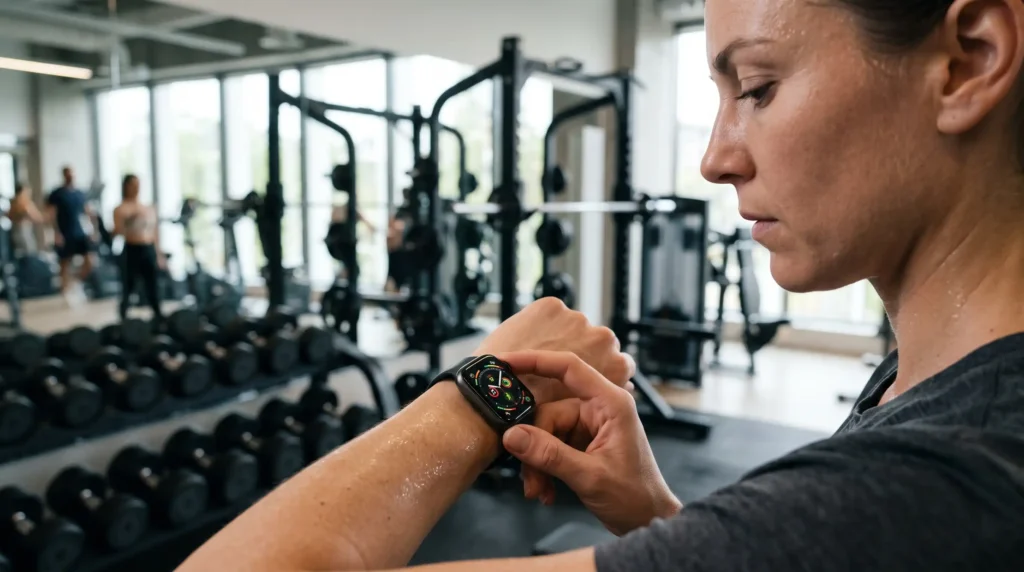
Fitness wearable technology has become one of the biggest forces shaping the fitness industry in 2026. Smartwatches, fitness trackers, smart rings, heart-rate monitors, and AI-powered fitness platforms are helping people understand their workouts, sleep, recovery, activity levels, and overall training habits.
The American College of Sports Medicine (ACSM) ranked wearable technology as the #1 fitness trend for 2026, highlighting the continued importance of devices that provide feedback, goal tracking, coaching, and training information.
But modern wearables are no longer simply counting steps.
In 2026, the biggest shift is from collecting data to interpreting data. AI-powered systems are increasingly being used to turn information such as heart rate, sleep, activity, and recovery into more personalized recommendations.
So, what does this mean for your workouts?
Let’s take a closer look.
What Is Fitness Wearable Technology?
Fitness wearable technology refers to electronic devices that you can wear on your body to monitor physical activity, exercise, recovery, or other health-related measurements.
Common examples include:
- Smartwatches
- Fitness trackers
- Smart rings
- Heart-rate monitors
- GPS sports watches
- Chest straps
- Sleep trackers
- Screen-free fitness bands
Depending on the device, wearables can track information such as:
- Heart rate
- Steps
- Distance
- Calories burned
- Sleep duration
- Workout duration
- Exercise intensity
- Heart-rate zones
- Recovery metrics
- Resting heart rate
- Training load
- Activity levels
The important development in 2026 is that wearable technology is becoming increasingly connected with mobile apps, AI systems, and personalized fitness platforms.
Why Is Wearable Technology the #1 Fitness Trend in 2026?
ACSM’s 2026 fitness trends report places wearable technology at the top of its annual ranking. The organization notes that wearables can support behavior change through feedback, goal setting, coaching, and training information.
There is a simple reason for this popularity:
People want measurable feedback.
Instead of simply saying:
“I worked out hard today.”
A wearable can help answer questions such as:
- How long did I exercise?
- What was my average heart rate?
- How active was I today?
- How much did I sleep?
- How does today’s activity compare with last week?
- Am I consistently reaching my activity goals?
This can make fitness feel more measurable and easier to manage.
1. Smartwatches Are Becoming Personal Fitness Hubs
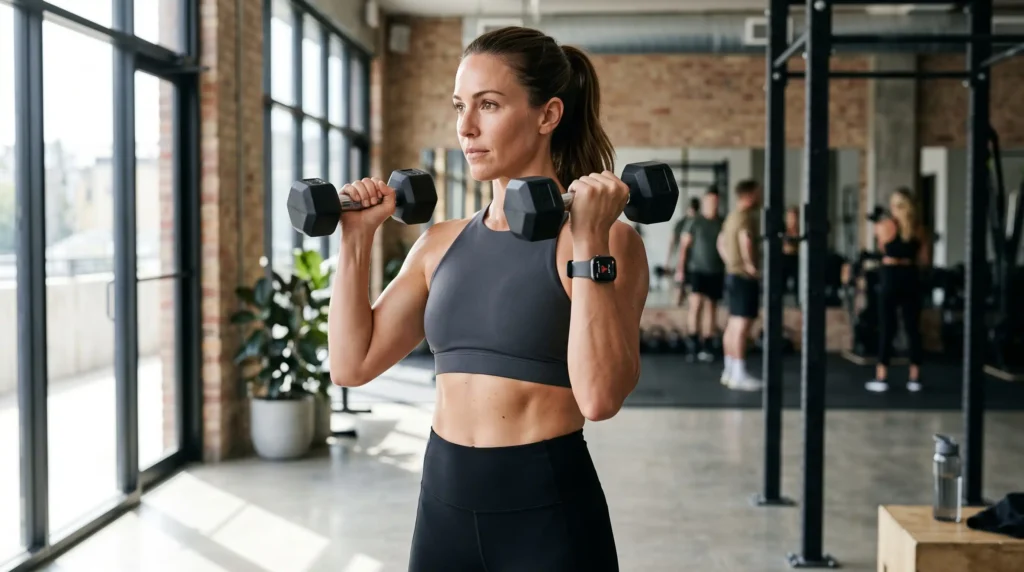
Smartwatches have evolved far beyond step counting.
Modern devices can combine workout tracking, GPS, heart-rate monitoring, sleep information, activity data, notifications, and fitness applications in one device.
For someone who exercises regularly, a smartwatch can become a central dashboard for training.
For example, a runner might use it to monitor:
- Pace
- Distance
- Heart rate
- Running duration
- GPS route
- Training intensity
Someone doing strength training may use it to track:
- Workout duration
- Heart rate
- Calories burned
- Exercise sessions
- Weekly activity
And someone focused on general health may use it primarily for:
- Daily steps
- Sleep
- Activity
- Resting heart rate
- Exercise consistency
The key advantage is convenience.
Instead of manually recording every workout, much of the information can be collected automatically.
2. Smart Rings Are Becoming More Popular

Smart rings are another important part of the wearable fitness technology trend.
Unlike traditional smartwatches, smart rings are small, lightweight, and designed to be worn continuously.
Many focus heavily on:
- Sleep
- Recovery
- Heart rate
- Daily activity
- Readiness
- Long-term health trends
The smart-ring market continues to expand in 2026, with products such as Oura and Samsung Galaxy Ring competing in the category.
One interesting development is the rise of screen-free wearables.
Rather than constantly displaying notifications, these devices collect information in the background and allow users to review their data later. This reflects growing interest in technology that provides useful health information without demanding constant attention.
3. AI Is Changing How Wearable Data Is Used
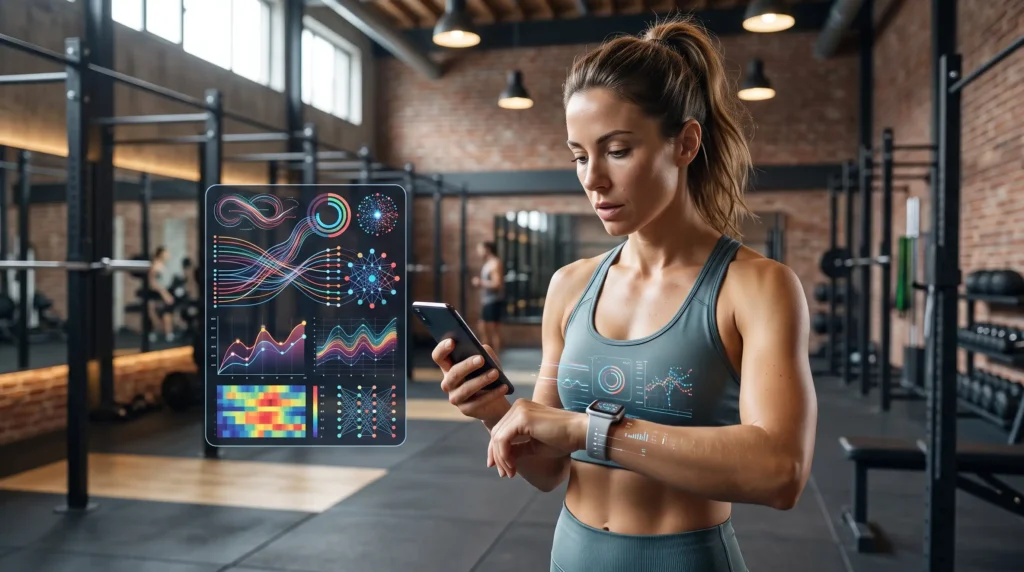
This may be the most important development of all.
A wearable can collect hundreds or thousands of data points, but data alone isn’t necessarily useful.
The real value comes from understanding what the information means.
AI can potentially analyze patterns involving:
- Sleep
- Activity
- Heart rate
- Training frequency
- Recovery
- Exercise intensity
- Personal goals
Research published in 2026 describes AI-driven wearable systems as capable of providing deeper insights into training adaptations, real-time performance analysis, and individualized feedback.
This is moving fitness technology toward a more personalized model.
Instead of everyone following exactly the same workout schedule, technology can increasingly help people adjust training based on their individual data.
4. Personalized Fitness Plans Are Becoming More Data-Driven
Imagine two people following the same four-day workout program.
Person A sleeps eight hours and feels recovered.
Person B sleeps five hours and has had several demanding training sessions recently.
A traditional program might tell both people to complete exactly the same workout.
A data-driven system could potentially recommend different approaches based on their recent activity and recovery information.
ACSM has previously highlighted how mobile health and wearable technologies can use AI and large datasets to create personalized fitness plans based on factors such as activity, sleep, mood, and body weight.
This doesn’t mean AI should replace qualified fitness professionals.
Instead, think of AI as a personalization tool that can help organize and interpret information.
5. Recovery Tracking Is Becoming Just as Important as Workout Tracking
One of the biggest changes in modern fitness is the growing focus on recovery.
For years, fitness tracking was mostly about:
How much did you exercise?
Now the question is increasingly:
How well are you recovering?
Recovery-related information can include:
- Sleep duration
- Resting heart rate
- Heart-rate variability
- Recent training load
- Daily activity
- Subjective fatigue
This can help people recognize when they may need an easier training day.
However, wearable recovery scores should be treated as guidance rather than medical measurements. Different devices use different algorithms, and the numbers aren’t necessarily interchangeable between brands.
6. Sleep Tracking Is Becoming Part of Fitness
Sleep is closely connected with recovery and performance, which is why sleep tracking has become a major feature of modern wearables.
A fitness enthusiast may use a wearable to monitor:
- Total sleep time
- Sleep schedule
- Sleep consistency
- Nighttime heart rate
- Sleep stages, depending on the device
The goal shouldn’t be to obsess over every number.
Instead, look for long-term patterns.
For example:
If you consistently sleep less during your busiest workdays and notice that your workouts also feel harder, that pattern may be more useful than a single night’s score.
7. Wearables Can Help With Weight Management
Wearable technology can also support people trying to manage their body weight.
Activity trackers can provide information about:
- Daily movement
- Steps
- Exercise sessions
- Estimated calories burned
- Weekly activity
This information can be combined with nutrition tracking.
For example, someone trying to lose weight could use:
Calorie Calculator → daily calorie target
Macro Calculator → protein, carbohydrate and fat targets
Fitness wearable → activity and workout tracking
This creates a more complete picture of daily habits.
However, calorie-burn estimates from wearables are estimates, not exact measurements. They should not be treated as a precise calculation of how many calories you can “eat back.”
8. Wearables Can Make Fitness More Consistent
One of the biggest benefits of fitness wearable technology may be behavioral rather than technological.
Seeing your activity every day can encourage consistency.
For example, you might notice:
Monday: 3,500 steps
Tuesday: 5,200 steps
Wednesday: 7,100 steps
Thursday: 8,000 steps
That information can encourage you to move more.
The same principle applies to workouts.
Tracking your sessions can make your training history visible and help you identify whether you’re actually following your planned routine.
9. Are Fitness Wearables Accurate?
This is one of the most important questions.
The answer is:
It depends on the measurement and the device.
Wearables can be useful for identifying trends, but they should not automatically be considered perfectly accurate.
For example:
- Step counting can be reasonably useful.
- Heart-rate measurements can be useful but vary by device and activity.
- GPS can provide useful distance information but isn’t perfect.
- Calorie-burn estimates can have substantial uncertainty.
- Sleep-stage estimates should not be treated like clinical sleep testing.
Therefore, the best way to use wearable data is to focus on trends rather than individual numbers.
Instead of worrying because your device says you burned 487 calories instead of 510, look at your overall activity pattern over weeks.
10. Do You Need a Fitness Wearable?
Not necessarily.
A wearable can be useful if you enjoy tracking information and want feedback about your activity.
It may be especially useful for people who:
- Run regularly
- Walk frequently
- Strength train
- Cycle
- Participate in sports
- Want to improve activity levels
- Want to monitor sleep habits
- Enjoy data-driven training
But you don’t need an expensive smartwatch to become healthier.
You can improve your fitness with:
- Regular exercise
- Strength training
- Walking
- Good nutrition
- Adequate sleep
- Consistency
Technology should support your habits—not replace them.
Smartwatch vs Smart Ring vs Fitness Tracker
| Device | Best For | Main Strength |
|---|---|---|
| Smartwatch | All-around fitness | Large range of features |
| Smart Ring | Sleep & recovery | Small and comfortable |
| Fitness Tracker | Daily activity | Simple activity tracking |
| GPS Sports Watch | Runners & athletes | Training and GPS data |
| Chest Strap | Serious training | Heart-rate monitoring |
The best device depends on what you actually want to measure.
If your main goal is running, a GPS watch may be more useful than a smart ring.
If sleep and recovery are your priorities, a smart ring may be more convenient.
If you simply want steps and basic activity tracking, a basic fitness tracker may be enough.
How to Use Wearable Technology Without Becoming Obsessed With Data
More data isn’t always better.
A common mistake is checking your wearable constantly and becoming anxious about every metric.
Instead, choose two or three metrics that actually matter to your goal.
If your goal is weight loss:
Focus on:
- Daily activity
- Workout consistency
- Nutrition
- Body-weight trends
If your goal is muscle building:
Focus on:
- Strength progression
- Workout consistency
- Protein intake
- Calories
- Recovery
If your goal is running:
Focus on:
- Pace
- Distance
- Heart-rate zones
- Training consistency
If your goal is better recovery:
Focus on:
- Sleep
- Training load
- Rest days
- Recovery trends
The goal is to turn data into action, not simply collect more numbers.
The Future of Fitness Wearable Technology
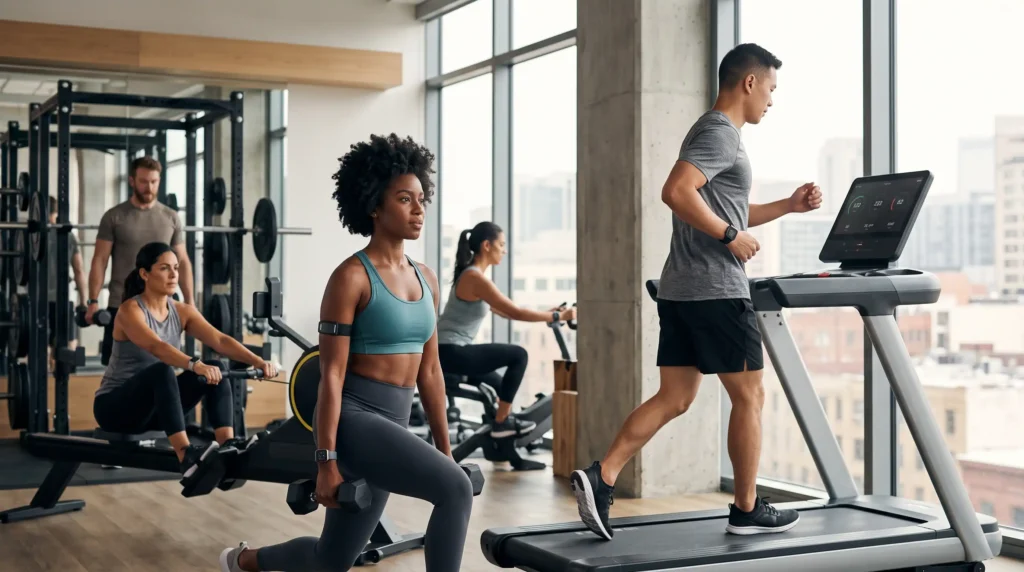
The future of fitness wearable technology will likely involve increasingly sophisticated combinations of sensors, apps, AI, and personalized recommendations.
The direction is already visible in 2026.
Newer devices and platforms are increasingly focused on interpreting information rather than simply displaying it. Some current products are integrating AI-based coaching, personalized recommendations, and more proactive health insights.
The next generation of fitness technology may therefore look less like:
“Here are your numbers.”
And more like:
“Here is what your recent data suggests, and here is how you could adjust your training.”
But privacy will become increasingly important as devices collect more personal information. Users should understand what data their device collects, where it is stored, and which services have access to it.
How FitCalculatorAI Can Work With Wearable Data
Wearables are excellent for collecting activity data, while calculators can help users understand specific fitness targets.
For example:
Start with your goals
Use the BMI Calculator to understand your BMI.
Then use the Calorie Calculator to estimate your daily calorie needs.
For muscle-building goals, the Protein Calculator can help estimate protein needs.
The Macro Calculator can help organize daily macronutrient targets.
And wearable technology can then help monitor daily activity and workouts.
This creates a simple ecosystem:
Calculate → Plan → Track → Adjust
The technology doesn’t have to make fitness complicated.
Frequently Asked Questions
What is the biggest fitness technology trend in 2026?
Wearable technology is the #1 fitness trend for 2026 according to ACSM.
Are smartwatches good for fitness?
Yes. Smartwatches can track activities such as workouts, heart rate, distance, GPS, and daily movement. The usefulness depends on the device and your fitness goals.
Can AI create personalized workout plans?
AI can help generate and adapt workout recommendations using information such as goals, activity, and recovery data. However, AI-generated fitness advice should not replace professional medical or exercise guidance when that is needed.
Are fitness trackers accurate?
Fitness trackers can be useful for monitoring trends, but measurements such as calorie expenditure and sleep stages should be considered estimates rather than perfectly precise values.
Is a smart ring better than a smartwatch?
Neither is universally better. Smart rings are attractive for discreet, continuous tracking, while smartwatches generally provide more features and a larger interface.
Do I need a wearable to get fit?
No. Wearables are optional tools. Consistent exercise, nutrition, recovery, and healthy habits remain more important than owning a particular device.
Final Thoughts
Fitness wearable technology is changing the way people approach exercise in 2026.
Smartwatches, fitness trackers, smart rings, and AI-powered platforms are making it easier to collect information about workouts, activity, sleep, and recovery.
The biggest opportunity isn’t simply having more data.
It’s learning how to use the right data to make better decisions.
If wearable technology can help you become more consistent, recover intelligently, and understand your training, it can be a valuable addition to your fitness routine.
But remember: your wearable is a tool, not your coach, doctor, or source of truth.
Use the numbers as guidance, watch long-term trends, and focus on sustainable habits.
Medical Disclaimer
This article is for educational and informational purposes only and does not constitute medical advice. Fitness trackers and wearable devices provide estimates and should not be used to diagnose, treat, or prevent medical conditions. Consult a qualified healthcare professional before making significant changes to your exercise, nutrition, or health routine.