
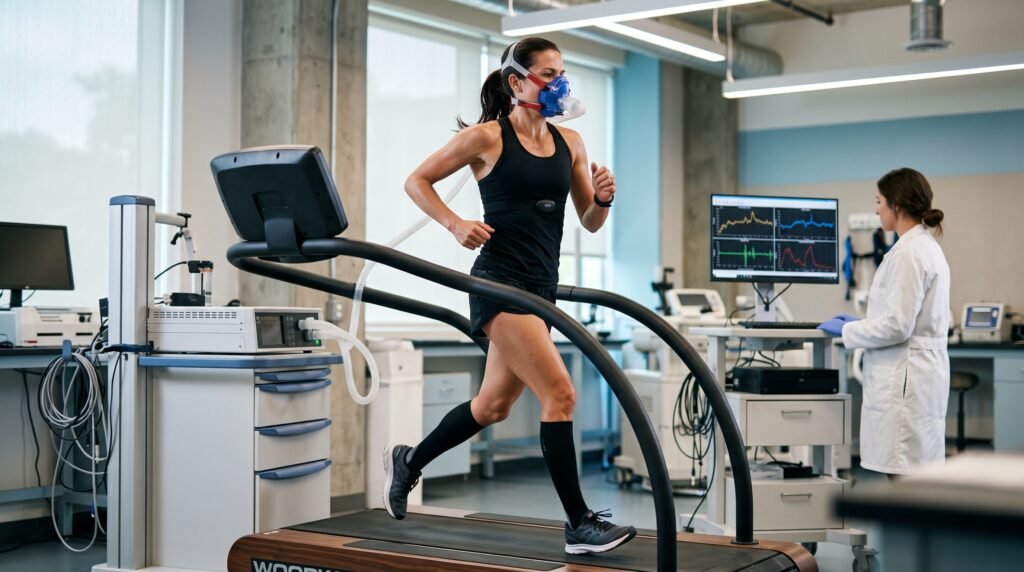
If you’ve ever wondered what is VO2 max and why runners, cyclists, athletes, fitness watches, and coaches talk about it so much, you’re looking at one of the most useful measurements of aerobic fitness.
VO₂ max describes the maximum amount of oxygen your body can take in and use during intense exercise. It is commonly expressed as milliliters of oxygen per kilogram of body weight per minute (mL/kg/min).
But VO₂ max is more than just a number on your smartwatch.
It gives you a way to understand how effectively your heart, lungs, blood, and muscles work together during exercise. A higher VO₂ max is generally associated with better cardiorespiratory fitness, although your result depends on factors such as age, sex, genetics, training status, and testing method.
Want to estimate yours?
👉 Try our VO₂ Max Calculator to get an estimate of your aerobic fitness.
- What Is VO₂ Max?
- Why Is VO₂ Max Important?
- What Is a Good VO₂ Max?
- VO₂ Max by Age
- How Is VO₂ Max Measured?
- Can a Watch Measure VO₂ Max?
- How Can You Estimate VO₂ Max Without a Lab?
- VO₂ Max Calculator
- What Does a VO₂ Max Score Tell You?
- How Can You Improve VO₂ Max?
- VO₂ Max Training: What Actually Works?
- How Quickly Can VO₂ Max Improve?
- VO₂ Max vs Cardio Fitness
- VO₂ Max vs VO₂ Peak
- Absolute vs Relative VO₂ Max
- Why Body Weight Matters
- Does Running Improve VO₂ Max?
- VO₂ Max and Heart Health
- Common VO₂ Max Mistakes
- Frequently Asked Questions
- Final Takeaway
What Is VO2 Max Mean?
The term VO₂ max can look complicated, but its meaning is straightforward:
- V = volume
- O₂ = oxygen
- Max = maximum
So, VO₂ max means your body’s maximum rate of oxygen consumption during exercise.
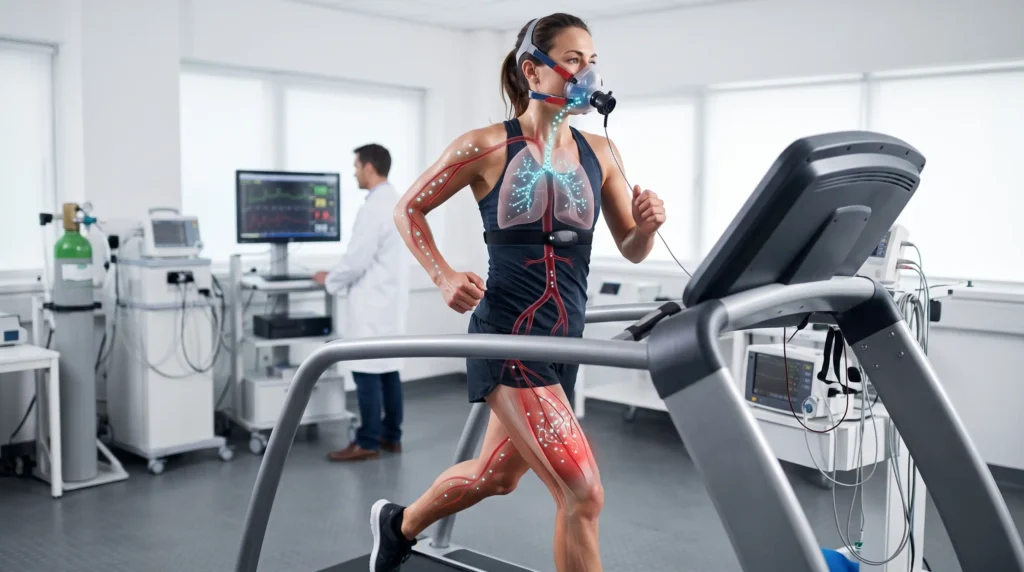
During physical activity, your muscles need oxygen to help produce energy. Your lungs take in oxygen, your blood transports it, your heart circulates it, and your muscles use it to support exercise.
VO₂ max therefore reflects the integrated performance of several systems involved in aerobic exercise.
VO₂ Max in Simple Terms
Think of your aerobic system as an engine.
Your lungs bring in the oxygen, your heart and blood vessels deliver it, and your muscles use it.
VO₂ max is one way of measuring how much oxygen that system can use when you’re working very hard.
That’s why VO₂ max is widely used as a measure of cardiorespiratory or aerobic fitness.
Why Is VO₂ Max Important?
VO₂ max is particularly useful because it provides a measurable way to track aerobic fitness.
For endurance activities, your ability to continuously supply and use oxygen can influence how long and how hard you can exercise.
A higher VO₂ max is generally associated with greater aerobic fitness, and research has also linked higher aerobic fitness with better long-term health outcomes. However, VO₂ max is not a complete measure of athletic ability or overall health.
For example, two runners can have similar VO₂ max values but perform differently because of differences in:
- Running economy
- Lactate threshold
- Training experience
- Muscle strength
- Pacing strategy
- Technique
- Recovery
So don’t treat VO₂ max as the only number that matters.
What Is a Good VO₂ Max?
There isn’t one universal VO₂ max number that is considered “good” for everyone.
Your result can vary significantly according to:
- Age
- Sex
- Genetics
- Training history
- Body composition
- Altitude
- Testing method
VO₂ max also tends to decline with age, although regular physical activity can help maintain aerobic fitness and reduce the decline associated with aging.
That’s why comparing your result with a professional athlete isn’t particularly useful.
A better approach is to understand your result in the context of your age, sex, activity level and goals.
VO₂ Max by Age
Age is one of the most important factors affecting VO₂ max.
In general, VO₂ max tends to decline as people get older. Cleveland Clinic notes that VO₂ max can decline roughly 5%–10% per decade after age 30, although the rate varies between individuals and can be influenced by training and lifestyle.
This means a VO₂ max value that looks impressive for one age group may be less remarkable for another.
For this reason, VO₂ max tables should be treated as reference ranges rather than universal targets.
Factors That Affect Your VO₂ Max
Your VO₂ max is influenced by multiple factors:
Age: Aerobic capacity generally declines with age.
Genetics: Genetics can have a substantial influence on your potential VO₂ max.
Training: Regular aerobic training can improve your body’s ability to deliver and use oxygen.
Body weight: Relative VO₂ max is expressed per kilogram of body weight, so changes in body mass can affect the number.
Altitude: Training or testing at higher elevations can affect oxygen availability and performance.
Testing method: Different tests and devices can produce different estimates.
How Is VO₂ Max Measured?
The most accurate way to directly measure VO₂ max is through a graded exercise test in a laboratory.
During a typical test, you may exercise on a:
- Treadmill
- Stationary bike
- Other specialized exercise equipment
You wear equipment that measures the gases you inhale and exhale while exercise intensity gradually increases.
The test continues until you reach a very high level of exertion. The measured oxygen consumption provides the basis for determining VO₂ max.
Laboratory testing is considered the most accurate approach, but it isn’t necessary for everyone.
Can a Watch Measure VO₂ Max?

Many modern fitness watches and wearable devices provide a VO₂ max estimate.
These estimates can use information such as:
- Heart rate
- Exercise pace
- Speed
- Distance
- Personal characteristics
- Workout history
They can be useful for tracking changes over time, but they aren’t identical to a laboratory measurement.
If you use a wearable, consistency can be more useful than obsessing over a single reading.
For example, if your watch estimates:
42 → 44 → 46 mL/kg/min
over several weeks of consistent training, the trend may be more informative than one isolated number.
Cleveland Clinic notes that wearable estimates can be reasonably close but aren’t equivalent to laboratory testing.
How Can You Estimate VO₂ Max Without a Lab?
You can also estimate VO₂ max using certain field tests.
Common approaches include:
1. One-Mile Walk Test
The Rockport-style one-mile walk test uses walking performance and heart-rate information to estimate VO₂ max.
This can be useful for people who aren’t runners.
2. Running Tests
Running-based protocols can estimate aerobic capacity using variables such as:
- Distance
- Time
- Pace
- Heart rate
3. Cycling Tests
Cycling protocols can also be used to estimate aerobic capacity.
4. Online VO₂ Max Calculators
An online VO2 Max Test Calculator can provide an estimate based on the specific test data you enter.
These estimates should not be confused with direct laboratory measurements.
Research comparing estimation methods with measured VO₂ max has found that prediction equations can have meaningful error, so calculated values should be interpreted as estimates rather than exact measurements.

VO₂ Max Calculator
If you don’t have access to laboratory testing, an online calculator can provide a convenient starting point.
Calculate Your VO₂ Max
Use our VO₂ Max Calculator to estimate your aerobic fitness based on your available test information.
Your result is an estimate and should be interpreted alongside your age, sex, fitness level, and the testing method used.
What Does a VO₂ Max Score Tell You?
Your VO₂ max score can help answer questions such as:
- How is my aerobic fitness changing?
- Is my endurance improving?
- Is my training producing measurable progress?
- How does my aerobic capacity compare with typical values for my age group?
- Should I focus more on cardiovascular conditioning?
The most useful way to use VO₂ max is often to track your own progress over time.
For example:
| Measurement | VO₂ Max |
|---|---|
| Starting point | 38 |
| After training | 41 |
| Later measurement | 44 |
A consistent upward trend may indicate improved aerobic fitness, assuming the measurements were obtained under reasonably similar conditions.
How to Improve VO₂ Max
One of the biggest reasons people search for VO₂ max information is simple:

Can I improve it?
In many cases, yes.
Regular aerobic training can improve cardiorespiratory fitness. Activities that can contribute include:
- Running
- Cycling
- Swimming
- Rowing
- Brisk walking
- Hiking
- Interval training
Cleveland Clinic recommends combining different intensities rather than relying exclusively on maximal efforts.
VO₂ Max Training: What Actually Works?
A balanced approach can include different types of cardiovascular training.
Easy Aerobic Training
Lower-intensity exercise helps build your aerobic base and allows you to accumulate training volume.
Examples include:
- Easy running
- Brisk walking
- Cycling
- Hiking
Moderate-Intensity Training
Longer sessions at moderate intensity can improve endurance and aerobic capacity.
High-Intensity Intervals
Shorter, harder intervals can provide a strong cardiovascular stimulus.
For example, a workout might alternate between harder efforts and easier recovery periods.
However, more intensity isn’t automatically better.
Your training should account for:
- Current fitness
- Training experience
- Recovery
- Injury history
- Weekly training volume
If you’re new to exercise, gradually building your aerobic base may be more appropriate than immediately performing maximal intervals.
How Quickly Can VO₂ Max Improve?
There isn’t one guaranteed timeline.
Your improvement depends on:
- Starting fitness
- Training frequency
- Training intensity
- Recovery
- Genetics
- Nutrition
- Sleep
- Consistency
Someone beginning from a low fitness level may see noticeable changes with regular training, while an already well-trained athlete may need more specialized programming to make smaller improvements.
The key is progressive and consistent training, rather than trying to maximize every workout.
VO₂ Max vs Cardio Fitness: What’s the Difference?
These terms are closely related but aren’t exactly identical.
Cardio fitness is a broader concept describing how well your cardiovascular and respiratory systems support physical activity.
VO₂ max is a specific physiological measurement used to quantify maximal oxygen consumption.
In other words:
VO₂ max is one important measurement of aerobic/cardiorespiratory fitness.
But it doesn’t capture every aspect of fitness.
VO₂ Max vs VO₂ Peak
You may also encounter the term VO₂ peak.
VO₂ max generally refers to a maximal oxygen uptake that meets established criteria during testing.
VO₂ peak can refer to the highest oxygen uptake achieved during a test when the strict criteria for VO₂ max aren’t demonstrated.
The distinction can matter in exercise testing, particularly in clinical and research settings.
For everyday fitness tracking, however, many devices and apps simply use the term VO₂ max for their estimated value.
Absolute vs Relative VO₂ Max
Another important distinction is absolute vs relative VO₂ max.
Absolute VO₂ Max
Absolute VO₂ max refers to the total amount of oxygen consumed per minute.
It can be expressed in:
L/min
Relative VO₂ Max
Relative VO₂ max adjusts oxygen consumption for body weight.
It is commonly expressed as:
mL/kg/min
This is the measurement you’ll most often see in fitness discussions and VO₂ max calculators.
Why Body Weight Matters
Because relative VO₂ max is calculated per kilogram of body weight, changes in body weight can influence your score.
For example, imagine someone maintains the same absolute oxygen consumption but gains significant body mass.
Their relative VO₂ max could decrease because the same oxygen consumption is now divided by a larger body weight.
This is one reason you shouldn’t interpret VO₂ max without considering the full context.
Does Running Improve VO₂ Max?
Running is one effective way to train aerobic fitness, especially when your program combines different intensities.
You don’t need to run every day.
Other activities can also improve cardiovascular fitness, including:
- Cycling
- Swimming
- Rowing
- Hiking
- Fast walking
The best activity is often one you can perform consistently while recovering adequately.
VO₂ Max and Heart Health
VO₂ max is strongly related to cardiorespiratory fitness, and higher aerobic fitness has been associated with favorable health outcomes.

However, VO₂ max should not be treated as a diagnosis or as a guarantee of health.
A VO₂ max number is one piece of information.
Other important factors include:
- Blood pressure
- Cholesterol
- Blood glucose
- Physical activity
- Body composition
- Sleep
- Diet
- Smoking status
- Medical history
If you have symptoms during exercise or a medical condition, speak with a qualified healthcare professional before starting or substantially increasing exercise intensity.
Common VO₂ Max Mistakes
Mistake 1: Comparing Yourself With Elite Athletes
Elite endurance athletes can have exceptionally high VO₂ max values.
Their numbers aren’t realistic targets for everyone.
Mistake 2: Treating a Watch Estimate as a Lab Result
A wearable estimate is useful for tracking trends, but it isn’t the same as directly measuring oxygen consumption in a laboratory.
Mistake 3: Chasing the Number
A higher number isn’t the only goal.
You should also consider:
- Performance
- Recovery
- Enjoyment
- Consistency
- Overall health
Mistake 4: Doing Hard Workouts Every Day
More intensity doesn’t necessarily mean faster progress.
Recovery is part of training.
Mistake 5: Comparing Different Testing Methods
A lab test, smartwatch estimate and field-test equation aren’t interchangeable.
Try to compare results obtained using the same method and similar conditions.
Frequently Asked Questions About VO₂ Max
What is VO₂ max?
VO₂ max is the maximum amount of oxygen your body can consume and use during intense exercise. It is commonly expressed in mL/kg/min and is widely used as a measure of aerobic fitness.
What does a high VO₂ max mean?
A higher VO₂ max generally indicates better cardiorespiratory fitness and a greater ability to use oxygen during exercise.
Can I increase my VO₂ max?
Yes. Regular aerobic exercise and appropriately structured higher-intensity training can improve VO₂ max, although the amount of improvement varies between individuals.
What is a good VO₂ max?
There isn’t one number that’s good for everyone. Age, sex, genetics, training status and testing method all influence the result.
How is VO₂ max tested?
The most accurate direct measurement uses a graded exercise test with respiratory gas analysis in a laboratory.
Can a smartwatch calculate VO₂ max?
Many wearables estimate VO₂ max using exercise and heart-rate data. These values can be useful for tracking trends but are estimates rather than direct laboratory measurements.
Does VO₂ max decrease with age?
VO₂ max generally declines with age, although regular physical activity can help maintain aerobic fitness and reduce the rate of decline.
Is VO₂ max the same as endurance?
No. VO₂ max is an important component of endurance performance, but endurance also depends on factors such as lactate threshold, running economy, muscular endurance and training experience.
Final Takeaway
VO₂ max is one of the most useful measurements for understanding aerobic fitness.
It tells you how much oxygen your body can use during intense exercise and provides a measurable way to track changes in cardiorespiratory fitness.
But don’t obsess over one number.
Use VO₂ max as a baseline and progress marker. Combine it with your actual exercise performance, recovery, training consistency and overall health.
Ready to check your number?
Try the FitCalculatorAI VO₂ Max Calculator to get an estimate of your aerobic fitness.