
Staying active isn’t only about changing how your body looks. Getting stronger can make everyday movements easier, improve your confidence, and help you feel more comfortable in your body.
If you’re new to strength training, the gym can sometimes feel overwhelming. There are so many machines, exercises, and workout plans that it’s difficult to know where to begin.
The good news? You don’t need a complicated routine to get started.
A simple full-body workout can train your legs, back, shoulders, arms, chest, and core in the same session. With consistent training, sensible progression, and enough recovery, you can gradually become stronger without spending hours in the gym.
In this guide, you’ll find a beginner-friendly full-body workout for women, including eight simple exercises, a gym routine, home alternatives, and practical tips to help you stay consistent.
What Is a Full-Body Workout?
A full-body workout is a training session that targets several major muscle groups instead of focusing on just one area.
For example, rather than having one day dedicated only to legs and another only to arms, a full-body session might include:
- A squat for your lower body
- A row for your back
- A shoulder press for your shoulders
- Push-ups for your chest and triceps
- A core exercise for stability
This makes full-body training a particularly practical option for beginners and people with busy schedules.
You also don’t necessarily need a gym. Many movements can be adapted for home workouts using your body weight or a few simple pieces of equipment.
If you’re interested in exploring different training options, you can also browse the FitCalculatorAI Fitness & Training calculators to track other aspects of your fitness routine.
Why Should Women Do Strength Training?
Strength training isn’t just about building bigger muscles. It can help you become stronger and more capable in everyday life.
1. Build Strength and Muscle
Resistance training gives your muscles a reason to adapt and become stronger over time.
That strength can be useful for everyday activities such as carrying groceries, lifting objects, climbing stairs, or simply moving around with more confidence.
And you don’t have to start with heavy weights.
Bodyweight exercises and light resistance can be enough when you’re learning the basic movements. As your technique and confidence improve, you can gradually make the exercises more challenging.
2. Improve Balance and Movement
Exercises such as squats, rows, and controlled core movements require coordination and stability.
Learning how to control these movements can help you become more comfortable with your body and improve your overall movement quality.
For beginners, good technique matters more than lifting heavy weights.
3. Support Bone Health
Resistance and weight-bearing activities can be an important part of an active lifestyle.
Strength training can also be combined with activities such as walking, cycling, swimming, or other forms of exercise that you enjoy.
The goal isn’t to make every workout exhausting. It’s to build habits that you can maintain for years.
4. Support Energy and Mood
Exercise can be a useful way to break up a sedentary day and make time for yourself.
Some people also find that regular physical activity helps them manage stress and feel more energetic.
You don’t need to complete an extremely intense workout to be active. A manageable session that you can repeat consistently is often a better starting point.
How Often Should You Do a Full-Body Workout?
If you’re new to strength training, two full-body workouts per week can be a simple starting point.
For example:
Monday: Full-body workout
Tuesday: Rest or easy walking
Wednesday: Rest
Thursday: Full-body workout
Friday: Rest or light activity
Weekend: Walking, cycling, swimming, or another activity you enjoy
You don’t need to train every day.
Your muscles need time to recover, especially when you’re new to resistance training. As you become more experienced, you can change your schedule based on your goals and how your body responds.
The best routine is one that fits your lifestyle well enough that you can actually stick with it.
8 Best Full-Body Exercises for Women
You don’t need 20 different exercises to build a useful workout.
Start with a few basic movements that cover the major muscle groups, learn the technique, and gradually increase the challenge.
Here are eight beginner-friendly options.
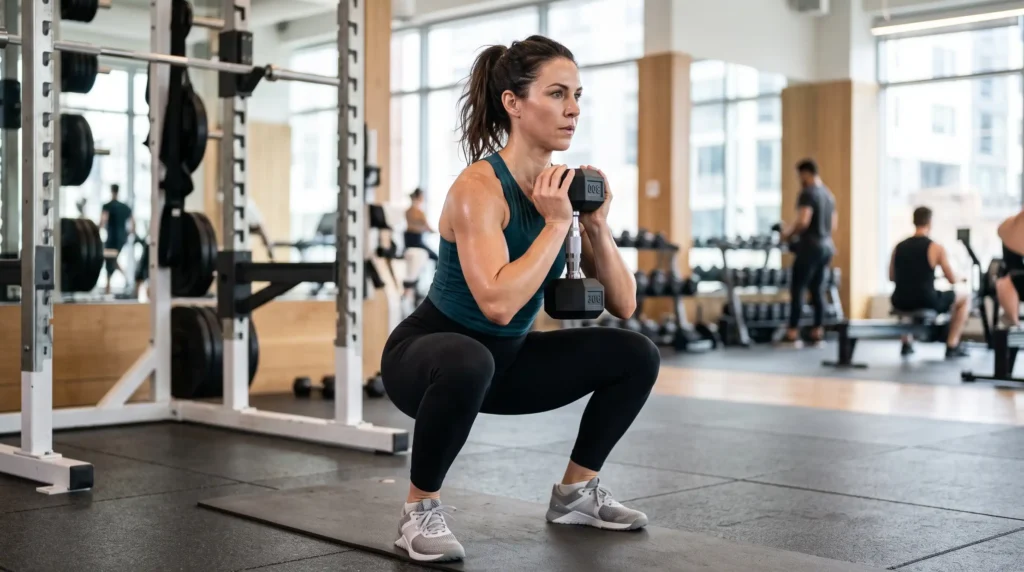
1. Squats
Main muscles: Quadriceps, glutes, and other lower-body muscles
Squats are one of the simplest ways to train your lower body.
They also reproduce a movement you use in everyday life: sitting down and standing back up.
How to do a squat
- Stand with your feet roughly shoulder-width apart.
- Keep your chest comfortable and your back in a natural position.
- Bend your knees and hips as you lower yourself.
- Go only as low as you can comfortably control.
- Push through your feet to return to standing.
If you’re completely new to squats, start with bodyweight squats.
Beginner starting point: 2 sets of 8–10 reps.
Once bodyweight squats become comfortable, you can gradually add resistance with a dumbbell or another suitable weight.
2. Seated Shoulder Press
Main muscles: Shoulders and triceps
The seated shoulder press is a straightforward way to train your upper body.
You can perform it with dumbbells or a suitable shoulder-press machine.
How to do it
- Sit with your back supported.
- Hold a light dumbbell in each hand at shoulder level.
- Keep your feet flat on the floor.
- Press the weights upward in a controlled movement.
- Slowly lower them back to shoulder height.
Choose a weight that allows you to maintain good technique throughout the set.
Beginner starting point: 2 sets of 8–10 reps.
3. Seated Row
Main muscles: Back, shoulders, and biceps
If you’re doing a full-body workout, don’t forget pulling movements.
The seated row is a useful exercise for training your back and upper body. It’s commonly performed using a cable or rowing machine.
How to do it
- Sit comfortably and place your feet on the supports.
- Hold the handles with your arms extended.
- Keep your back in a natural position.
- Pull the handles toward your torso.
- Slowly extend your arms again.
Try not to swing your body to move the weight. A slower, controlled movement is usually a better choice for beginners.
Beginner starting point: 2 sets of 10 reps.
4. Lying Hamstring Curl
Main muscles: Hamstrings
The hamstring curl is a machine-based exercise that focuses on the muscles at the back of your thighs.
How to do it
- Lie face down on the machine.
- Adjust the machine so the padded roller sits comfortably above your heels.
- Hold the handles if the machine provides them.
- Bend your knees and bring your heels toward your body.
- Slowly lower your legs back down.
Use a comfortable resistance and avoid jerking the weight.
Beginner starting point: 2 sets of 10 reps.
5. Dumbbell Bicep Curls
Main muscles: Biceps
Bicep curls are simple, require very little equipment, and can easily fit into a beginner workout.
How to do them
- Stand with your feet comfortably apart.
- Hold a dumbbell in each hand.
- Keep your elbows close to your sides.
- Bend your elbows to raise the weights.
- Lower them slowly.
Avoid swinging your entire body to lift the dumbbells.
Beginner starting point: 2 sets of 10 reps.
6. Triceps Extensions
Main muscles: Triceps
Triceps extensions target the muscles at the back of your upper arms.
You can perform them with a light dumbbell or an appropriate machine.
How to do them
- Hold a light dumbbell with both hands.
- Carefully position it above your head.
- Keep your elbows comfortably positioned.
- Bend your elbows and lower the weight behind your head.
- Extend your arms to return to the starting position.
Use a weight that allows you to stay in control throughout the movement.
Beginner starting point: 2 sets of 8–10 reps.
7. Push-Ups
Main muscles: Chest, shoulders, triceps, and core
Push-ups are one of the most convenient upper-body exercises because you can perform them almost anywhere.
If a traditional push-up is too difficult, don’t worry. You can start with your hands against a sturdy elevated surface or a wall.
How to do a push-up
- Place your hands slightly wider than shoulder-width apart.
- Extend your legs behind you or use a modified position.
- Keep your body comfortably aligned.
- Bend your elbows and lower your chest.
- Push through your hands to return to the starting position.
Choose the variation that allows you to maintain good form.
Beginner starting point: 2 sets of 5–8 reps.
8. Russian Twists
Main muscles: Core
Russian twists are a seated core exercise that involves controlled rotation.
They require little or no equipment, making them convenient for home workouts.
How to do them
- Sit on the floor with your knees bent.
- Keep your feet on the ground.
- Lean back slightly while maintaining a stable position.
- Slowly rotate your upper body to one side.
- Return to the center and repeat on the other side.
Don’t force the rotation. Keep the movement controlled and stay within a comfortable range.
Beginner starting point: 2 sets of 8 reps per side.
If this exercise doesn’t feel comfortable, choose another simple core movement instead.
A Simple Full-Body Workout Plan for Women
You can combine the exercises above into a straightforward beginner session.
| Exercise | Sets | Reps |
|---|---|---|
| Bodyweight squats | 2 | 8–10 |
| Seated shoulder press | 2 | 8–10 |
| Seated row | 2 | 10 |
| Lying hamstring curl | 2 | 10 |
| Dumbbell bicep curls | 2 | 10 |
| Triceps extensions | 2 | 8–10 |
| Modified push-ups | 2 | 5–8 |
| Russian twists | 2 | 8/side |
Before your workout
Spend a few minutes warming up with easy movement, such as walking or cycling.
You can also practise the exercises with no weight or very light resistance before starting your working sets.
During your workout
Don’t feel pressured to rush.
Rest between sets when you need to, especially when you’re still learning the exercises. Focus on controlled movements and good technique.
After your workout
Give yourself time to cool down and recover.
You don’t need an elaborate post-workout routine. Gentle movement and normal hydration can be enough.
If you’re unfamiliar with gym equipment, asking a qualified trainer to demonstrate an exercise can also be helpful.
Can You Do a Full-Body Workout at Home?
Absolutely.
A gym can give you access to more equipment, but it’s not a requirement for getting started.
Here are four simple exercises you can use at home.
Bodyweight Squats
Stand comfortably with your feet apart and bend your knees and hips in a controlled manner.
If you need additional support, you can use a sturdy chair.
Wall Push-Ups
Wall push-ups are an excellent starting point if traditional push-ups feel too difficult.
Stand facing a wall, place your hands around shoulder height, bend your elbows to bring your body toward the wall, then push yourself away.
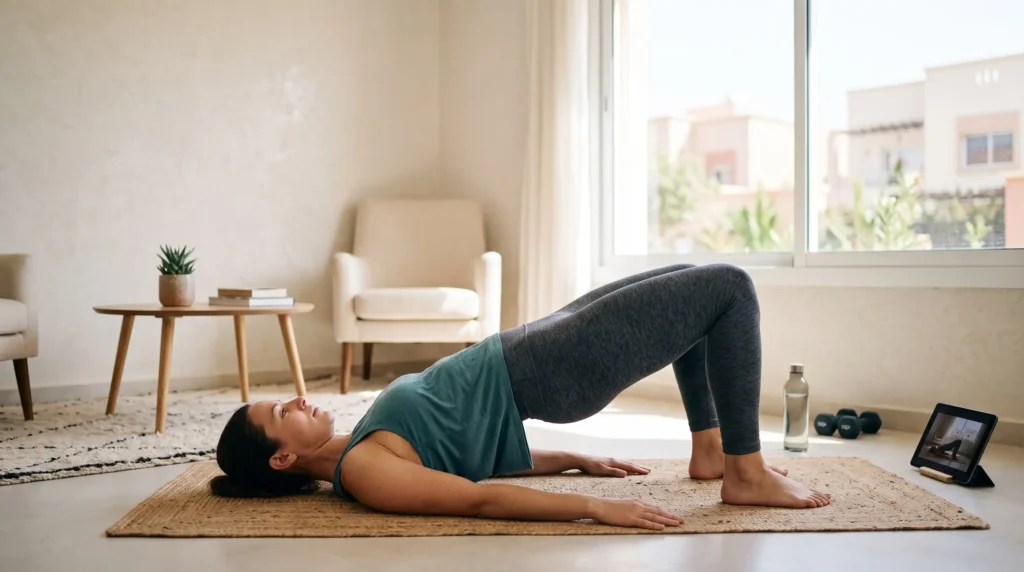
Glute Bridges
Lie on your back with your knees bent and feet flat on the floor.
Lift your hips slowly, pause briefly, and lower them back down.
This movement targets your glutes and the muscles around your hips.
Bird Dogs
Start on your hands and knees.
Slowly extend one arm forward while extending the opposite leg backward. Return to the starting position and repeat on the other side.
Move slowly rather than trying to complete the repetitions quickly.
How to Make Your Workouts More Effective
A workout plan is only useful if you can follow it consistently.
Here are a few habits that can make your training easier to maintain.
1. Start at your current level
You don’t need to train like someone who has been lifting for five years.
Choose exercises and resistance that match your current ability. As they become easier, gradually increase the challenge.
2. Prioritize technique
Good form should come before heavier weights or more repetitions.
If you can’t control an exercise, reduce the resistance or choose an easier variation.
3. Give yourself time to recover
Strength doesn’t improve only during the workout.
Rest, sleep, and adequate nutrition all contribute to your ability to recover and continue training.
4. Eat enough to support your activity
Exercise and nutrition work together.
If you’re unsure about your daily energy needs, the FitCalculatorAI Calorie Calculator can give you a starting estimate based on your personal information and activity level.
If your goal is building or maintaining muscle, getting enough protein is also important. You can use the FitCalculatorAI Protein Calculator to estimate your daily protein needs based on your body weight, activity level, and goal.
5. Stay hydrated
Keep drinking water throughout the day and pay attention to your fluid needs, particularly when you’re exercising or sweating.
6. Include activities you actually enjoy
Strength training doesn’t have to be your only form of exercise.
Walking, cycling, swimming, dancing, and recreational sports can all be part of an active lifestyle.
7. Don’t judge your progress only by the mirror
Getting stronger is progress too.
You may notice that you’re lifting a little more, performing more repetitions, moving with better control, or simply feeling more confident in the gym.
Those changes matter.
How to Track Your Progress
You don’t need to measure everything.
A simple training log can be enough.
Write down:
- The exercise
- The weight used
- The number of repetitions
- How the exercise felt
- Any improvements from your previous session
Over several weeks, you may notice that exercises that once felt difficult are becoming easier.
You can also track broader health and fitness measurements. For example, the FitCalculatorAI BMI Calculator can help you calculate BMI from your height and weight, while remembering that BMI is only one general screening measurement and doesn’t directly measure body fat or muscle mass.
For a broader overview, you can explore the Weight & Body calculators available on FitCalculatorAI.
Frequently Asked Questions
Are full-body workouts good for beginners?
Yes. Full-body workouts can be a practical way for beginners to learn several basic movements without needing a complicated weekly training schedule.
Starting with bodyweight exercises or light resistance can make the learning process easier.
How many days a week should women strength train?
For someone new to strength training, two sessions on separate days can be a manageable starting point.
As your experience increases, you can adjust your schedule according to your goals, recovery, and lifestyle.
Can I do a full-body workout at home?
Yes.
Exercises such as squats, wall push-ups, glute bridges, and bird dogs require little or no equipment.
You can gradually add resistance bands, dumbbells, or other equipment if you want more options.
Do women need heavy weights to build strength?
No.
Beginners can make progress with bodyweight exercises and light resistance. The important thing is to use an appropriate level of challenge and gradually progress as you become stronger.
Should I do cardio as well as strength training?
Cardio can be a useful part of a balanced fitness routine.
Walking, cycling, swimming, dancing, and other enjoyable activities can complement your strength workouts.
You don’t necessarily need to choose between cardio and strength training. The right combination depends on your goals and preferences.
How long should a full-body workout take?
A beginner workout may take around 30–45 minutes, depending on how many exercises you perform and how much rest you take.
There’s no prize for finishing as quickly as possible.
A controlled 30-minute workout that you can perform consistently is more useful than a rushed session that leaves you unable to recover.
Can women of different ages do strength training?
Many women can include strength training at different stages of life.
However, exercise selection and intensity should be appropriate for your individual experience, abilities, and health.
If you have a medical condition, injury, or concerns about starting exercise, speak with an appropriate healthcare professional before beginning a new training program.
Build a Routine You Can Actually Maintain
The best full-body workout for women isn’t necessarily the most complicated one.
You don’t need dozens of exercises, extremely heavy weights, or hours in the gym.
Start with a handful of movements you can perform comfortably. Focus on your technique, train consistently, eat and recover well, and gradually make the workouts more challenging as you become stronger.
And remember: progress isn’t only about appearance.
Being able to perform an exercise with better control, lift a little more weight, walk farther, or simply feel more confident in your body are all meaningful improvements.
If you want more personalized guidance, you can also try the FitCalculatorAI Smart Fitness Advisor to explore recommendations based on your goals, activity level, training experience, and lifestyle.
The best workout is the one that fits your life well enough that you can keep doing it.