
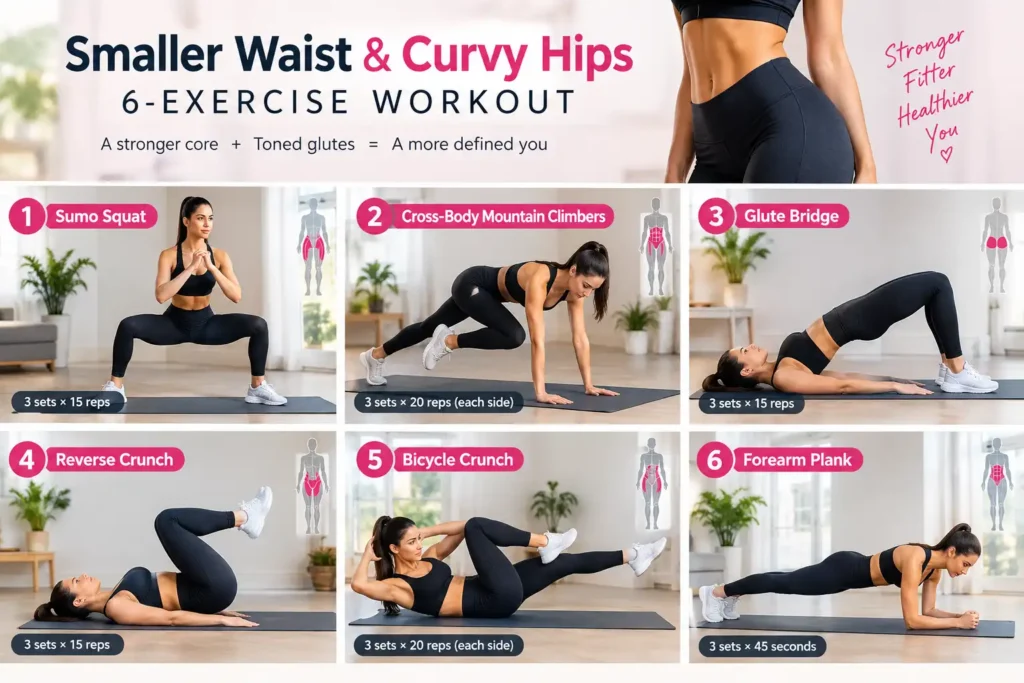
A smaller-looking waist and fuller, stronger hips don’t come from doing hundreds of crunches or trying to change your body shape overnight. A better approach is to build the muscles that support your posture, strengthen your core, and progressively train your glutes and lower body.
The good news is that you don’t need a complicated gym routine to get started. A few well-chosen exercises, performed consistently and with good technique, can create a solid foundation for strength and muscle development.
This smaller waist and curvy hips workout combines six simple movements that target the glutes, legs, abdominals, and obliques. You can perform it at home with little or no equipment.
Important: You can’t selectively burn fat from your waist with ab exercises. Your overall body composition is influenced by genetics, nutrition, activity, sleep, and training. What this workout can do is strengthen your core and develop your glutes and hips, which may help create a more defined and balanced appearance as your overall fitness improves.
Table of Contents
Can You Really Get a Smaller Waist and Curvier Hips?
It’s worth clearing up one common misconception before starting.
Exercises can’t physically “shrink” your waist bones or decide exactly where your body loses fat. Your natural waist-to-hip shape is strongly influenced by genetics and your skeletal structure.
However, resistance training can change the muscles around your midsection and lower body.
Building the glutes can make the hips appear more developed, while strengthening the core can improve posture and give your midsection a firmer appearance. If you also lose excess body fat through a sustainable calorie deficit, your waist may become more defined.
That’s why the goal shouldn’t be to chase a specific body shape as quickly as possible. Instead, focus on becoming stronger, more muscular, and consistent.
The 6-Exercise Smaller Waist and Curvy Hips Workout
Perform this routine 3 times per week to begin. If you’re recovering well and have some training experience, you can increase it to 4 sessions per week.
Rest around 30–60 seconds between sets. For exercises that become difficult toward the end of a set, take a little more rest rather than sacrificing your form.
If you’re a beginner, start with fewer repetitions and gradually work toward the suggested numbers.
1. Sumo Squat
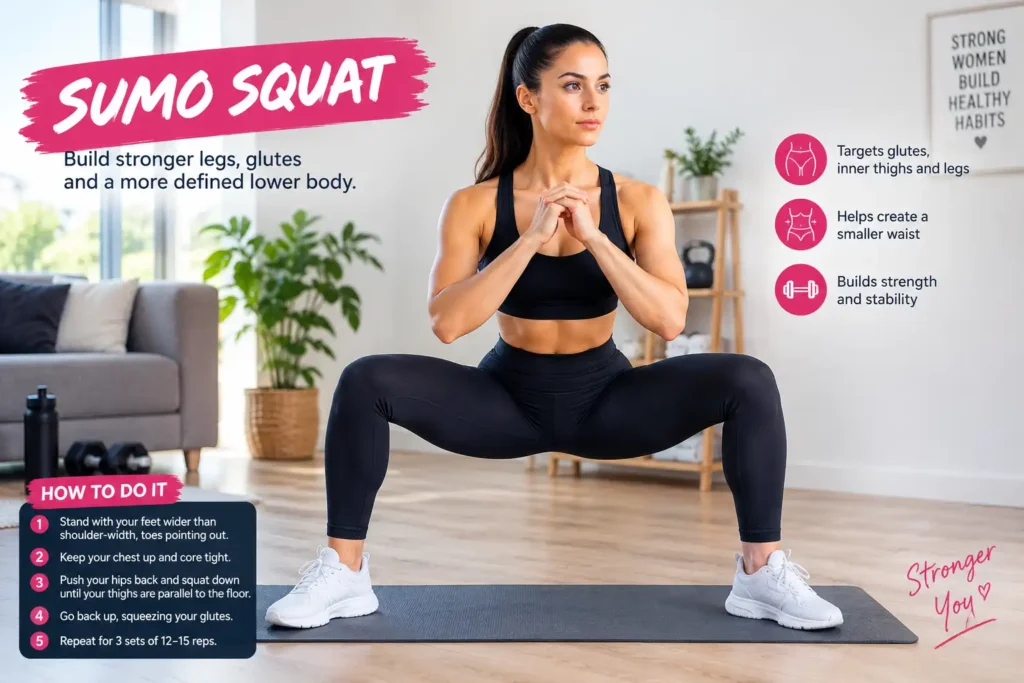
The sumo squat is an excellent lower-body exercise for training the glutes, quadriceps, and inner thighs.
The wider stance also gives the movement a slightly different feel from a traditional squat and makes it a useful addition to a lower-body routine focused on developing the hips and glutes.
Sets & reps: 3 × 18
How to do it:
- Stand with your feet wider than shoulder-width apart.
- Turn your toes slightly outward.
- Keep your chest lifted and your abdominal muscles gently braced.
- Push your hips back and bend your knees.
- Lower yourself as far as you can while maintaining good control.
- Push through your feet to return to standing.
Form tip: Your knees should generally track in the same direction as your toes. Don’t allow them to collapse inward as you squat.
Make it harder: Hold a dumbbell, kettlebell, or another suitable weight close to your chest.
2. Cross-Body Mountain Climbers
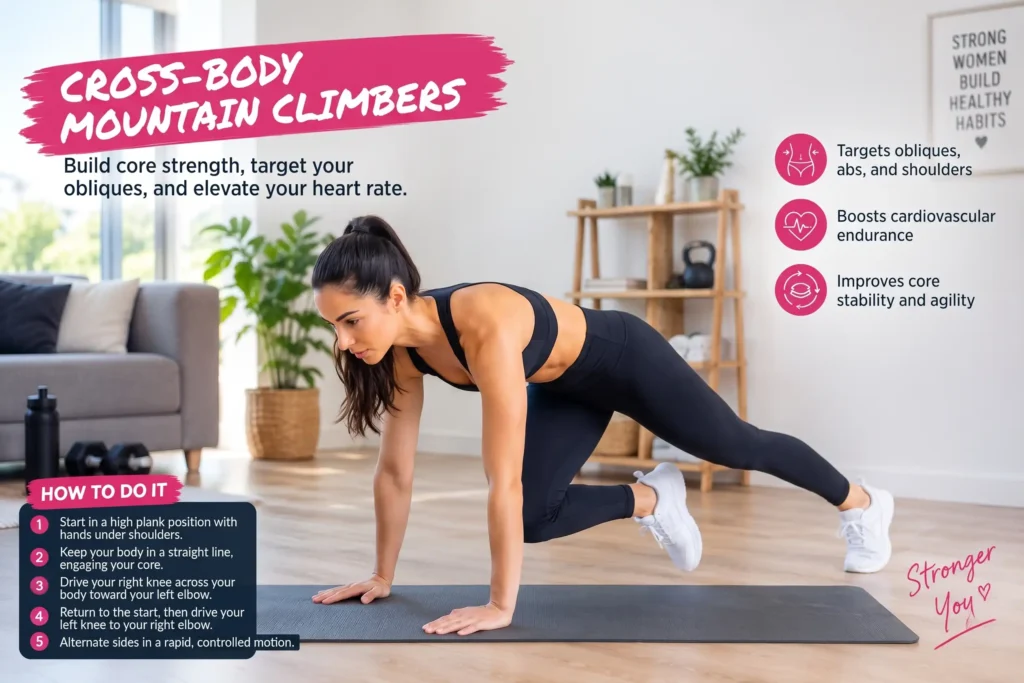
Cross-body mountain climbers combine core stability with a faster movement that challenges the abdominal muscles and shoulders.
Because you’re repeatedly moving one knee toward the opposite side of your body, the exercise also requires your obliques to stabilize your torso.
Sets & reps: 3 × 20 total reps
How to do it:
- Start in a high-plank position with your hands underneath your shoulders.
- Extend both legs behind you.
- Brace your core and keep your body relatively straight.
- Bring your right knee toward your left elbow.
- Return your right leg to the starting position.
- Bring your left knee toward your right elbow.
- Continue alternating sides.
Form tip: Don’t let your hips bounce dramatically from side to side. Slow the movement down if you lose control.
You don’t have to perform mountain climbers as fast as possible. For core training, controlled repetitions are often more useful than simply chasing speed.
3. Glute Bridge
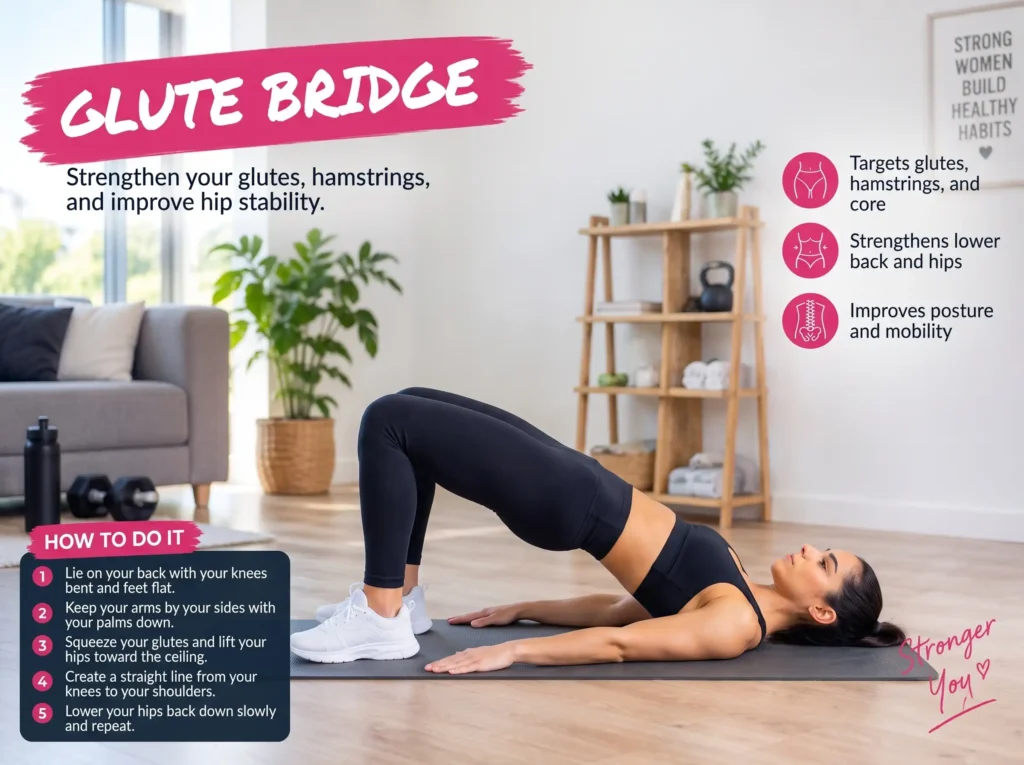
If your goal is to build stronger glutes, the glute bridge deserves a place in your routine.
It is simple, requires very little space, and allows you to focus on contracting the glute muscles without needing heavy equipment.
Sets & reps: 3 × 22
How to do it:
- Lie on your back.
- Bend your knees and place your feet flat on the floor.
- Keep your feet roughly hip-width apart.
- Brace your abdominal muscles.
- Push through your heels and squeeze your glutes.
- Lift your hips toward the ceiling.
- Pause briefly at the top.
- Lower your hips slowly.
Form tip: Think about squeezing your glutes rather than simply pushing your hips as high as possible. Avoid excessively arching your lower back at the top.
Make it harder: Once 22 bodyweight repetitions become easy, try adding resistance or progressing to a single-leg variation.
4. Reverse Crunch
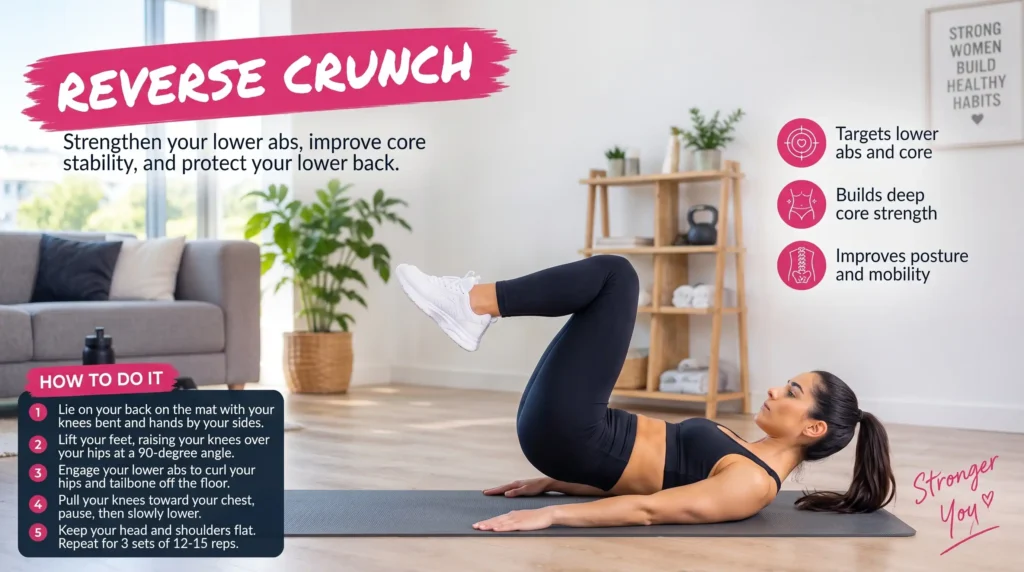
Reverse crunches place an emphasis on the abdominal muscles while requiring you to control the movement of your pelvis.
They’re a useful alternative to repeatedly pulling your head and neck forward during traditional sit-ups.
Sets & reps: 3 × 16
How to do it:
- Lie flat on your back.
- Bend your knees and raise your legs.
- Keep your arms beside your body or place your hands on the floor for stability.
- Brace your core.
- Slowly curl your hips off the floor and bring your knees toward your chest.
- Lower your pelvis back down with control.
Form tip: The movement should come from your abdominal muscles and pelvis, not from swinging your legs.
If you find yourself using momentum, reduce the number of repetitions and focus on slower movement.
5. Bicycle Crunch
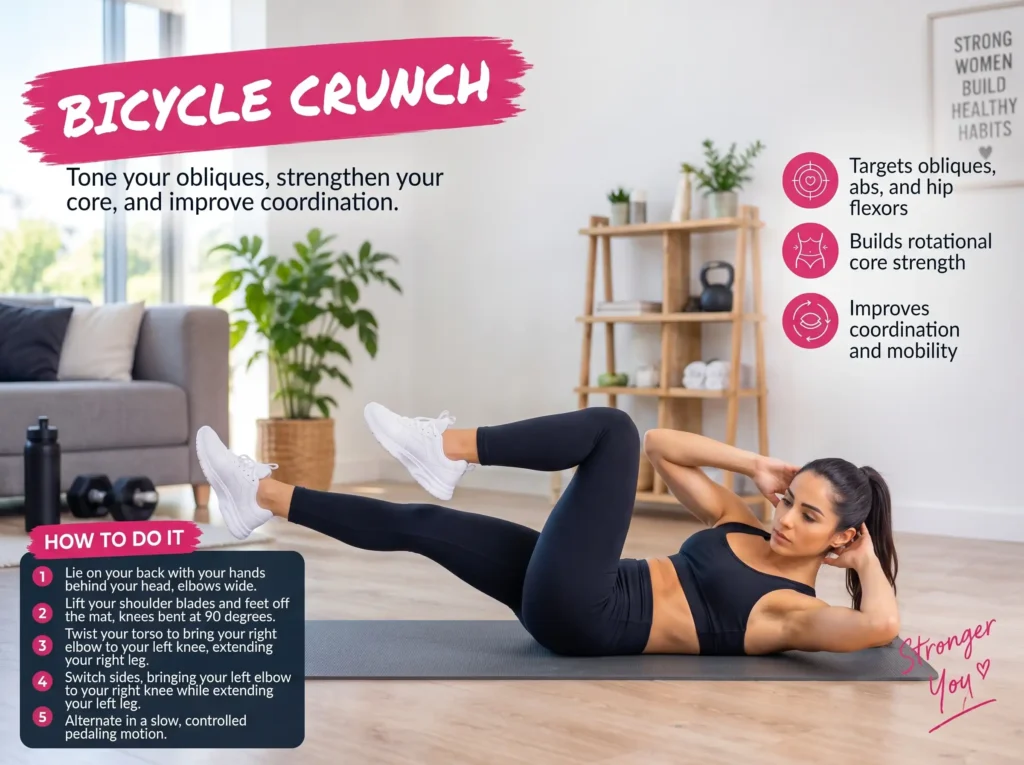
The bicycle crunch trains your abdominal muscles while challenging the obliques and requiring coordination between your upper and lower body.
It’s particularly useful when performed slowly rather than as a fast cardio movement.
Sets & reps: 3 × 20 total reps
How to do it:
- Lie on your back.
- Place your hands lightly behind your head.
- Lift your shoulders slightly from the floor.
- Bring one knee toward your chest.
- Rotate your torso so the opposite elbow moves toward that knee.
- Return to the starting position.
- Switch sides and repeat.
Form tip: Don’t pull on your neck with your hands. Keep the movement controlled and focus on rotating through your torso.
If 20 repetitions feel too difficult, start with 10 per side and gradually build up.
6. Forearm Plank
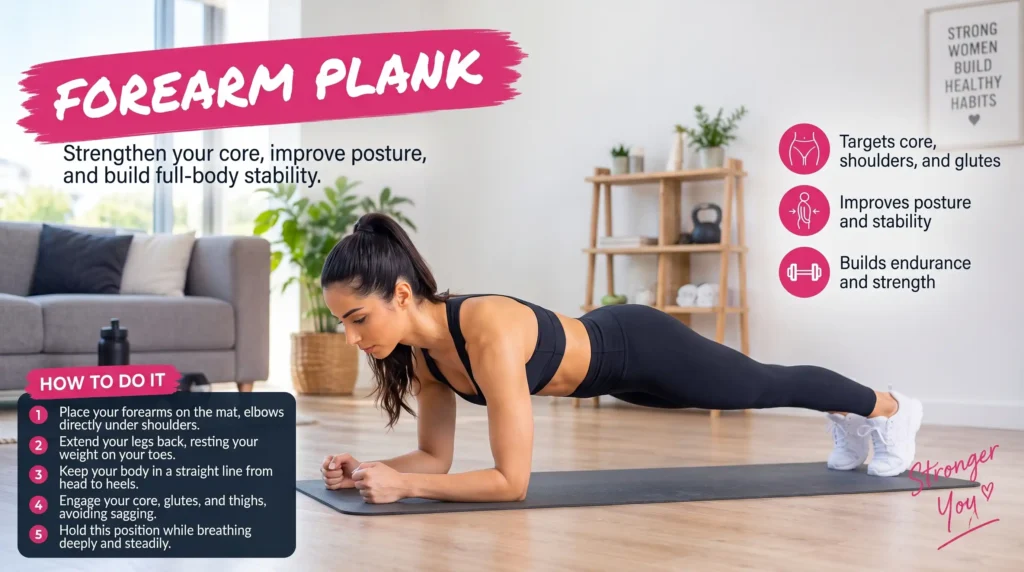
Featured Image
The plank may look simple, but maintaining a strong position requires your abdominal muscles, shoulders, hips, and legs to work together.
Instead of thinking about “holding yourself up,” think about creating tension throughout your entire body.
Duration: 40 seconds
How to do it:
- Place your forearms on the floor.
- Extend your legs behind you.
- Keep your elbows approximately underneath your shoulders.
- Brace your core.
- Squeeze your glutes.
- Keep your body in a relatively straight line.
- Breathe normally while maintaining the position.
Form tip: Don’t allow your lower back to sag or your hips to rise excessively.
If 40 seconds is too challenging, start with 15–20 seconds and gradually increase the duration.
Your Weekly Workout Structure
You don’t necessarily need to perform this workout every day to see progress.
A simple schedule could look like this:
| Day | Activity |
|---|---|
| Monday | Smaller waist & curvy hips workout |
| Tuesday | Walking or light activity |
| Wednesday | Rest |
| Thursday | Smaller waist & curvy hips workout |
| Friday | Walking or light activity |
| Saturday | Smaller waist & curvy hips workout |
| Sunday | Rest |
This gives your muscles time to recover between strength sessions.
If you’re new to exercise, three workouts per week is more than enough to start.
How to Make the Workout More Effective
Doing the same number of repetitions forever won’t necessarily produce continued progress.
Your body adapts to training. Once an exercise becomes easy, gradually increase the challenge.
You can do this by:
- Adding resistance
- Increasing repetitions slightly
- Increasing the number of sets
- Using a more difficult variation
- Slowing down the eccentric portion of the movement
- Improving your range of motion
- Maintaining better control throughout each repetition
For example, if you can easily perform 22 glute bridges without feeling challenged, you could eventually add resistance rather than simply performing 50 or 60 repetitions.
This principle is called progressive overload, and it’s one of the foundations of building muscle.
Don’t Forget Your Glutes
If your goal includes fuller-looking hips, core exercises alone aren’t enough.
Your glutes are muscles, and like other muscles, they respond to progressive resistance training.
The glute bridge in this routine is a good starting point, but you can eventually introduce other lower-body movements such as:
- Hip thrusts
- Romanian deadlifts
- Bulgarian split squats
- Step-ups
- Lunges
- Cable or band kickbacks
- Hip abductions
You don’t need to perform all of them in one workout. Choose a few movements that you can perform safely and progressively improve over time.
What About Nutrition?
Training provides the stimulus, but nutrition supports recovery and muscle growth.
If you’re trying to build your glutes and lower body, getting enough protein and total calories is important.
Good protein sources include:
- Eggs
- Greek yogurt
- Chicken
- Fish
- Lean beef
- Beans
- Lentils
- Tofu and other soy foods
Your calorie needs will depend on your body size, activity level, goals, and current body composition.
If you’re trying to lose body fat while maintaining muscle, you may need a moderate calorie deficit.
If your priority is building muscle and you’re already relatively lean, eating around maintenance or a small calorie surplus may be more appropriate.
There isn’t one diet that works for everyone.
Can Ab Exercises Burn Belly Fat?
This is one of the most common questions about waist workouts.
Unfortunately, doing more crunches doesn’t tell your body to burn fat specifically from your stomach.
Your body decides where it stores and releases fat based largely on genetics, hormones, and overall energy balance.
Core exercises still have value because they strengthen the muscles underneath the fat and can improve stability and posture.
For changes in body composition, combine resistance training with appropriate nutrition and regular movement such as walking, cycling, running, or other activities you enjoy.
How Long Does It Take to See Results?
There’s no universal timeline.
Your results can depend on your starting point, training history, genetics, nutrition, recovery, and how consistently you follow the program.
You may notice improvements in strength and exercise control within a few weeks. Visible changes in muscle size or body composition generally take longer and require consistent training.
Instead of checking your waist every day, track progress over several weeks.
You can monitor:
- Exercise repetitions
- Resistance used
- Waist and hip measurements
- Progress photos
- How your clothes fit
- Energy and fitness levels
- Overall strength
Remember that daily body weight and measurements can fluctuate because of hydration, food intake, digestion, and other factors.
Common Mistakes to Avoid
Doing hundreds of ab exercises
More isn’t automatically better. Your core also needs recovery.
Using momentum
Fast, uncontrolled repetitions can make an exercise easier rather than harder. Focus on the muscles you’re trying to train.
Training glutes without progression
If every workout feels exactly the same, your body may have little reason to continue adapting. Gradually increase the challenge.
Expecting spot reduction
A waist workout can strengthen your core, but it cannot specifically remove belly fat.
Ignoring recovery
Muscles need time to recover and adapt. Sleep, nutrition, rest days, and overall activity all matter.
Changing programs every week
Give a routine enough time to work. Consistency is generally more valuable than constantly searching for a new “waist-slimming” workout.
A Simple Progression Plan
You don’t have to make dramatic changes every week.
Try this approach:
Weeks 1–2: Learn the movements and prioritize technique.
Weeks 3–4: Work toward completing the recommended repetitions with good form.
Weeks 5–6: Add resistance to exercises such as squats and glute bridges if the bodyweight version has become easy.
Weeks 7–8: Continue gradually increasing resistance or using more challenging variations.
The goal isn’t to make every workout exhausting. The goal is to become stronger over time.
Final Thoughts
A smaller-looking waist and fuller hips are best approached through a combination of core training, lower-body strength work, nutrition, and consistency.
This six-exercise routine gives you a simple starting point: sumo squats, cross-body mountain climbers, glute bridges, reverse crunches, bicycle crunches, and planks.
You don’t need to spend hours training your abs or perform hundreds of repetitions. Focus on good technique, gradually make your workouts more challenging, eat appropriately for your goal, and give your body enough time to recover.
And most importantly, don’t judge your progress solely by how your waist looks. Becoming stronger, moving better, and building a healthier relationship with exercise are meaningful results too.
Track Your Starting Point
Get a clearer picture of your current body measurements before starting your program.
Frequently Asked Questions
Can these exercises make my waist smaller?
They can strengthen your abdominal muscles and improve core stability, but exercises cannot specifically burn fat from your waist. A more defined waist usually comes from a combination of overall body-fat levels, muscle development, genetics, nutrition, and regular activity.
How often should I do this smaller waist and curvy hips workout?
For most beginners, 3 times per week is a good starting point. Leave at least a day between challenging strength sessions so your muscles have time to recover.
Can I do this workout at home?
Yes. The routine is designed to be performed at home with little or no equipment. As you get stronger, you can add dumbbells, resistance bands, or other suitable weights to increase the challenge.
Will this workout make my hips bigger?
The glute-focused exercises, particularly sumo squats and glute bridges, can help develop the muscles around your hips and buttocks. Noticeable muscle growth requires consistent resistance training, adequate nutrition, and enough recovery.
How long does it take to see results?
It varies from person to person. You may notice improvements in strength and exercise control within a few weeks, while visible changes in muscle development and body composition generally take longer. Consistency is more important than trying to get results as quickly as possible.
Do I need to do cardio to get a smaller waist?
Not necessarily. Strength training is valuable for building and maintaining muscle. Cardio can be added for cardiovascular health, fitness, and increased daily activity, but you don’t need to rely on cardio alone to change your body composition.
Can I do this workout every day?
It’s better not to perform the full routine every day, especially if you’re training with challenging resistance. Your muscles need recovery time between workouts. Light walking or other easy activity can be useful on rest days.
What should I eat while doing this workout?
Aim for a balanced diet that provides enough protein, carbohydrates, healthy fats, vitamins, and minerals. If your goal is muscle growth, adequate protein and total calorie intake are particularly important. Your ideal intake depends on your individual goals and body size.
Are bicycle crunches and reverse crunches enough to lose belly fat?
No. These exercises strengthen your abdominal muscles but don’t specifically remove belly fat. Fat loss occurs throughout the body and is influenced by your overall energy balance, genetics, activity level, and nutrition.
What if I can’t complete all the recommended repetitions?
That’s completely fine. Start with a number of repetitions you can perform with good form. For example, if 18 squats are too difficult, begin with 10–12 and gradually increase your repetitions as your strength improves.
Can beginners do this workout?
Yes. Beginners can use this routine as a starting point. Focus on learning the movements correctly rather than rushing through the repetitions. Reduce the repetitions or plank duration when necessary and gradually build up.
Should I track my measurements?
Tracking measurements can help you see changes that aren’t obvious from day to day. You can record your waist and hip measurements, body weight, progress photos, and strength improvements every few weeks rather than checking constantly.