
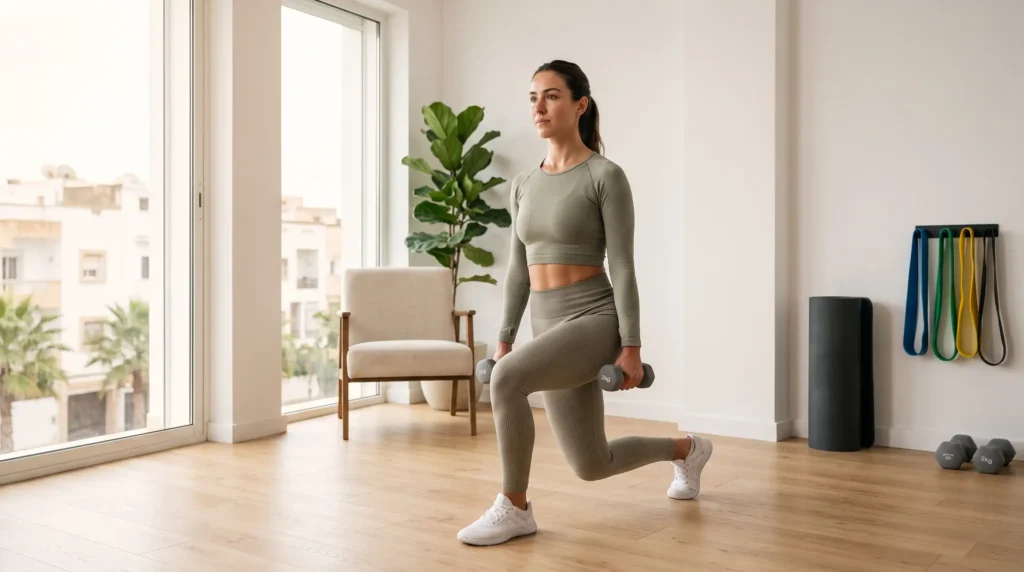
What Is a Women Fitness Aesthetic?
The women fitness aesthetic is not about achieving one specific body shape. It is better understood as building a physique that looks strong, balanced, athletic, and healthy while developing fitness habits that are realistic enough to maintain.
For many women, this can mean focusing on:
- Stronger legs and glutes
- A stronger core
- Defined shoulders and arms
- Better posture
- Improved cardiovascular fitness
- A balanced body composition
- Greater strength and confidence
You do not need a gym membership to start. The American College of Sports Medicine’s 2026 resistance-training guidance notes that bodyweight exercises, resistance bands, and home-based routines can produce meaningful improvements in strength, muscle growth, and physical function.
Why Home Workouts Can Work for Women
One of the biggest advantages of training at home is consistency.
You can exercise with:
- Your body weight
- Resistance bands
- Dumbbells
- A kettlebell
- A yoga mat
- A sturdy chair or bench
You also don’t need complicated equipment or an advanced workout program.
ACSM’s 2026 guidance emphasizes that consistency is more important than complicated training methods for most healthy adults.
This makes home training a practical option for women who have busy schedules or simply prefer exercising privately.
The 5 Main Areas to Train
A balanced women fitness aesthetic can be built by training the entire body rather than focusing exclusively on one area.
1. Glutes and Legs
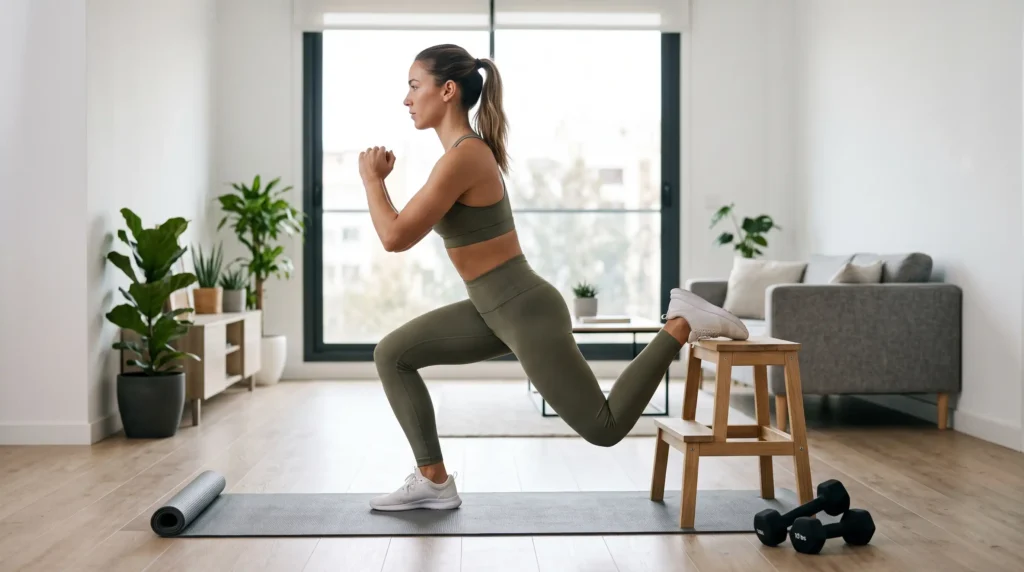
Lower-body exercises can help develop strength and muscle in the glutes, quadriceps, hamstrings, and calves.
Good home exercises include:
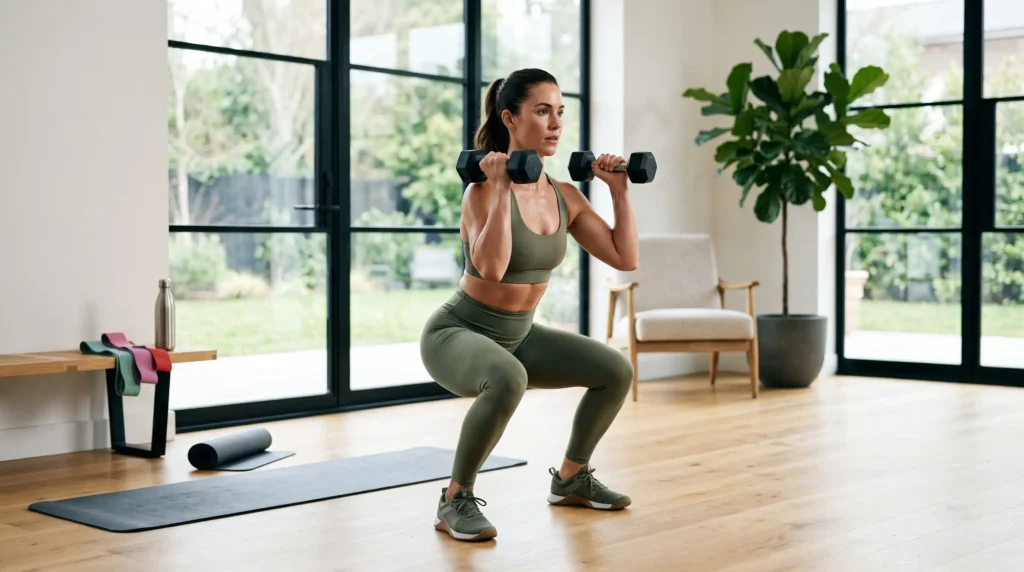
- Squats
- Reverse lunges
- Bulgarian split squats
- Glute bridges
- Hip thrusts
- Step-ups
- Romanian deadlifts with dumbbells
- Calf raises
2. Core
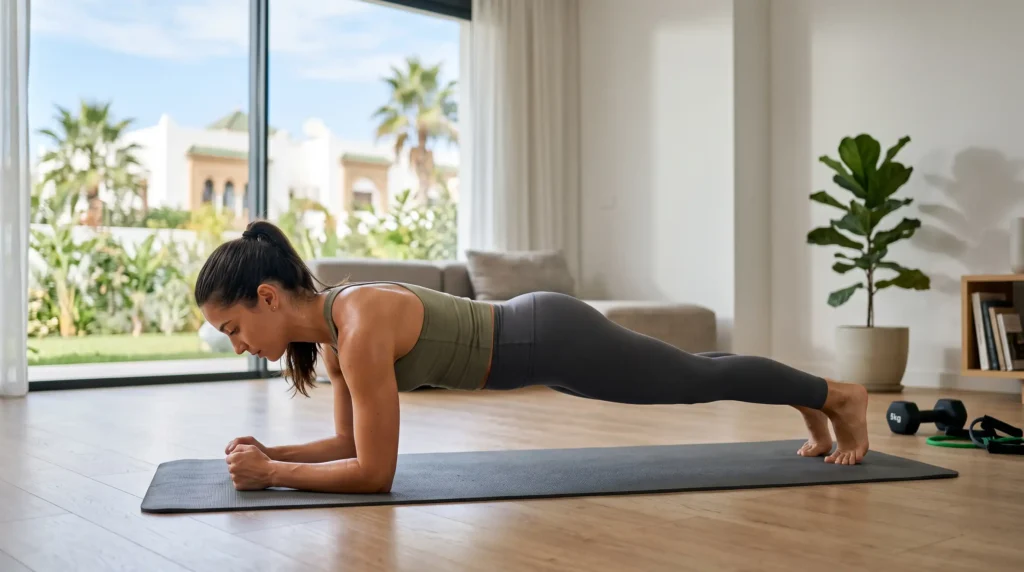
A strong core supports movement, balance, and posture.
Try:
- Planks
- Side planks
- Dead bugs
- Bird dogs
- Mountain climbers
- Reverse crunches
Remember that core training alone does not specifically remove abdominal fat. Overall activity, nutrition, genetics, and body composition all influence how your midsection looks.
3. Upper Body
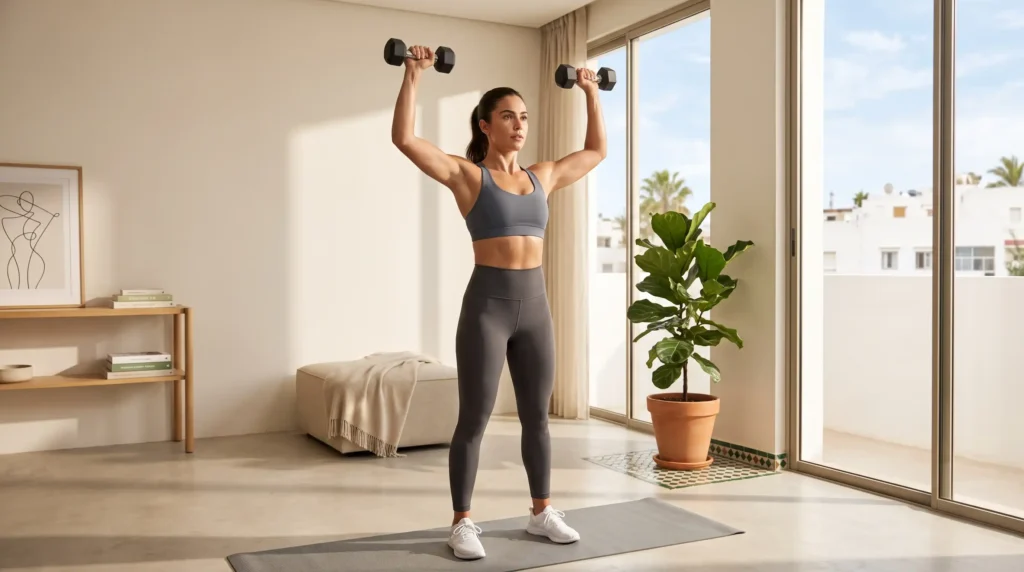
Women can benefit from resistance training for the shoulders, back, chest, and arms.
Useful exercises include:
- Push-ups
- Incline push-ups
- Dumbbell rows
- Shoulder presses
- Lateral raises
- Biceps curls
- Triceps extensions
4. Cardio and Conditioning
Cardio can complement resistance training by improving cardiovascular fitness and increasing overall activity.
Home-friendly options include:
- Brisk walking
- Dancing
- Jumping rope
- Cycling
- Jogging
- Low-impact cardio
- Short interval sessions
U.S. physical-activity guidelines recommend adults work toward 150–300 minutes of moderate-intensity aerobic activity per week, alongside muscle-strengthening activity on at least two days.
5. Mobility and Flexibility
Mobility work can make your workouts more comfortable and help you move through exercises with better control.
Consider adding:
- Hip mobility
- Shoulder circles
- Thoracic rotations
- Hamstring stretches
- Calf stretches
- Gentle yoga
A Simple 4-Day Women Home Workout Plan
You don’t need to train every day to make progress.
Here’s a simple weekly structure for beginners and intermediate exercisers.
| Day | Workout |
|---|---|
| Monday | Glutes + Legs |
| Tuesday | Upper Body + Core |
| Wednesday | Rest / Walking |
| Thursday | Glutes + Legs |
| Friday | Rest |
| Saturday | Full Body + Cardio |
| Sunday | Rest / Mobility |
Monday — Glutes & Legs
3 sets each:
- Squats — 10–15 reps
- Glute bridges — 12–20 reps
- Reverse lunges — 8–12 each leg
- Romanian deadlifts — 10–15 reps
- Calf raises — 15–20 reps
Tuesday — Upper Body + Core
3 sets each:
- Incline or regular push-ups — 8–15 reps
- Dumbbell rows — 10–15 reps
- Shoulder presses — 10–15 reps
- Lateral raises — 12–15 reps
- Plank — 20–45 seconds
- Dead bugs — 8–12 each side
Thursday — Glutes & Legs
3 sets each:
- Bulgarian split squats — 8–12 each leg
- Hip thrusts — 10–15 reps
- Step-ups — 10–12 each leg
- Sumo squats — 10–15 reps
- Glute kickbacks — 12–20 each leg
Saturday — Full Body
Perform 3 rounds:
- Squats × 12
- Push-ups × 10
- Dumbbell rows × 12
- Reverse lunges × 10 each leg
- Shoulder presses × 12
- Mountain climbers × 20
- Plank × 30 seconds
Rest about 60–90 seconds between rounds.
How to Progress Your Home Workouts
Doing the same workout forever isn’t necessary.
As an exercise becomes easier, gradually increase the challenge.
For example:
Week 1:
Bodyweight squats → 10 reps
Week 2:
Bodyweight squats → 15 reps
Week 3:
Add a dumbbell → 10–12 reps
Week 4:
Increase the weight slightly or add another set
This concept is called progressive overload.
ACSM’s 2026 resistance-training recommendations emphasize adjusting training volume and load according to the individual’s goals, while noting that advanced techniques are not essential for most healthy adults.
How Often Should Women Work Out?
For someone starting from a low activity level, there is no need to jump immediately into a demanding routine.
Start with manageable sessions and gradually increase your activity.
A practical starting point could be:
3 workouts per week × 25–40 minutes
Then progress toward four sessions if recovery and schedule allow.
The official physical-activity guidance also recommends that inactive adults start with smaller amounts of activity and build up gradually toward the weekly targets.
Can Home Workouts Build Muscle?
Yes.
Muscle growth doesn’t require a traditional gym.
You can create resistance through:
- Bodyweight
- Dumbbells
- Resistance bands
- Kettlebells
- Backpacks loaded with appropriate weight
The important factor is that the muscles receive enough resistance and progressively challenging training.
ACSM’s 2026 review specifically reports that elastic bands, bodyweight exercises, and home-based routines can be effective for strength and hypertrophy.
Nutrition for a Women Fitness Aesthetic
Training is only one part of the equation.
Your nutrition should support your individual goal.
If your goal is muscle growth
You generally need enough total calories and protein to support training and recovery.
Useful protein foods include:
- Eggs
- Chicken
- Fish
- Greek yogurt
- Cottage cheese
- Lean beef
- Beans
- Lentils
- Tofu
If your goal is fat loss
A sustainable approach usually combines appropriate calorie intake, resistance training, protein-rich foods, and regular physical activity.
Avoid assuming that eating as little as possible will automatically produce a better physique.
Adequate nutrition is particularly important when combining training with body-composition goals. ACSM highlighted adequate nutrition and energy availability as important considerations for women participating in sport and exercise.
Women’s Fitness Aesthetic: Don’t Chase Perfection
Social media can make fitness look like everyone should have the same waist, hips, legs, or body proportions.
That’s not realistic.
Your:
- Genetics
- Bone structure
- Muscle distribution
- Height
- Age
- Training history
- Nutrition
- Lifestyle
all influence your appearance.
Instead of trying to copy someone else’s physique, use measurable fitness goals.
For example:
Instead of:
“I want to look exactly like this person.”
Try:
“I want to perform 15 controlled squats with more resistance.”
Or:
“I want to complete four consistent workouts every week.”
Or:
“I want to improve my push-ups from 5 to 15.”
These goals give you something measurable to work toward.
30-Minute Women Home Workout
If you have limited time, try this simple structure:
Warm-up — 5 minutes
- March in place
- Arm circles
- Bodyweight squats
- Hip rotations
- Light dynamic movements
Strength — 20 minutes
Perform 3 rounds:
- Squats — 12 reps
- Glute bridges — 15 reps
- Push-ups — 8–12 reps
- Dumbbell rows — 12 reps
- Reverse lunges — 10 each leg
- Plank — 30 seconds
Finisher — 5 minutes
Choose:
- Brisk walking
- Dancing
- Step-ups
- Low-impact cardio
- Jump rope
You can modify the exercises according to your fitness level.
Common Mistakes to Avoid
1. Only Training the Glutes
Glute-focused workouts are popular, but a balanced program should also train the back, chest, shoulders, arms, core, and legs.
2. Doing Cardio Every Day
Cardio is useful, but resistance training plays an important role in maintaining and developing muscular fitness.
3. Changing Your Workout Every Week
Constantly changing exercises can make it harder to measure progress.
4. Training Through Pain
Muscle fatigue is normal. Sharp or unusual pain is different. Stop an exercise if something feels wrong and seek professional advice when appropriate.
5. Ignoring Recovery
Rest days, sleep, nutrition, and manageable training volume all contribute to long-term progress.
How to Track Your Progress
The scale isn’t the only way to measure fitness.
Track:
- Body weight if relevant to your goal
- Waist and hip measurements
- Exercise repetitions
- Resistance used
- Workout consistency
- Walking or cardio time
- Progress photos
- Energy and recovery
A workout journal can make improvements easier to see over several weeks.
Women Fitness Aesthetic in 2026: Keep It Simple
The current evidence does not require an elaborate gym program to build a stronger, fitter body. ACSM’s 2026 resistance-training guidance emphasizes practical training approaches, including home workouts and bodyweight or band exercises.
A simple formula is:
Strength training + cardio + adequate nutrition + recovery + consistency
Start where you are, gradually increase the challenge, and give the process enough time.
The goal isn’t to find a perfect workout. It’s to build a routine you can actually maintain.
Try Our Free Fitness Calculators
Want to make your fitness goals more measurable?
Explore FitCalculatorAI’s free fitness calculators for calories, protein, BMI, body fat, macros, TDEE, and other fitness metrics.
👉 Explore FitCalculatorAI Calculators
You can also use a Smart Fitness Advisor to explore personalized fitness questions and planning ideas.
FAQ: Women Fitness Aesthetic
What is a women fitness aesthetic?
It generally refers to a strong, balanced, athletic-looking physique developed through resistance training, physical activity, nutrition, and consistent lifestyle habits.
Can I achieve a fitness aesthetic at home?
Yes. Bodyweight exercises, resistance bands, dumbbells, and other simple equipment can be used for effective home resistance training.
How many days a week should women work out?
A practical starting point is 2–3 strength sessions per week. Adults are generally advised to perform muscle-strengthening activities at least two days per week.
Do women need to lift heavy weights?
Not necessarily. Different resistance levels can be effective. The appropriate challenge depends on your experience, goals, and ability.
How long should a home workout last?
There is no single required duration. A focused 25–45 minute workout can be enough for many people, particularly when performed consistently.
Can women build muscle without going to the gym?
Yes. Home-based resistance training using bodyweight, bands, and free weights can support muscle development.
How quickly will I see results?
Results vary considerably. Your starting point, training consistency, nutrition, recovery, genetics, and goal all affect the timeline. Focus on gradual improvements rather than expecting a specific physical change by a fixed date.
Final Takeaway
A women fitness aesthetic doesn’t require extreme workouts, expensive equipment, or spending hours in a gym.
A consistent home routine built around strength training, cardio, core work, balanced nutrition, and recovery can provide a strong foundation for improving fitness and body composition.
Start small, track your progress, and progressively make your workouts more challenging as your fitness improves.