
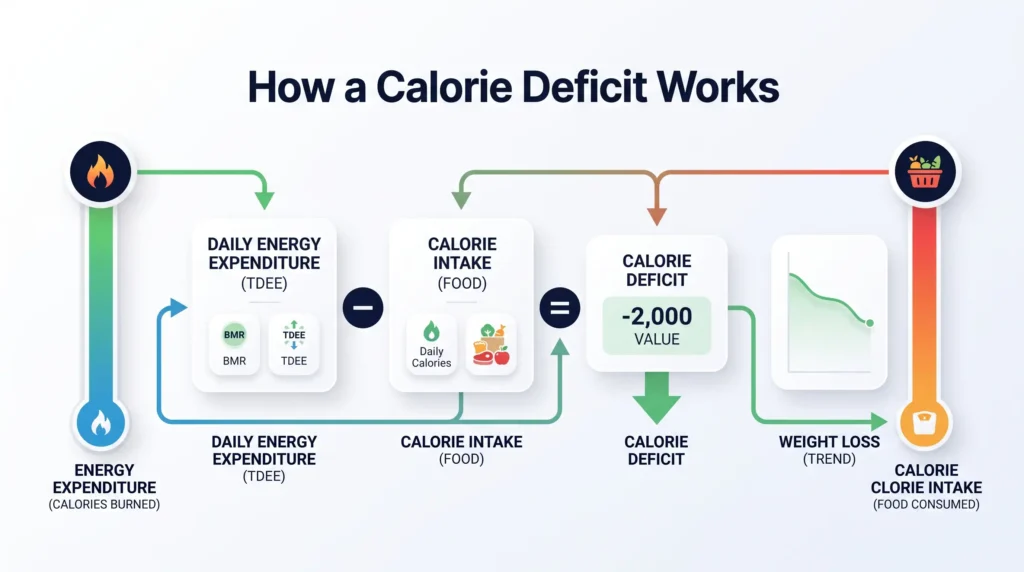
Losing body weight usually requires your body to use more energy than you consume over time. This difference between energy intake and energy expenditure is commonly called a calorie deficit.
A Calorie Deficit Calculator can help estimate how many calories you may need to eat each day to create a reasonable deficit based on your estimated energy expenditure and weight-loss goal.
In this guide, you’ll learn what a calorie deficit is, how it is calculated, how it relates to TDEE, how to choose a realistic deficit, and how to use calorie estimates more effectively.
What Is a Calorie Deficit?
A calorie deficit occurs when you consume fewer calories than your body uses over a period of time.
For example, if your body uses approximately 2,400 calories per day and your average intake is 2,000 calories, the difference is about 400 calories.
Calorie Deficit = Calories Burned − Calories Consumed
A deficit does not have to be identical every day. What matters most for body-weight trends is the overall energy balance over time.
What Does a Calorie Deficit Calculator Do?
A Calorie Deficit Calculator estimates your daily calorie requirements and then suggests a lower calorie target based on the deficit selected for your weight-loss goal.
Most calculators use information such as age, sex, height, body weight, and activity level to estimate your energy expenditure.
You can use our Calorie Deficit Calculator to get a personalized starting estimate.
How Is a Calorie Deficit Calculated?
A calorie deficit calculation usually starts by estimating your Basal Metabolic Rate, or BMR. This represents the approximate amount of energy your body needs at rest.
The estimated BMR can then be combined with your activity level to estimate your Total Daily Energy Expenditure, or TDEE.
Your desired calorie deficit is then subtracted from your estimated maintenance calories.
Estimated Maintenance Calories − Desired Deficit = Daily Calorie Target
For example, if estimated maintenance calories are 2,400 kcal and a person chooses a 400 kcal deficit, their estimated daily target would be approximately 2,000 kcal.
This is an example rather than a universal recommendation. Individual calorie needs vary considerably.
Why TDEE Matters for a Calorie Deficit
TDEE stands for Total Daily Energy Expenditure. It represents the estimated amount of energy your body uses during a typical day.
Because a calorie deficit depends on the difference between energy expenditure and energy intake, estimating TDEE can provide a useful starting point for choosing a calorie target.
Learn more about your estimated daily energy expenditure with our TDEE Calculator .
What Is BMR and Why Is It Important?
BMR, or Basal Metabolic Rate, estimates the energy your body uses to support essential functions while at rest.
Your BMR is only one part of your total daily energy expenditure. Physical activity, exercise, digestion, and normal daily movement also contribute to the calories your body uses.
If you want to understand BMR in more detail, see our BMR Calculator Guide .
How Much of a Calorie Deficit Should You Have?
There is no single calorie deficit that is appropriate for everyone. The right approach depends on factors such as your current body weight, estimated energy expenditure, activity level, nutritional needs, and overall goal.
A moderate deficit is often easier to maintain than an extremely aggressive restriction. A gradual approach may also make it easier to maintain adequate nutrition and continue exercising.
The best calorie target is not necessarily the lowest possible number. A sustainable approach should allow you to maintain adequate nutrition, normal daily activities, and a consistent routine.
Common Calorie Deficit Examples
| Estimated Maintenance | Example Deficit | Example Daily Intake |
|---|---|---|
| 2,000 kcal | 250 kcal | 1,750 kcal |
| 2,200 kcal | 300 kcal | 1,900 kcal |
| 2,400 kcal | 400 kcal | 2,000 kcal |
| 2,600 kcal | 500 kcal | 2,100 kcal |
These numbers are examples designed to explain the calculation. They should not be interpreted as personalized calorie prescriptions.
Can a Calorie Deficit Help You Lose Weight?
A sustained energy deficit can lead to weight loss because the body needs to obtain energy from stored sources when energy intake does not fully cover expenditure.
However, the amount and speed of weight change can vary from person to person. Water retention, glycogen, digestive contents, changes in activity, and other factors can affect the number shown on the scale.
For that reason, short-term fluctuations should not automatically be interpreted as changes in body fat.
How Fast Should You Lose Weight?
Weight-loss speed depends on your starting body weight, calorie intake, activity level, and other individual factors.
Rather than focusing only on a specific weekly number, it can be more useful to monitor your progress over several weeks and look for a consistent trend.
If your weight is changing much faster than expected or you are experiencing significant fatigue, dizziness, weakness, or other concerning symptoms, reconsider your approach and seek professional guidance when appropriate.
Calorie Deficit and Protein Intake
Protein becomes particularly important when reducing calorie intake. Adequate protein can support muscle maintenance while you are working toward a lower body weight, especially when combined with resistance training.
Your ideal protein intake depends on factors such as body weight, activity level, training goals, and individual circumstances.
You can estimate your daily protein needs with our Protein Calculator .
Calorie Deficit and Macronutrients
Calories are important for energy balance, but the composition of your diet also matters.
Protein, carbohydrates, and dietary fats all have important roles in a balanced diet. Setting appropriate macronutrient targets can make a calorie-controlled diet easier to structure.
Our Macro Calculator can help you estimate your daily protein, carbohydrate, and fat targets.
Should You Exercise During a Calorie Deficit?
Exercise can be useful during weight loss because it can support fitness, strength, cardiovascular health, and daily energy expenditure.
Resistance training can be particularly useful when your goal is to preserve muscle while losing weight.
Cardiovascular exercise and normal daily movement can also contribute to total energy expenditure.
However, exercise should not be viewed as a reason to create an unnecessarily aggressive calorie restriction.
How to Use a Calorie Deficit Calculator Correctly
To get a useful estimate, enter accurate and current information. Your weight, height, age, and activity level should reflect your current situation.
- Enter your current body weight rather than an old measurement.
- Use your actual height and age.
- Choose an activity level that represents your normal routine.
- Select a realistic weight-loss goal.
- Treat the result as an estimate rather than an exact number.
- Monitor your progress and adjust your approach when necessary.
Why Your Calculator Result May Not Match Your Actual Needs
Even a well-designed calculator cannot perfectly measure your individual metabolism.
Most calculators rely on predictive equations and activity multipliers. Actual energy expenditure can differ because people have different body compositions, movement patterns, exercise habits, and metabolic characteristics.
This means that your real maintenance calories may be somewhat higher or lower than the initial calculator estimate.
Your progress over time can provide useful information about whether the estimated calorie target is working for you.
How to Adjust Your Calorie Target Over Time
Your calorie needs can change as your body weight changes. Consequently, a calorie target that worked at the beginning of a weight-loss phase may not produce exactly the same result later.
Instead of making frequent changes based on daily scale fluctuations, monitor your average weight trend over several weeks.
If progress consistently stops, you can reassess your estimated calorie intake, activity level, food tracking accuracy, and overall routine.
Common Mistakes When Using a Calorie Deficit Calculator
Choosing an Activity Level That Is Too High
One common mistake is selecting a very active category based only on occasional workouts. Your activity level should reflect your overall daily movement and typical weekly routine.
Eating Back Every Exercise Calorie
Fitness trackers and exercise machines provide estimates that may not perfectly represent actual calories burned. Automatically eating back every reported exercise calorie can therefore make it harder to maintain the intended deficit.
Changing Calories Too Quickly
Daily scale changes are normal. Making large calorie adjustments after only a few days can lead to unnecessary changes to your plan.
Ignoring Food Quality
A calorie deficit does not make overall nutrition irrelevant. Nutrient-dense foods, adequate protein, fiber, vitamins, minerals, and hydration remain important.
Focusing Only on the Scale
Body weight is useful, but it is not the only measure of progress. Waist measurements, strength, fitness performance, clothing fit, and overall consistency can provide additional context.
Calorie Deficit vs Calorie Restriction
A calorie deficit describes an energy balance where expenditure is higher than intake. Calorie restriction is a broader term that can refer to deliberately reducing food intake.
Creating a deficit does not necessarily mean eating as little as possible. A well-planned calorie deficit should still provide sufficient nutrition for your individual needs.
What Should You Eat During a Calorie Deficit?
There is no single food list that everyone must follow. A balanced calorie-controlled diet can include a wide range of foods.
Many people find it easier to manage hunger by emphasizing foods that provide protein, fiber, and a high volume of nutrients without using a large amount of calories.
- Lean protein sources
- Vegetables and fruits
- Whole grains and other high-fiber carbohydrates
- Healthy sources of dietary fat
- Adequate fluids and hydration
Frequently Asked Questions
What is a good calorie deficit?
A good calorie deficit is one that is appropriate for your individual situation and sustainable over time. There is no single deficit that works for everyone. A moderate approach is often easier to maintain than an extremely aggressive one.
How many calories should I eat to lose weight?
Your target depends on your estimated maintenance calories, activity level, current body size, and goals. A Calorie Deficit Calculator can provide a personalized starting estimate based on the information you enter.
Is a 500 calorie deficit safe?
A 500-calorie deficit is commonly used as an example of a moderate deficit, but it is not automatically appropriate for every person. Your calorie needs and health circumstances should be considered before choosing a target.
Can I lose weight without exercise?
Weight loss can occur when there is a sustained calorie deficit, even without structured exercise. However, physical activity can provide important health and fitness benefits and may help support long-term weight management.
Does a calorie deficit always mean fat loss?
A sustained energy deficit can lead to weight loss, but the weight lost can include changes in body fat, water, glycogen, and other tissues. Resistance training and adequate protein can help support muscle retention during weight loss.
Why did my weight stop going down?
Weight loss can temporarily slow or appear to stop because of water fluctuations, changes in activity, tracking errors, or changes in energy requirements as body weight decreases. Looking at longer-term trends is more useful than judging progress from a few days.
Can I build muscle while in a calorie deficit?
Some people can gain or maintain muscle while losing body weight, particularly beginners or people returning to resistance training. Results depend on training status, protein intake, calorie deficit, recovery, and individual factors.
Should I recalculate my calorie deficit after losing weight?
It can be useful to reassess your estimated energy needs as your body weight and activity level change. Your calorie requirements may not remain the same throughout a weight-loss journey.