
Look down at the back of your legs or catch a glimpse in harsh bathroom lighting, and there it is: that familiar dimpled, orange-peel texture on your thighs and glutes. If you are frustrated by cellulite, you are in the overwhelming majority. Up to 90% of women (and roughly 10% of men) experience cellulite at some point in their lives, regardless of their body weight or fitness level.
While cosmetic creams, dry brushing, and expensive spa rollers promise overnight miracles, the physiological reality of cellulite requires a deeper approach. You cannot rub away structural tissue changes from the outside. However, you can reshape the foundation underneath your skin.
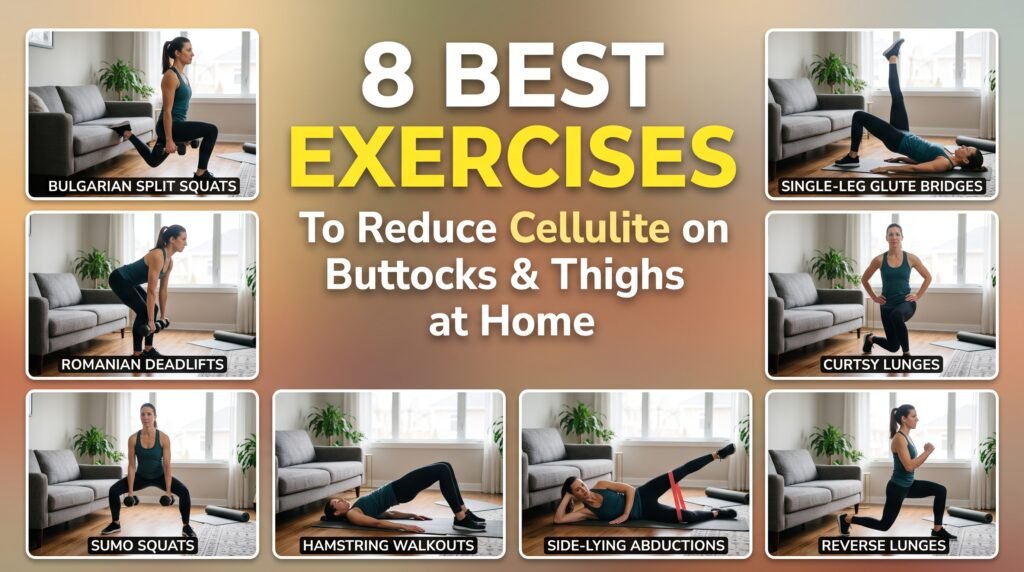
By combining targeted lower-body hypertrophy (muscle-building) with strategic metabolic conditioning right in your living room, you can firm the underlying muscle, improve local blood flow, and noticeably smooth out the appearance of dimpled skin. Below is the complete, science-backed guide to the 8 best exercises to reduce cellulite on buttocks and thighs at home, complete with a weekly routine and nutritional strategy.
Table of Contents
What Actually Causes Cellulite? (And How Exercise Fixes It)
To understand why specific exercises work while endless jogging often fails, you need to understand the anatomy of a cellulite dimple.
Cellulite (gynoid lipodystrophy) is not a special type of “trapped toxin” or abnormal fat. It is regular subcutaneous fat sitting right beneath the dermis. Across your buttocks and thighs, fibrous connective bands called septae tether your skin down to the underlying muscle fascia.
In women, these collagen bands are arranged vertically—like the buttons on a tufted mattress—whereas in men, they form a tight criss-cross lattice. When subcutaneous fat cells expand, they push upward against the skin while the stiff fibrous bands pull downward. This opposing tension creates the classic hills and valleys on the surface of the skin. Three primary factors make this texture look more pronounced as we age:
- Muscle Atrophy: When the gluteal and hamstring muscles lose tone and volume, the skin and fat sitting on top of them lose their structural support, causing the tissue to sag and fold over the fibrous bands.
- Enlarged Fat Cells: Excess body fat increases the upward pressure against the dermal layer, deepening the appearance of each pocket.
- Poor Microcirculation & Collagen Loss: Reduced blood flow and lymphatic drainage lead to fluid retention in the lower body, while thinning skin makes the underlying fat pockets much easier to see.
Why Targeted Resistance Training Is the Solution
You cannot “spot-reduce” fat from your thighs by doing a hundred leg lifts. However, you can spot-build muscle. When you build firm, dense muscle in your glutes (gluteus maximus, medius, and minimus) and thighs (hamstrings, quadriceps, and adductors), that muscle pushes outward smoothly against the skin. Think of it like inflating a slightly deflated balloon: adding healthy muscle volume fills out the slack, reducing the puckering effect while simultaneous fat loss reduces the upward bulging of fat pockets. Because scale weight alone doesn’t distinguish between subcutaneous fat and lean muscle, use our Body Fat Percentage Calculator to establish your starting baseline and track your lower-body recomposition accurately.
The 8 Best Exercises to Reduce Cellulite on Buttocks and Thighs at Home
I selected 8 exercises for this blueprint because addressing the lower body from every angle requires covering four fundamental movement patterns: hip extension, knee flexion, hip abduction, and unilateral (single-leg) knee dominance. Together, these movements target every pocket where cellulite commonly forms—from the “banana roll” right under the buttock crease to the outer saddlebags and inner thighs.
1. Bulgarian Split Squats
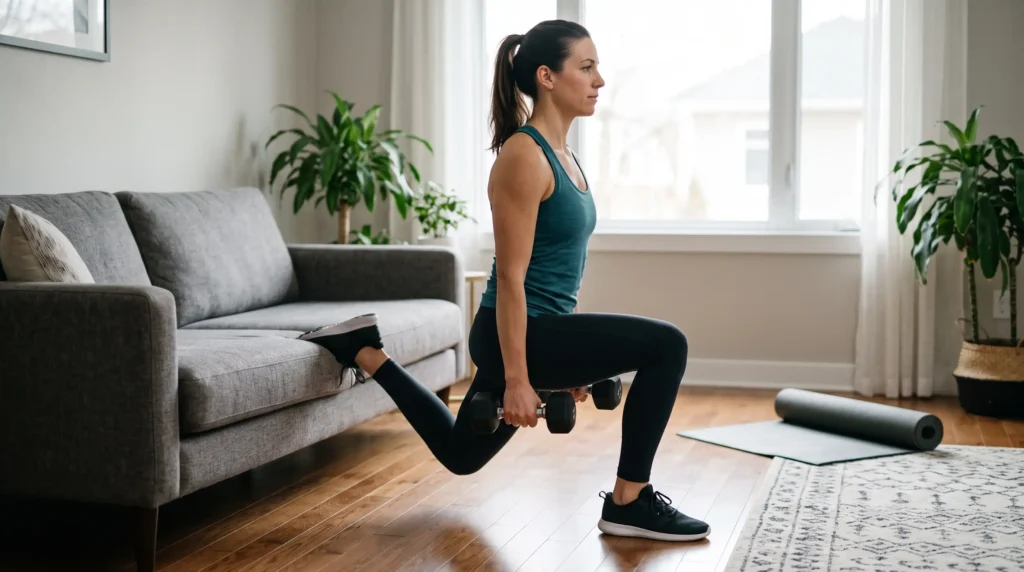
If there is one undisputed king of lower-body transformation at home, it is the Bulgarian Split Squat. Because it forces one leg to handle your entire bodyweight through a deep range of motion, it generates massive mechanical tension in the gluteus maximus and quads without needing heavy gym barbells.
- Primary Muscles Targeted: Gluteus maximus, quadriceps, hamstrings, and core stabilizers.
- Cellulite Target Zone: The lower glute-hamstring tie-in (the crease right under the buttocks) and the front/outer sweep of the thigh.
How to Perform It:
- Stand about two feet in front of a sturdy chair, couch, or low step, facing away from it.
- Reach one foot back and rest the top of your laces flat on the elevated surface. Keep about 80% to 90% of your weight planted firmly on your front foot (especially through the heel and mid-foot).
- Hinge your torso slightly forward at the hips (roughly a 30-degree angle)—this slight forward lean shifts the workload directly onto your glutes rather than just your knees.
- Slowly lower your back knee toward the floor until your front thigh is parallel to the ground.
- Pause for 1 full second at the bottom to eliminate momentum, then drive forcefully through your front heel to return to the starting position.
- Recommended Volume: 3 sets of 10–12 reps per leg (Rest 60 seconds between legs).
- Home Progression Tip: Hold a pair of dumbbells, filled water jugs, or a loaded backpack to increase resistance as you get stronger.
2. Single-Leg Glute Bridges (or Hip Thrusts)
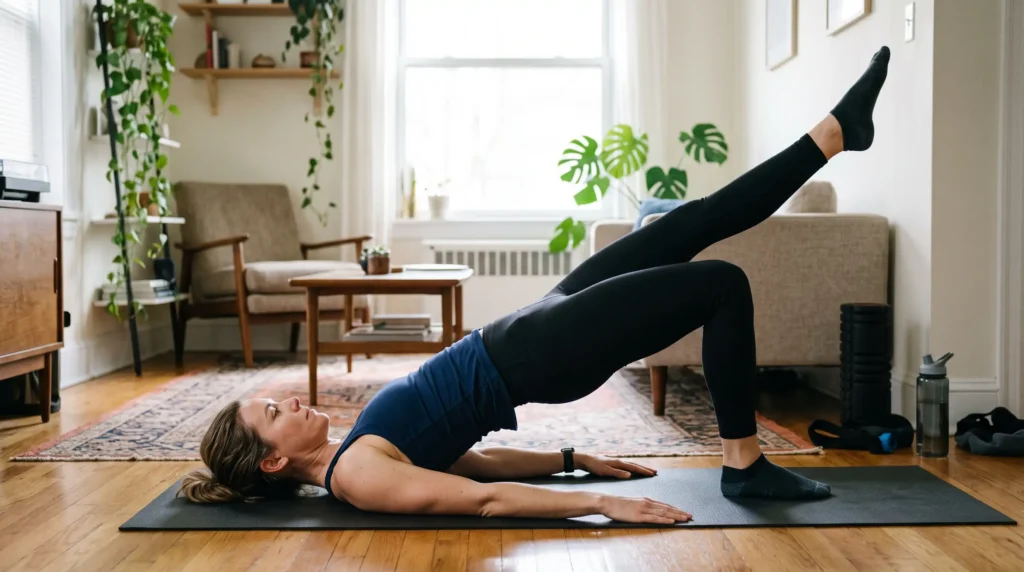
The largest muscle in your body is the gluteus maximus, and when it is underactive from hours of sitting at a desk, the tissue on the back of the hips loses its lift. Single-leg glute bridges isolate each side independently, ensuring high muscle-fiber recruitment at full hip extension—where the glutes contract the hardest.
- Primary Muscles Targeted: Gluteus maximus and hamstrings.
- Cellulite Target Zone: The center and lower portions of the buttocks and upper rear thighs.
How to Perform It:
- Lie flat on your back on an exercise mat with your knees bent and feet flat on the floor, positioned about hip-width apart and close enough that your fingertips can graze your heels.
- Lift one leg off the floor, pulling that knee toward your chest or extending it straight up at a 45-degree angle.
- Brace your core and flatten your lower back against the mat so your ribs stay down.
- Drive through the heel of your grounded foot, lifting your hips upward until your working knee, hips, and shoulders form a straight diagonal line.
- Squeeze your working glute intensely at the top for 2 full seconds, ensuring you do not hyperextend your lower back.
- Lower your hips slowly until they hover just an inch above the floor, then immediately begin the next repetition.
- Recommended Volume: 3 sets of 12–15 reps per side.
- Home Progression Tip: Elevate your upper back on the edge of a couch to turn this into a Single-Leg Hip Thrust, which increases the range of motion by nearly double.
3. Romanian Deadlifts (Dumbbell, Resistance Band, or Single-Leg)
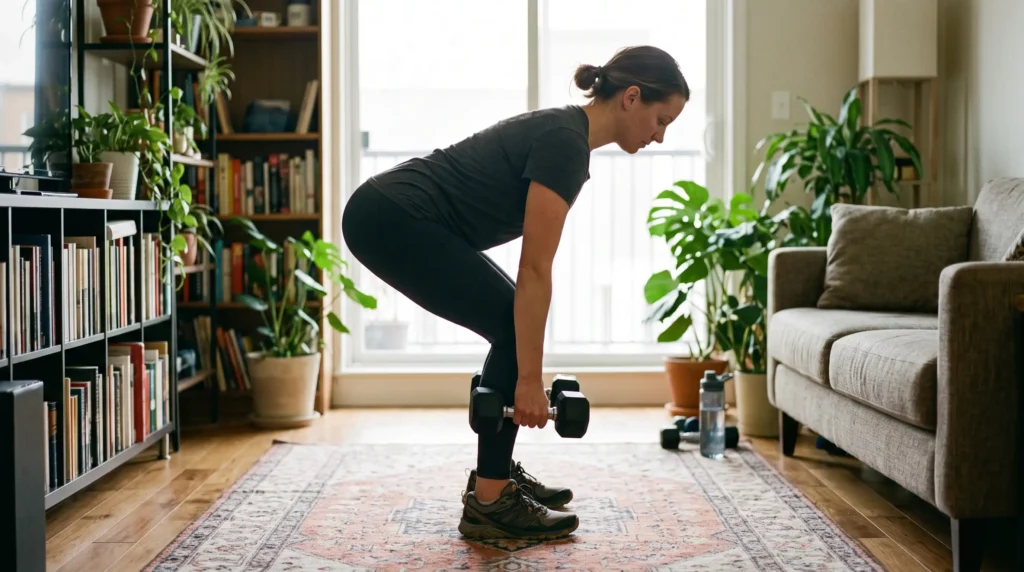
The back of the thighs (the posterior chain) is the #1 area where women notice stubborn cellulite dimpling. Standard squats are primarily quad-dominant; to smooth out the back of your legs, you need a pure hip-hinge movement that stretches the hamstrings under load.
- Primary Muscles Targeted: Hamstrings (biceps femoris, semitendinosus, semimembranosus) and gluteus maximus.
- Cellulite Target Zone: The entire back of the thighs and the lower buttock crease.
How to Perform It:
- Stand tall with your feet hip-width apart, holding a pair of dumbbells, household weights, or standing on the center of a heavy resistance band. (If you have zero equipment, perform this on one leg at a time).
- Unlock your knees into a soft, slight bend (about 15 degrees) and freeze them at that exact angle for the rest of the movement.
- Without bending your knees further, push your hips straight back toward the wall behind you—imagine trying to shut a car door with your butt while your hands are full of groceries.
- Keep your spine completely flat and neutral as you slide your hands down the front of your thighs until they reach mid-shin level (or until you feel a deep stretch running down the back of your legs).
- Drive your hips forward and squeeze your glutes to stand back up tall.
- Recommended Volume: 4 sets of 12 reps with a slow 3-second lowering phase (eccentric tempo).
- Form Mistake to Avoid: Never round your lower back to reach the floor; the movement stops the moment your hips stop moving backward.
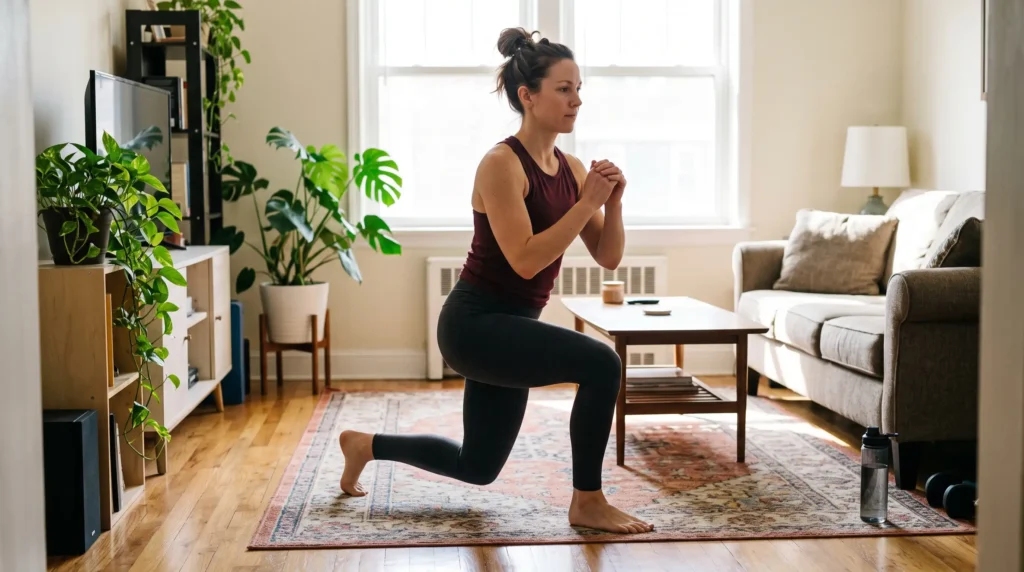
4. Curtsy Lunges
While standard exercises work the body in a straight front-to-back plane, cellulite frequently accumulates along the outer thighs and upper hip dips (“saddlebag” region). The Curtsy Lunge introduces transverse and frontal plane tension, specifically targeting the gluteus medius and minimus—the side-glute muscles responsible for giving the hips a lifted, rounded contour.
- Primary Muscles Targeted: Gluteus medius, gluteus minimus, outer quadriceps, and inner thighs.
- Cellulite Target Zone: Outer thighs, side glutes, and hip edges.
How to Perform It:
- Stand with your feet hip-width apart and clasp your hands in front of your chest for balance.
- Keep your chest and hips facing straight forward. Step your right foot diagonally behind your left leg—as if you are performing a formal curtsy—placing the ball of your back foot on the floor.
- Bend both knees simultaneously, lowering your back knee until it hovers two inches above the ground. You should feel a deep tension and stretch across the outside of your front (left) hip and glute.
- Push firmly through the heel of your front foot to return to the starting standing position.
- Complete all reps on one side before switching, or alternate legs cleanly.
- Recommended Volume: 3 sets of 12 reps per leg.
- Form Mistake to Avoid: Do not let your front knee twist inward; keep your front kneecap tracking directly over your middle toes.
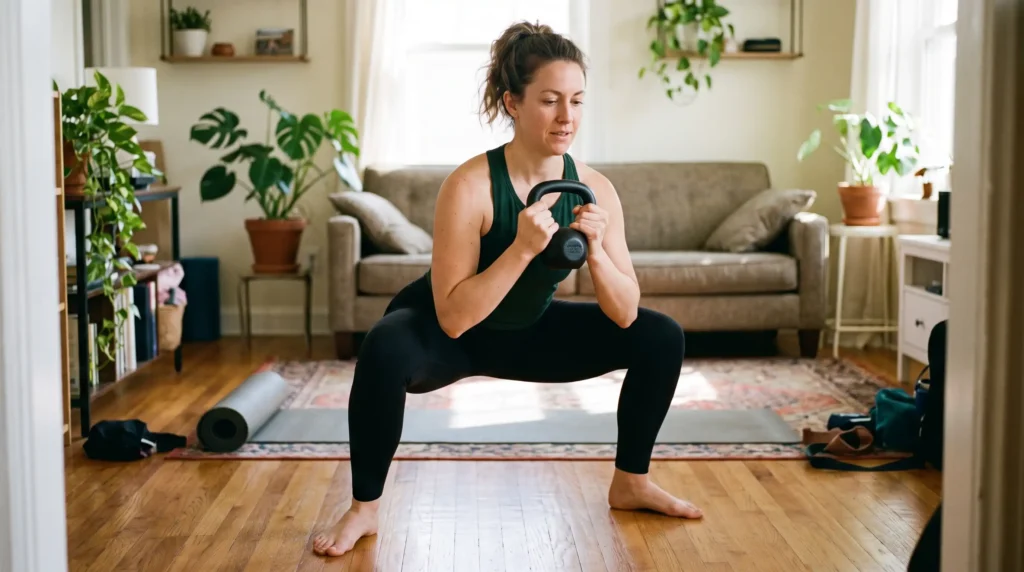
5. Sumo Squats with a Bottom Pulse
The inner thighs (adductors) have thinner skin and softer tissue than the outer legs, making them particularly prone to loose skin and dimpling. By widening your stance and rotating your hips externally, the Sumo Squat shifts mechanical emphasis onto the inner thighs and deep glute fibers, while the bottom pulse maximizes Time Under Tension (TUT) and local blood flow.
- Primary Muscles Targeted: Adductors (inner thighs), glutes, and quadriceps.
- Cellulite Target Zone: Inner thighs and lower buttocks.
How to Perform It:
- Stand with your feet significantly wider than shoulder-width apart and turn your toes outward at a 45-degree angle.
- Keep your torso upright, shoulders pulled back, and core braced.
- Bend your knees and sink your hips straight down between your legs, actively pushing your knees outward so they stay aligned with the direction of your toes.
- Lower down until your thighs are parallel to the floor.
- Once at the bottom, rise up just 3 to 4 inches, lower right back down to parallel (that is one pulse), and then drive all the way up to the starting position, squeezing your inner thighs and glutes at the top.
- Recommended Volume: 3 sets of 15 reps (1 full squat + 1 pulse = 1 rep).
- Home Progression Tip: Hold a single heavy dumbbell, kettlebell, or laundry detergent jug vertically between your legs (Goblet style) to add load.
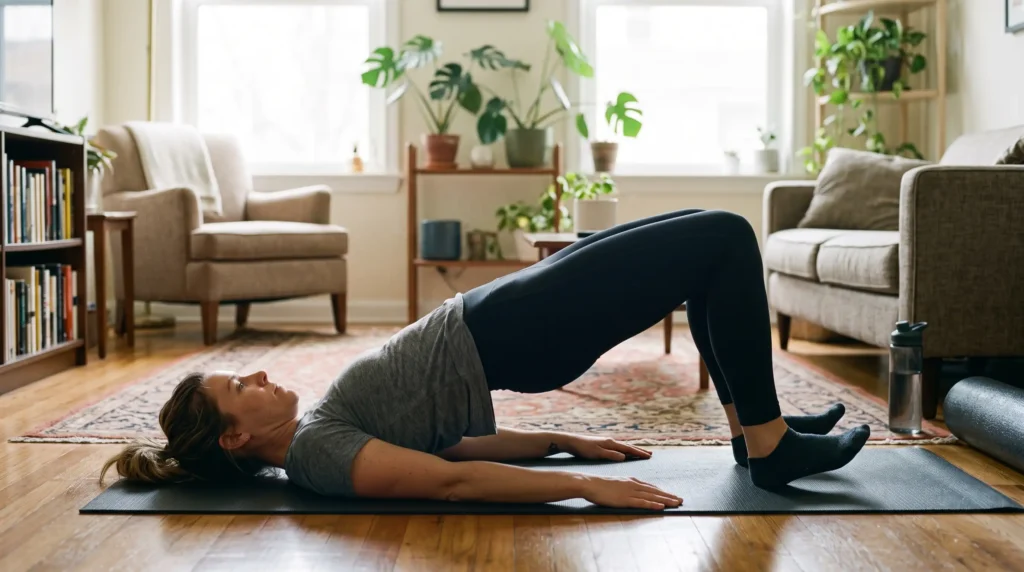
6. Floor Hamstring Walkouts (or Towel Leg Curls)
Most people think you need a commercial gym leg-curl machine to train the lower hamstring fibers near the back of the knee. That happens to be a huge mistake: the hamstrings cross both the hip joint and the knee joint. While Romanian Deadlifts train them at the hip, Hamstring Walkouts force intense knee-flexion contractions using only your bodyweight, tightening the lower rear thigh.
- Primary Muscles Targeted: Distal hamstrings, calves, and glutes.
- Cellulite Target Zone: Lower and mid-back of the thighs.
How to Perform It:
- Lie on your back with your knees bent and feet flat on the floor, then lift your hips into a standard Glute Bridge position. Keep your hips elevated off the floor for the entire set.
- Digging only your heels into the floor (toes pointed up toward the ceiling), take tiny, controlled steps forward with your heels, walking your feet away from your body until your legs are nearly straight.
- Pause for a split second as you feel your hamstrings firing intensely to keep your hips off the ground.
- Take small, controlled heel steps backward to walk your feet back into the starting bridge position.
- Recommended Volume: 3 sets of 8–10 full walkouts.
- Alternative Option: If you have hardwood or tile floors, place a small hand towel under your heels while in a bridge, slide your legs out straight, and curl your heels forcefully back toward your glutes.
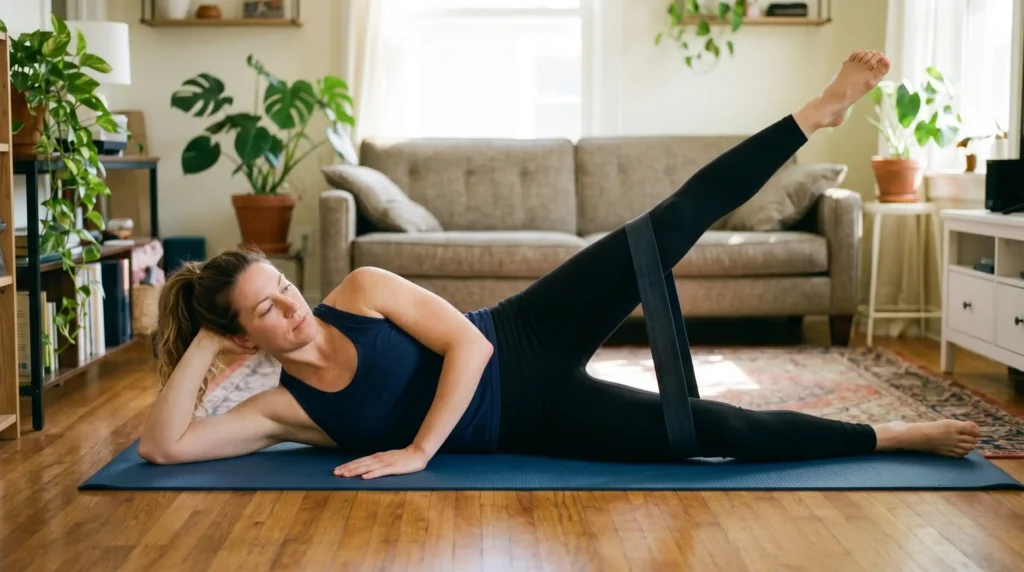
7. Side-Lying Hip Abductions (or Banded Clamshells)
To truly smooth out the outer thigh and upper side-hip region, compound exercises benefit from a high-repetition isolation finisher. Side-lying abductions flush the lateral glutes and tensor fasciae latae (TFL) with blood, stimulating local microcirculation in areas that normally have poor blood flow.
- Primary Muscles Targeted: Gluteus medius, gluteus minimus, and outer thigh fascia.
- Cellulite Target Zone: Saddlebags and upper-outer buttocks.
How to Perform It:
- Lie on your side on a mat with your legs stacked on top of each other and your head resting comfortably on your bottom arm. Bend your bottom leg slightly behind you for stability.
- Crucial Form Cue: Rotate your top foot slightly downward so your heel is higher than your toes, and tilt your top hip slightly forward toward the floor. This prevents your hip flexors from taking over and locks the tension directly onto your side glute.
- Keeping your top leg straight, lift it upward toward the ceiling to about a 45-degree angle.
- Hold at the top for 1 second, feeling the deep burn in the upper side of your buttock, then lower slowly without letting your foot rest completely at the bottom.
- Recommended Volume: 3 sets of 20–25 high-burn reps per side.
- Home Progression Tip: Loop a mini fabric resistance band just above your knees or ankles to double the muscular activation.
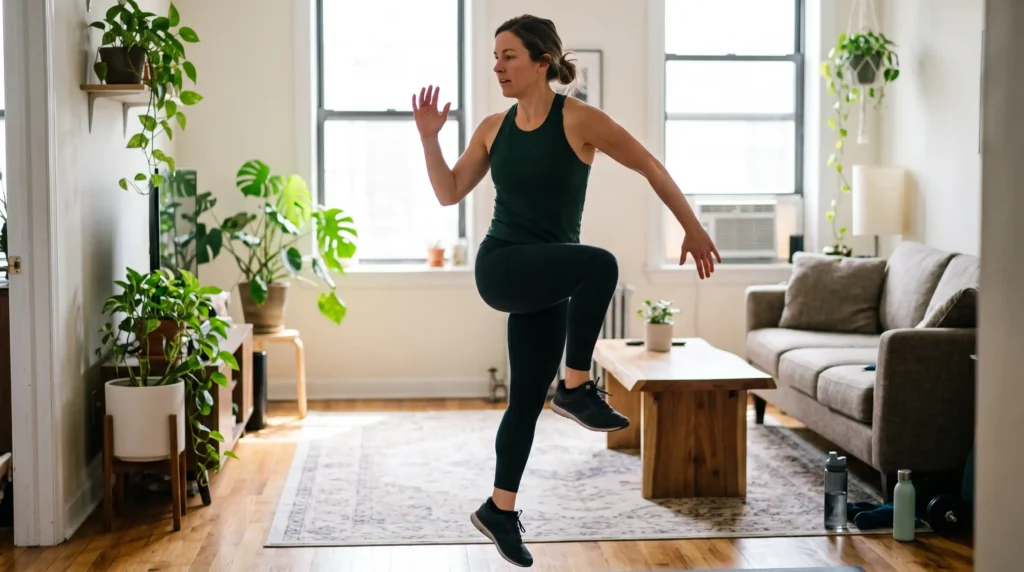
8. Step-Back Reverse Lunges into Knee Drives
To round out the 8 movements, we need an exercise that combines unilateral muscle building with a cardiovascular, lymphatic-pumping effect. Stepping backward into a lunge puts significantly less shear stress on the knee joint than forward lunges while placing a deeper stretch on the glute of the front leg. Driving the knee up dynamically accelerates heart rate and venous return from the lower extremities.
- Primary Muscles Targeted: Gluteus maximus, quadriceps, hamstrings, calves, and core.
- Cellulite Target Zone: Full thigh circumference and gluteal fold.
How to Perform It:
- Stand tall with your feet hip-width apart.
- Step your right foot backward about two to three feet, landing softly on the ball of your back foot.
- Lower your hips until both knees are bent at clean 90-degree angles, with your front thigh parallel to the floor and your front shin nearly vertical.
- Push powerfully through your front (left) heel, bringing your back leg forward and driving your right knee all the way up toward your chest in one fluid, explosive motion until you are balancing on your left leg.
- Control the descent and step straight back into the next repetition.
- Recommended Volume: 3 sets of 12–15 reps per leg.
Quick Reference: Home Anti-Cellulite Exercise Matrix
| Exercise Name | Primary Target Area | Main Mechanism | Sets & Reps | Equipment Needed |
| 1. Bulgarian Split Squats | Lower Glutes & Quads | Deep mechanical tension & muscle lift | 3 x 10–12 / leg | Chair or Couch |
| 2. Single-Leg Glute Bridges | Center & Upper Glutes | Peak contraction at full hip extension | 3 x 12–15 / leg | Floor Mat |
| 3. Romanian Deadlifts | Rear Thighs (Hamstrings) | Eccentric stretching of posterior chain | 4 x 12 (slow tempo) | Dumbbells / Household Items |
| 4. Curtsy Lunges | Outer Thighs & Side Glutes | Multi-planar tension on gluteus medius | 3 x 12 / leg | Bodyweight |
| 5. Sumo Squat + Pulse | Inner Thighs & Deep Glutes | High Time Under Tension (TUT) | 3 x 15 | Bodyweight or 1 Weight |
| 6. Hamstring Walkouts | Lower Back of Thighs | Knee-flexion hamstring isolation | 3 x 8–10 walkouts | Floor Mat / Towel |
| 7. Side-Lying Abductions | Saddlebags & Upper Hips | High-rep metabolic flush & blood flow | 3 x 20–25 / side | Bodyweight or Mini-Band |
| 8. Reverse Lunge Knee Drive | Full Leg & Lymphatic Flow | Unilateral strength + cardio circulation | 3 x 12–15 / leg | Bodyweight |
Your Weekly At-Home Anti-Cellulite Workout Schedule
Doing random exercises sporadically won’t remodel muscle tissue. Muscle fibers need progressive overload (gradually doing more reps, slowing down the tempo, or adding household weights) paired with adequate recovery days so the fibers can rebuild firmer and denser.
Follow this balanced 4-Day Weekly Split at home:
- Monday – Workout A (Glute & Posterior Chain Focus):
- Bulgarian Split Squats: 3 x 10–12/leg
- Romanian Deadlifts: 4 x 12 (3-second lowering phase)
- Single-Leg Glute Bridges: 3 x 15/leg
- Floor Hamstring Walkouts: 3 x 10
- Tuesday – Active Recovery & Circulation:
- 30–40 minutes of brisk incline walking, cycling, or low-impact step aerobics to promote lymphatic drainage without spiking cortisol.
- Wednesday – Workout B (Outer/Inner Thighs & Metabolic Tone):
- Sumo Squats with Bottom Pulse: 3 x 15
- Curtsy Lunges: 3 x 12/leg
- Reverse Lunge into Knee Drives: 3 x 15/leg
- Side-Lying Hip Abductions: 3 x 25/side
- Thursday – Rest Day: Focus on hydration, stretching, and sleep.
- Friday – Full Lower-Body Sculpt (The All-8 Circuit):
- Perform 2 sets of each of the 8 exercises back-to-back with 45 seconds of rest between exercises for a high-circulation metabolic session.
- Saturday – Optional Low-Impact Cardio or Mobility Flow: 20–30 minutes of brisk walking or yoga.
- Sunday – Full Rest.
4 Lifestyle Multipliers to Smooth Skin Faster
Exercise builds the muscular foundation, but what you do during the other 23 hours of the day controls subcutaneous fat levels, skin thickness, and fluid retention. Pair your workouts with these four evidence-based habits:
1. Prioritize Daily Protein for Collagen & Muscle Repair
- To replace soft subcutaneous tissue with firm muscle AND keep the dermis thick and elastic, your body needs amino acids. Aim for 1.6 to 2.0 grams of protein per kilogram of body weight daily from whole sources like eggs, chicken breast, fish, Greek yogurt, lentils, and lean beef. Adequate protein intake directly supports both muscle hypertrophy and natural collagen synthesis in the skin’s connective bands. You can calculate your exact daily gram target in seconds using our Protein Intake Calculator or balance your full meal plan with the Macro Calculator.
2. Maintain a Slight, Sustainable Caloric Deficit (If Needed)
- If you carry excess body fat on your lower body, shrinking the volume of those fat cells will immediately reduce the upward pressure pushing through the fibrous septae. Avoid crash diets or extreme starvation regimens! Losing weight too rapidly without strength training strips away muscle mass and leaves behind loose, crepey skin—which actually makes cellulite look worse. Aim for a gentle deficit of 300 to 400 calories below maintenance using our TDEE & Calorie Deficit Calculator so you lose stubborn fat while still fueling glute and thigh muscle growth.
3. Flush Out Edema Through Hydration and Potassium
- Fluid retention (interstitial edema) swells the tissue pockets between your connective fibers, magnifying every dimple on your thighs. When you are dehydrated, your body holds onto extra subcutaneous water. Drink 2.5 to 3 liters of water daily—or find your personalized hydration target based on your body weight and workout intensity with our Daily Water Intake Calculator—while reducing excess sodium and eating potassium-rich whole foods (avocados, spinach, bananas, sweet potatoes) to balance cellular fluid levels.
4. Boost Local Circulation Post-Workout
Fat tissue in areas prone to cellulite typically has fewer blood vessels and feels cooler to the touch right after a workout compared to other body parts. Immediately after finishing your home leg workout—while blood is already pumping through your lower body—spend 5 minutes performing foam rolling, massage gun therapy, or brisk upward massage strokes in the shower. While massage alone doesn’t permanently cure cellulite, doing it right after resistance exercise aids lymphatic drainage and prevents fluid pooling around the thighs.
Frequently Asked Questions (FAQ)
Q1: Can you really get rid of cellulite on thighs and buttocks with home exercises?
While you cannot change the genetic structure of your connective collagen bands, targeted home exercises can visibly reduce the appearance of cellulite by 50% to 80%. Compound and isolation movements like Bulgarian split squats, glute bridges, and Romanian deadlifts build dense muscle tissue beneath the dermis. As your glutes and hamstrings grow firmer, they push outward against the skin, smoothing out surface dimples while reducing underlying fat pockets.
Q2: How long does it take for exercises to reduce cellulite on legs and glutes?
With a consistent routine of 3 to 4 lower-body strength workouts per week, most people notice tighter skin tone and improved circulation within 2 to 3 weeks. More significant structural smoothing—where new muscle volume lifts the skin and subcutaneous fat decreases—typically becomes visible between 6 and 10 weeks, especially when paired with high protein intake and proper hydration.
Q3: What is the single most effective exercise for cellulite on the back of the thighs?
The Romanian Deadlift (RDL)—coupled with Floor Hamstring Walkouts—is the most effective combination for the back of the thighs. Cellulite on the posterior thigh is largely worsened by weak, under-stimulated hamstrings. Romanian deadlifts load and stretch the entire hamstring muscle belly under tension, creating firm muscular support right underneath the most stubborn dimpled areas.
Q4: Do squats make cellulite worse or better?
Squats make cellulite significantly better, never worse. Sometimes, right after an intense leg workout, your thighs may look temporarily thicker due to muscle inflammation and water retention (the “muscle pump”), which can push against the skin for a few hours. However, once that post-workout inflammation subsides, the newly developed muscle fibers pull the skin tighter and create a much smoother, firmer contour.
Q5: Is cardio or strength training better for reducing cellulite?
Strength training is far superior to cardio as your primary tool against cellulite. Endless running or high-impact cardio without resistance training can strip away both fat and muscle mass, leaving the skin over your thighs and buttocks loose and more dimpled. For the best results, focus 75% of your effort on lower-body muscle-building exercises and 25% on low-impact cardio (like brisk incline walking) to stimulate lymphatic drainage and burn extra calories.
Q6: Do resistance bands work as well as weights for smoothing cellulite at home?
Yes. Your muscles do not know the difference between the weight of a dumbbell and the tension of a heavy resistance band—they only respond to mechanical tension and progressive overload. Using fabric loop bands around your thighs during glute bridges, sumo squats, and side-lying abductions dramatically increases recruitment of the gluteus medius and outer thighs, making bands one of the best home tools for smoothing saddlebag and hip cellulite.