

How to lose weight without counting calories is possible, and you don’t need to track every meal or record every calorie to make progress. While calorie tracking can be useful for some people, it can also feel time-consuming and difficult to maintain.
If you’re wondering how to lose weight without counting calories, the most practical approach is to focus on food quality, portion sizes, protein, fiber, physical activity, sleep, and sustainable daily habits.
The basic principle of weight loss remains the same: your body generally needs to use more energy than you consume over time. However, you can influence this balance through consistent habits without manually tracking every calorie.
Table of Contents
- Can You Lose Weight Without Counting Calories?
- 1. Build Meals Around Protein
- 2. Eat More High-Fiber Foods
- 3. Control Portions Without Weighing Food
- 4. Drink Fewer Liquid Calories
- 5. Eat Slowly and Pay Attention to Your Meals
- 6. Make Highly Processed Snacks Less Convenient
- 7. Increase Your Daily Movement
- 8. Prioritize Sleep
- 9. Monitor Your Progress Without Tracking Every Calorie
- 10. Focus on Habits You Can Maintain
- What Should You Eat to Lose Weight Without Counting Calories?
- What If You’re Not Losing Weight?
- Why Counting Calories Isn’t Necessary for Everyone
- A Simple Day of Eating Without Counting Calories
- The Bottom Line
- Frequently Asked Questions
- FitCalculatorAI Tools You Can Use
- Medical Disclaimer
Can You Lose Weight Without Counting Calories?
Yes. You can lose weight without tracking every calorie by creating habits that naturally reduce excessive calorie intake while helping you feel satisfied.
Useful strategies include:
- Building meals around protein and vegetables
- Choosing high-fiber foods
- Controlling portion sizes
- Drinking fewer sugary beverages
- Eating more slowly
- Limiting highly processed snacks
- Staying physically active
- Getting enough sleep
- Monitoring your progress
- Creating habits you can maintain long term
The goal isn’t to eliminate calories from your thinking. Calories still matter for body weight. Instead, the goal is to manage your food choices and portions without having to record every number.
1. Build Meals Around Protein
Protein can make meals more satisfying and is an important nutrient when you’re trying to manage your weight.
Good protein sources include:
- Eggs
- Chicken
- Turkey
- Fish
- Greek yogurt
- Cottage cheese
- Beans
- Lentils
- Tofu
- Lean beef
Instead of starting a meal with bread, rice, pasta, or snacks, try building it around a protein source first.
For example:
Instead of:
Large plate of pasta + creamy sauce
Try:
Chicken + vegetables + moderate portion of whole-grain pasta
If you’re unsure how much protein you may need based on your body size and activity level, you can use the Protein Calculator on FitCalculatorAI as a starting point.
2. Eat More High-Fiber Foods
Fiber-rich foods can help make meals more filling while providing important nutrients.
NIDDK recommends foods such as fruits, vegetables, whole grains, beans, peas, nuts, and seeds as part of a healthy eating pattern.
Easy ways to increase fiber include:
- Adding vegetables to lunch and dinner
- Choosing oatmeal instead of sugary cereal
- Eating beans or lentils regularly
- Choosing whole-grain bread
- Adding fruit to breakfast
- Snacking on whole fruit instead of sweets
A simple rule is:
Make plants a bigger part of your plate.
3. Control Portions Without Weighing Food
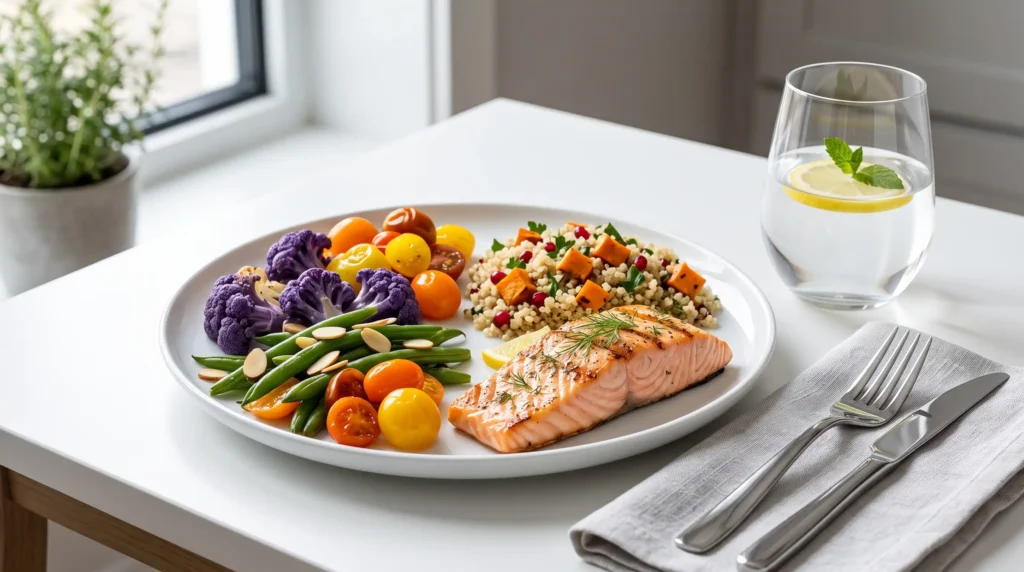
You don’t need a food scale to become more aware of portions.
One simple approach is to use your plate as a visual guide.
A practical plate method
Try making approximately:
- ½ plate: vegetables and other non-starchy vegetables
- ¼ plate: protein
- ¼ plate: grains, potatoes, rice, or another carbohydrate source
This isn’t a strict prescription for every person. Your needs can vary depending on your body, activity level, health, and goals.
The important idea is to avoid letting calorie-dense foods automatically dominate the meal.
NIDDK also recommends paying attention to portion sizes and being aware of what and how much you consume.
4. Drink Fewer Liquid Calories
Drinks can contribute calories without making you feel as satisfied as a solid meal.
Common examples include:
- Soda
- Sweetened coffee drinks
- Energy drinks
- Sweetened tea
- Fruit drinks
- Large amounts of juice
You don’t necessarily have to eliminate them completely.
A simple first step is replacing some sugary drinks with:
- Water
- Sparkling water
- Unsweetened tea
- Coffee without large amounts of added sugar
This can be one of the easiest ways to improve your diet without tracking calories.
5. Eat Slowly and Pay Attention to Your Meals
Eating quickly can make it easier to consume more food before you recognize that you’re satisfied.
Try making meals more intentional.
Put your phone away, sit at a table, and take your time eating.
NIDDK specifically recommends eating at a table and reducing distractions such as television and other devices to help avoid mindless eating.
You can also ask yourself:
“Am I still hungry, or am I simply continuing because the food is there?”
This small pause can help you become more aware of your eating habits.
6. Make Highly Processed Snacks Less Convenient
You don’t need to completely ban cookies, chips, chocolate, or other favorite foods.
Instead, make healthier choices easier to reach.
For example:
Keep available:
- Fruit
- Greek yogurt
- Nuts in reasonable portions
- Vegetables
- Eggs
- Hummus
- Whole-grain foods
And avoid keeping large quantities of highly tempting snacks immediately available.
NIDDK recommends having healthier snacks available and limiting foods that are high in added sugar, solid fats, and calories.
Your environment can influence your decisions more than motivation alone.
7. Increase Your Daily Movement

Exercise isn’t the only factor in weight loss.
Your total daily movement also matters.
Consider simple activities such as:
- Walking after meals
- Taking the stairs
- Walking while talking on the phone
- Doing household chores
- Gardening
- Going for short walks during work breaks
The CDC recommends at least 150 minutes of moderate-intensity aerobic activity per week for adults, along with muscle-strengthening activities on at least two days per week.
You don’t need to start with an extreme workout routine.
If you’re currently inactive, start small and gradually increase your activity.
8. Prioritize Sleep
Weight management isn’t only about food.
Sleep is another important part of a healthy lifestyle. The CDC identifies adequate sleep and stress management as components of healthy weight management.
Poor sleep can also make healthy routines more difficult to maintain.
Try to create a consistent sleep schedule and reduce habits that interfere with your sleep.
For example:
- Keep a regular bedtime
- Reduce late-night screen use
- Avoid very large meals immediately before bed
- Create a dark, comfortable sleeping environment
Better sleep won’t magically cause fat loss, but it can support the lifestyle habits that make weight management easier.
9. Monitor Your Progress Without Tracking Every Calorie
Not counting calories doesn’t mean ignoring your progress.
You can monitor:
- Body weight
- Waist measurement
- Clothing fit
- Physical activity
- Hunger levels
- Energy levels
- Meal consistency
You don’t need to weigh yourself multiple times every day.
A consistent method is more useful than constantly checking for immediate changes.
Remember that body weight naturally fluctuates because of factors such as water, food volume, sodium intake, and other short-term changes.
That’s why one day’s measurement doesn’t necessarily tell you whether your strategy is working.
10. Focus on Habits You Can Maintain
The biggest mistake many people make is trying to change everything at once.
A very restrictive diet may produce quick changes, but if you cannot maintain it, the results may not last.
Instead, choose two or three habits first.
For example:
Week 1
- Drink mostly water
- Add vegetables to dinner
Week 2
- Add a protein source to breakfast
- Walk for 20 minutes several days per week
Week 3
- Reduce restaurant portions
- Improve your sleep schedule
This approach can be much easier to maintain than completely changing your diet overnight.
The CDC notes that gradual, steady weight loss is more likely to be maintained than very rapid weight loss.
What Should You Eat to Lose Weight Without Counting Calories?
You don’t need a special “weight-loss food.”
Instead, build most meals around minimally processed, nutrient-dense foods.
Protein
Examples:
- Eggs
- Chicken
- Fish
- Lean meat
- Greek yogurt
- Beans
- Lentils
- Tofu
Vegetables
Examples:
- Broccoli
- Spinach
- Carrots
- Peppers
- Tomatoes
- Cauliflower
- Green beans
Fruits
Examples:
- Apples
- Berries
- Oranges
- Bananas
- Pears
High-fiber carbohydrates
Examples:
- Oats
- Brown rice
- Potatoes
- Whole-grain bread
- Beans
- Lentils
Healthy fats
Examples:
- Nuts
- Seeds
- Avocado
- Olive oil
NIDDK recommends a varied eating pattern containing nutrient-rich foods such as vegetables, fruits, whole grains, lean protein sources, beans, nuts, and seeds.
What If You’re Not Losing Weight?
If you’ve been following healthier habits consistently but your weight isn’t changing, it may be useful to look more closely at your overall energy intake.
This doesn’t mean you have to start counting calories permanently.
You could temporarily use the Calorie Calculator and TDEE Calculator to understand approximately how much energy your body may need.
Your calorie needs depend on factors including age, sex, body size, metabolism, and activity level.
You can also use FitCalculatorAI’s Calorie Deficit Calculator to understand how a moderate calorie deficit may fit into your weight-loss goal.
These calculators provide estimates, not medical diagnoses or guarantees.
Why Counting Calories Isn’t Necessary for Everyone
Calorie tracking can be useful, but it isn’t the only way to manage weight.
Some people enjoy tracking because it provides structure and awareness.
Others find it stressful, time-consuming, or difficult to maintain.
If counting every calorie makes healthy eating feel overwhelming, focusing on food quality, portions, hunger, activity, and consistent habits may be a more practical approach.
The best strategy is often the one you can follow consistently.
A Simple Day of Eating Without Counting Calories
Here’s an example of what this approach could look like.
Breakfast
Eggs + whole-grain toast + fruit
Lunch
Grilled chicken + large vegetable salad + potatoes or rice
Snack
Greek yogurt + fruit
Dinner
Fish or beans + vegetables + moderate portion of whole grains
Drinks
Mostly water, unsweetened tea, or coffee
This isn’t a prescribed diet. Portions and food choices should be adapted to your individual needs, preferences, activity level, and health situation.
The Bottom Line
You can lose weight without counting calories.
You still need an overall energy balance that supports weight loss, but you don’t necessarily need to track every calorie to achieve it.
Start by improving the habits that have the biggest impact:
- Eat more protein-rich foods.
- Increase vegetables and fiber.
- Pay attention to portions.
- Reduce sugary drinks.
- Eat more slowly.
- Make healthier snacks easier to access.
- Move more throughout the day.
- Prioritize sleep.
- Monitor your progress.
- Choose sustainable habits rather than extreme diets.
Healthy weight management is usually more successful when the strategy fits your lifestyle rather than forcing you to follow rules you cannot maintain.
Frequently Asked Questions
Can I lose weight without counting calories?
Yes. You can focus on portion control, nutritious foods, protein, fiber, physical activity, sleep, and sustainable eating habits. However, calorie balance still influences whether body weight decreases over time.
Do I need to stop eating carbohydrates to lose weight?
No. Carbohydrates can be part of a healthy eating pattern. Choosing nutrient-rich carbohydrate sources such as whole grains, potatoes, fruits, beans, and vegetables can be more useful than eliminating carbohydrates completely.
Is portion control more important than food quality?
Both matter. Food quality affects nutrition and fullness, while portion size affects how much energy you consume. Combining nutritious foods with reasonable portions is a practical approach.
How much exercise should I do for weight loss?
For general health, adults should aim for at least 150 minutes of moderate-intensity aerobic activity per week and muscle-strengthening activities on at least two days per week. Individual weight-loss needs can vary.
How fast should I lose weight?
A gradual approach is generally recommended. The CDC notes that people who lose weight at a steady rate of about 1–2 pounds per week are more likely to maintain the loss than those who lose weight faster.
What if healthy eating isn’t helping me lose weight?
Review your portions, drinks, snacks, activity level, sleep, and overall consistency. If you’ve made sustained changes without seeing progress, consider discussing your situation with a healthcare professional, particularly if medications or medical conditions may affect your weight.
FitCalculatorAI Tools You Can Use
While you don’t need to count calories forever, calculators can help you understand your starting point.
- Calorie Calculator — estimate daily calorie needs.
- TDEE Calculator — estimate total daily energy expenditure.
- Calorie Deficit Calculator — explore a potential calorie deficit.
- Protein Calculator — estimate protein needs based on your profile.
- BMI Calculator — understand BMI based on height and weight.
Ready to understand your numbers? Use FitCalculatorAI’s health and fitness calculators to build a more personalized starting point.
Medical Disclaimer
This article is for educational purposes only and does not provide medical advice. Individual nutrition and weight-loss needs vary. If you have a medical condition, take medications that affect weight, are pregnant, have a history of an eating disorder, or are unsure whether weight loss is appropriate for you, speak with a qualified healthcare professional.