
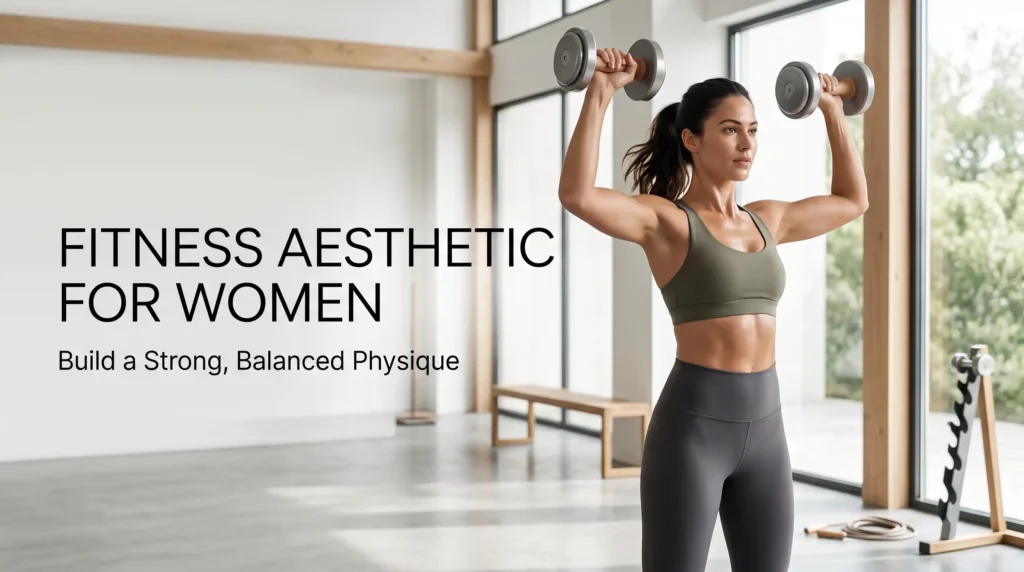
A fitness aesthetic for women is not about chasing one specific body shape or trying to look like someone else. A well-developed physique usually comes from combining strength training, balanced nutrition, recovery, and consistency over time.
For many women, an aesthetic fitness goal means developing stronger legs and glutes, maintaining a defined upper body, improving posture, and gradually building a balanced physique while keeping health and performance in focus.
The good news is that you do not need an extreme workout routine or restrictive diet to make progress. A simple training plan, enough protein, appropriate calorie intake, and consistent recovery can create noticeable changes over time.
In this guide, you’ll learn how to approach a female fitness aesthetic, how to structure your workouts, how much protein and calories you may need, and which measurements and calculators can help you track your progress.
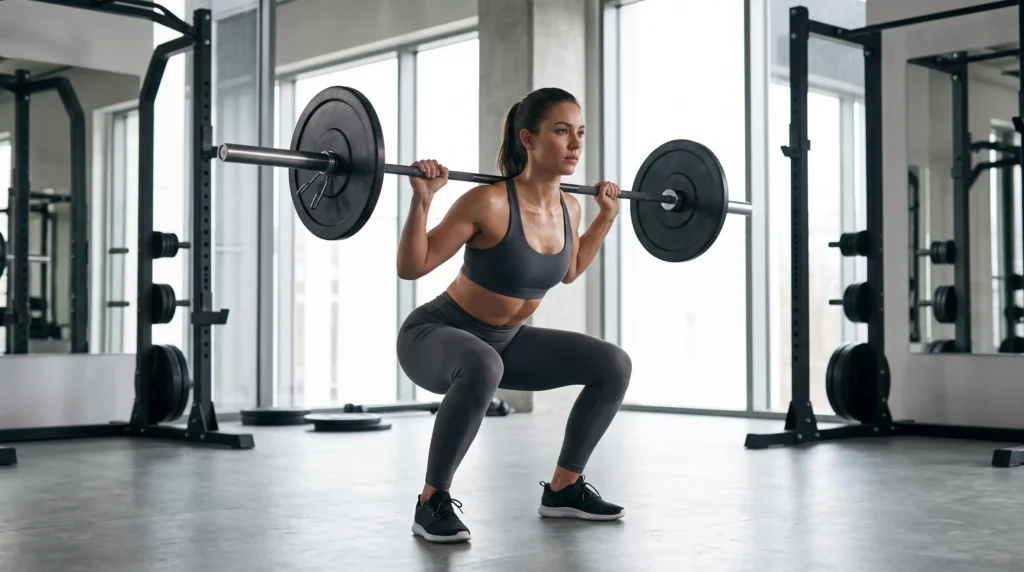
Table of Contents
What Does Fitness Aesthetic Mean for Women?
A fitness aesthetic generally refers to developing a physique that looks athletic, balanced, and proportionate.
For women, common aesthetic goals may include:
- Building stronger glutes and legs
- Developing the shoulders and upper back
- Creating better muscle definition
- Maintaining a healthy level of body fat
- Improving posture
- Building overall strength
- Creating better body proportions
- Feeling stronger and more confident
However, there is no single definition of an aesthetic female body.
Genetics, bone structure, muscle insertions, height, body-fat distribution, and training history all influence how a person’s physique develops.
That’s why comparing your body directly with fitness influencers or edited social-media photos can create unrealistic expectations.
Instead, focus on measurable improvements such as strength, muscle development, fitness performance, body composition, and consistency.
The Main Principles of an Aesthetic Workout for Women
A good aesthetic workout for women does not need to be complicated.
The most important principle is progressive resistance training.
Your muscles need a reason to adapt. Over time, this can mean gradually increasing the weight, repetitions, sets, training quality, or difficulty of an exercise.
A balanced program can include four main movement categories:
1. Lower-Body Training
Lower-body exercises are often important for women who want to develop their legs and glutes.
Useful exercises include:
- Squats
- Romanian deadlifts
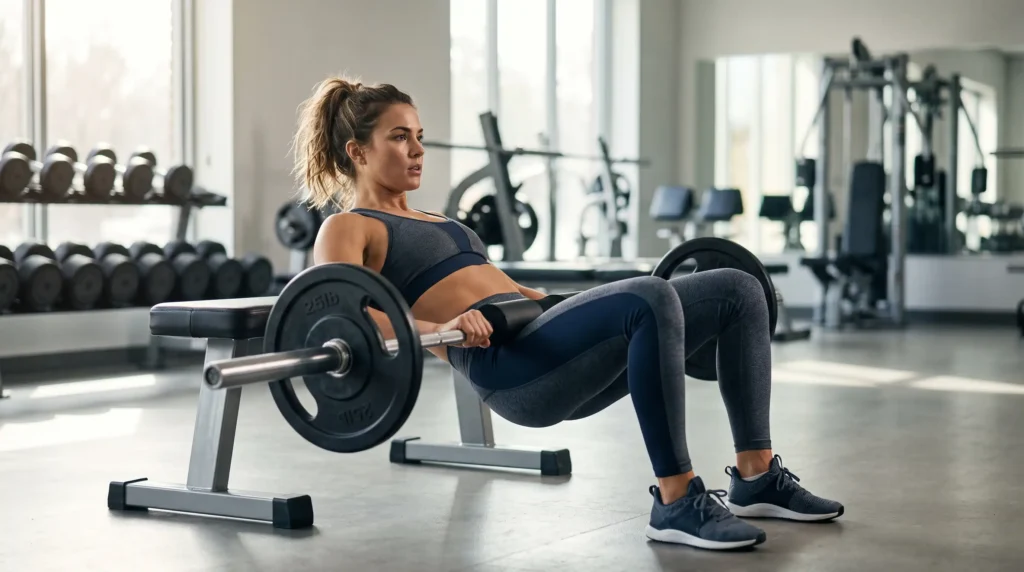
- Hip thrusts
- Bulgarian split squats
- Lunges
- Leg presses
- Leg curls
- Calf raises
You do not need to perform all of them in every workout.
Instead, choose a few movements that cover the major muscles and perform them consistently.
2. Glute Training
The glutes are one of the largest muscle groups in the body and can respond well to progressive resistance training.
Exercises such as hip thrusts, Romanian deadlifts, split squats, step-ups, and squats can all contribute to glute development.
The key is not simply doing more exercises.
Good technique, adequate training volume, sufficient recovery, and gradual progression matter more than constantly changing your routine.
3. Upper-Body Training
An aesthetic physique is not only about the lower body.
Training the shoulders, back, chest, and arms can help create a more balanced appearance.
Good options include:
- Lat pulldowns
- Seated rows
- Dumbbell rows
- Shoulder presses
- Lateral raises
- Push-ups
- Chest presses
- Biceps curls
- Triceps extensions
Building the upper body can also improve strength and posture.
4. Core Training
A strong core supports many other exercises.
Instead of doing hundreds of crunches, combine different types of core movements.
For example:
- Planks
- Side planks
- Dead bugs
- Hanging knee raises
- Cable crunches
- Pallof presses
Remember that visible abdominal definition depends on several factors, including muscle development and overall body-fat levels. Ab exercises alone cannot specifically remove abdominal fat.
How Many Days Should Women Train for an Aesthetic Physique?
You do not need to train every day.
For many beginners, three to four strength-training sessions per week can provide a practical starting point.
One possible structure is:
3-Day Example
Day 1 – Lower Body
- Squat
- Romanian deadlift
- Hip thrust
- Leg curl
- Calf raise
Day 2 – Upper Body
- Lat pulldown
- Dumbbell row
- Shoulder press
- Lateral raise
- Biceps curl
- Triceps extension
Day 3 – Full Body
- Leg press
- Hip thrust
- Chest press
- Seated row
- Lateral raise
- Core exercise
Another option is a four-day upper/lower split.
Monday: Lower body
Tuesday: Upper body
Wednesday: Rest
Thursday: Lower body
Friday: Upper body
Weekend: Rest or light activity
The best routine is one that you can consistently follow.
How Nutrition Supports a Female Fitness Aesthetic
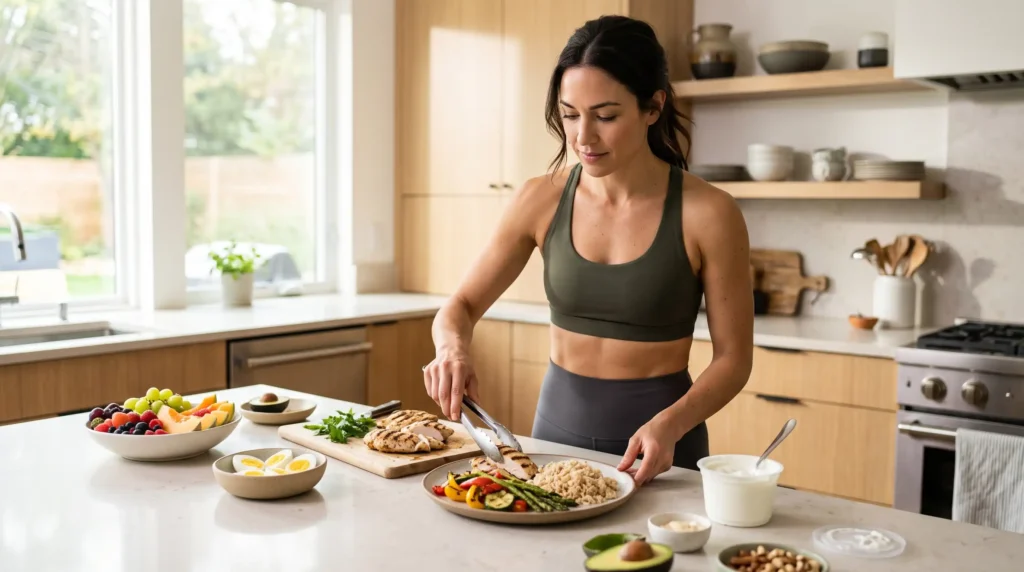
Training provides the stimulus, but nutrition provides many of the resources your body needs to recover and adapt.
Your calorie intake should match your specific goal.
If you want to lose body fat, you generally need a calorie deficit.
If your priority is building muscle and you are already relatively lean, a small calorie surplus may be appropriate.
If you want to maintain your current weight while improving your physique, eating around maintenance calories while progressively training can be another approach.
You can estimate your daily calorie needs with the Calorie Calculator and then use the TDEE Calculator to understand your estimated daily energy expenditure.
These are estimates rather than exact measurements, so your real-world weight and performance trends are useful when adjusting your intake.
How Much Protein Do Women Need for Muscle Growth?
Protein is especially important when your goal involves maintaining or building muscle.
Good protein sources include:
- Eggs
- Chicken
- Turkey
- Lean beef
- Fish
- Greek yogurt
- Cottage cheese
- Milk
- Beans
- Lentils
- Tofu
- Other protein-rich foods
Instead of focusing on one meal, try to distribute protein across your meals throughout the day.
Your total daily protein intake matters more than trying to find a single “perfect” protein source.
You can use the Protein Calculator to get a personalized starting estimate based on your body and fitness goal.
If you are also tracking carbohydrates and fats, the Macro Calculator can help you create a broader nutrition target.
Should Women Eat More to Build an Aesthetic Physique?
Sometimes, yes.
One common mistake is trying to build significant muscle while continuously eating too little.
Muscle growth requires training, protein, recovery, and sufficient energy availability.
If someone is already relatively lean and wants to build more muscle, maintaining calories or using a modest calorie surplus may be more appropriate than continually reducing food intake.
On the other hand, someone with a higher body-fat level may prefer a gradual fat-loss phase while maintaining resistance training and adequate protein.
There is no single approach that works for every woman.
Your goal, current body composition, training experience, and preferences all matter.
Body Recomposition for Women
Body recomposition means improving your ratio of muscle to fat rather than focusing only on scale weight.
For example, your body weight could remain relatively stable while:
- Muscle mass increases
- Body fat gradually decreases
- Strength improves
- Measurements change
- Your physique looks more athletic
This is one reason the scale should not be your only progress measurement.
You can also track:
- Waist measurement
- Hip measurement
- Thigh measurement
- Progress photos
- Strength levels
- Workout performance
- Body weight trends
For another basic measurement, you can check your BMI Calculator.
BMI is only one general screening measurement and does not distinguish muscle from fat, so it should not be treated as a complete description of your physique.
What About Body Fat Percentage?
Body-fat percentage can provide additional context when you’re tracking body composition.
However, different measurement methods can produce different results.
Home scales, skinfold measurements, tape measurements, and professional testing methods all have limitations.
Instead of obsessing over a single number, look for trends over time.
If you want an estimate, the Body Fat Calculator can provide a useful starting point.
The important thing is to avoid treating a particular body-fat percentage as a universal target for every woman.
Health, menstrual function, energy levels, performance, genetics, and individual circumstances all matter.
How to Create a More Defined Look
A “toned” appearance generally comes from having some muscle development combined with a level of body fat that allows muscle shape to be visible.
You cannot directly target fat loss from one body part.
For example, doing hundreds of abdominal exercises does not specifically burn abdominal fat.
Instead, focus on the fundamentals:
Resistance training + appropriate calorie intake + sufficient protein + recovery + consistency
Over time, these factors can change body composition.
This approach is generally more sustainable than repeatedly switching between extreme diets and intense workout programs.
Cardio and the Female Fitness Aesthetic
Cardio does not have to interfere with your aesthetic goals.
Walking, cycling, jogging, swimming, and other forms of cardiovascular activity can support general fitness and help you maintain an active lifestyle.
The amount you need depends on your goals and training schedule.
If you enjoy running, the Running Pace Calculator can help you understand your pace and race-time targets.
For people who want to monitor training intensity, a Heart Rate Zone Calculator can also be useful.
You don’t need to turn every cardio session into an exhausting workout.
Regular walking and moderate cardio can complement a strength-focused program.
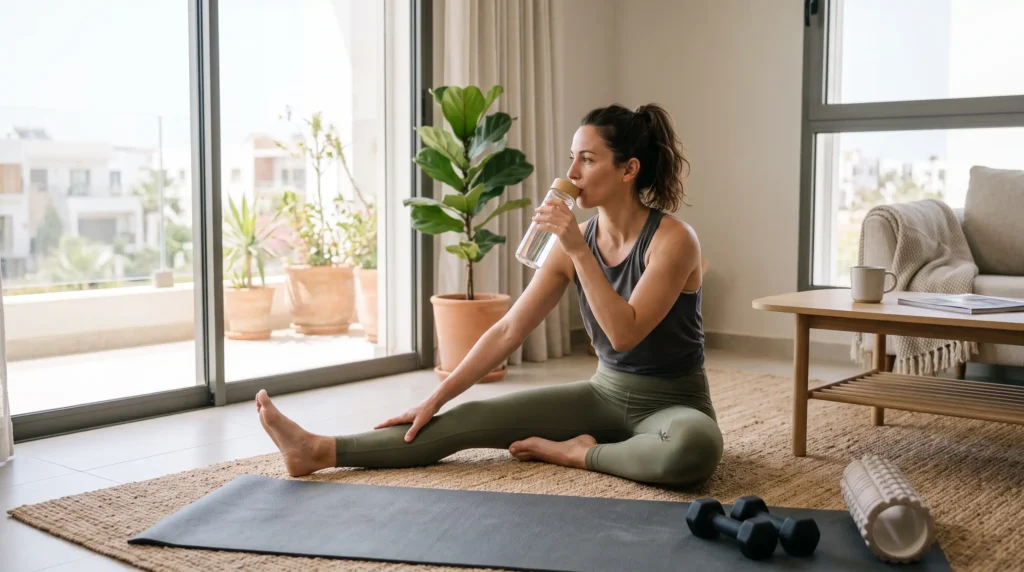
Recovery Is Part of the Program
Training is only one part of building a strong physique.
Recovery matters too.
Your body needs time to repair and adapt after training.
Important recovery habits include:
- Getting enough sleep
- Eating enough food
- Consuming sufficient protein
- Taking rest days
- Managing training volume
- Staying hydrated
- Avoiding constant high-intensity training
If you consistently feel exhausted, your workouts become weaker, or your motivation drops for extended periods, your training and recovery balance may need adjustment.
Progress does not require destroying yourself in the gym.
Hydration and Fitness Performance
Hydration is another simple part of your fitness routine.
Fluid requirements can vary depending on body size, climate, activity level, sweating, diet, and other factors.
Rather than forcing a fixed amount of water on everyone, use your daily activity and environment as context.
The Water Intake Calculator can provide a starting estimate.
During longer or particularly sweaty training sessions, hydration and electrolyte needs may also change.
Supplements: Do You Need Them?
Supplements are optional.
They should complement a good diet and training program rather than replace them.
Some people use supplements such as:
- Creatine
- Protein powder
- Caffeine
- Vitamin D
- Magnesium
- Electrolytes
Creatine is particularly popular among people interested in strength and muscle performance.
If you are considering creatine and want to understand typical intake calculations, you can use the Creatine Calculator.
However, supplements should be considered in the context of your individual diet, goals, and health situation.
A Simple Weekly Fitness Aesthetic Plan for Women
Here is a practical example for someone who wants to focus on strength and balanced physique development.
Monday — Lower Body
- Squats: 3 sets
- Romanian deadlifts: 3 sets
- Hip thrusts: 3 sets
- Leg curls: 2–3 sets
- Calf raises: 2–3 sets
Tuesday — Upper Body
- Lat pulldown: 3 sets
- Seated row: 3 sets
- Dumbbell shoulder press: 3 sets
- Lateral raises: 3 sets
- Biceps curls: 2 sets
- Triceps extensions: 2 sets
Wednesday — Recovery
Walking, mobility work, or complete rest.
Thursday — Lower Body
- Leg press: 3 sets
- Bulgarian split squat: 3 sets
- Hip thrust: 3 sets
- Leg extension: 2–3 sets
- Leg curl: 2–3 sets
Friday — Upper Body + Core
- Dumbbell row: 3 sets
- Chest press: 3 sets
- Lat pulldown: 3 sets
- Lateral raises: 3 sets
- Core exercise: 3 sets
Weekend
Rest, walking, recreational activity, or another form of enjoyable movement.
This is only an example. Training volume and exercise selection should be adjusted according to experience, equipment, recovery, and individual goals.
How Long Does It Take to See Results?
There is no universal timeline.
Beginners may notice improvements in strength relatively quickly because the body is adapting to a new training stimulus.
Visible changes in muscle size and body composition generally take longer and require consistent training and nutrition.
Instead of expecting a dramatic transformation within a few weeks, use several indicators:
Are you getting stronger?
Are your exercises becoming easier with the same weight?
Are your measurements changing?
Are your clothes fitting differently?
Are your progress photos changing?
Are you consistently following your routine?
These indicators can tell you much more than judging your physique from day to day.
Frequently Asked Questions
What is a fitness aesthetic for women?
A fitness aesthetic for women generally refers to developing a balanced, athletic physique through strength training, nutrition, recovery, and consistent physical activity.
How many days a week should a woman work out?
Many beginners can start with three strength-training sessions per week. More experienced individuals may use four or more sessions depending on their goals and recovery.
Can women build muscle without getting bulky?
Yes. Muscle development happens progressively, and the amount of muscle a woman gains depends on training, nutrition, genetics, hormones, and time. Building a large amount of muscle generally requires substantial long-term training and nutrition.
What should women eat for an aesthetic physique?
A balanced diet can include sufficient protein, carbohydrates, healthy fats, fruits, vegetables, and adequate overall calories. Individual calorie and nutrient needs vary.
How long does it take to build an aesthetic physique?
Results vary considerably. Strength improvements can occur relatively quickly, while visible changes in muscle and body composition generally require consistent training and nutrition over a longer period.
Final Thoughts: Build Your Own Fitness Aesthetic
A sustainable fitness aesthetic for women is built through consistency rather than perfection.
Focus on progressive strength training, adequate protein, appropriate calories, regular movement, hydration, and recovery.
Don’t let social media define what your body “should” look like. Your genetics and starting point are different from everyone else’s.
Instead, create measurable goals that belong to you.
Build stronger legs. Improve your squat. Develop your back and shoulders. Increase your fitness. Improve your nutrition. Sleep better. Become stronger.
Your aesthetic results are often a byproduct of these habits.
And if you want to make your fitness plan more measurable, FitCalculatorAI provides calculators for calories, TDEE, macros, protein, body fat, BMI, hydration, heart-rate zones, running pace, and other fitness metrics.
Want to Make Your Fitness Goals More Measurable?
Explore FitCalculatorAI’s free fitness calculators for calories, protein, macros, body composition, hydration, heart rate, and more.
Explore All Calculators →