
Knowing how many calories your body needs each day can make planning your nutrition much easier. Whether your goal is to lose weight, maintain your current weight, or build muscle, understanding your daily calorie needs gives you a useful starting point.
Your Total Daily Energy Expenditure (TDEE) represents the approximate number of calories your body uses during a typical day. A TDEE Calculator estimates this number using information such as your age, sex, height, weight, and activity level.
In this guide, you’ll learn what TDEE means, how it is calculated, the difference between TDEE and BMR, how to choose the correct activity level, and how to use your result for weight loss, maintenance, or muscle gain.
Use the TDEE Calculator to estimate your daily calorie expenditure.
What Is TDEE?
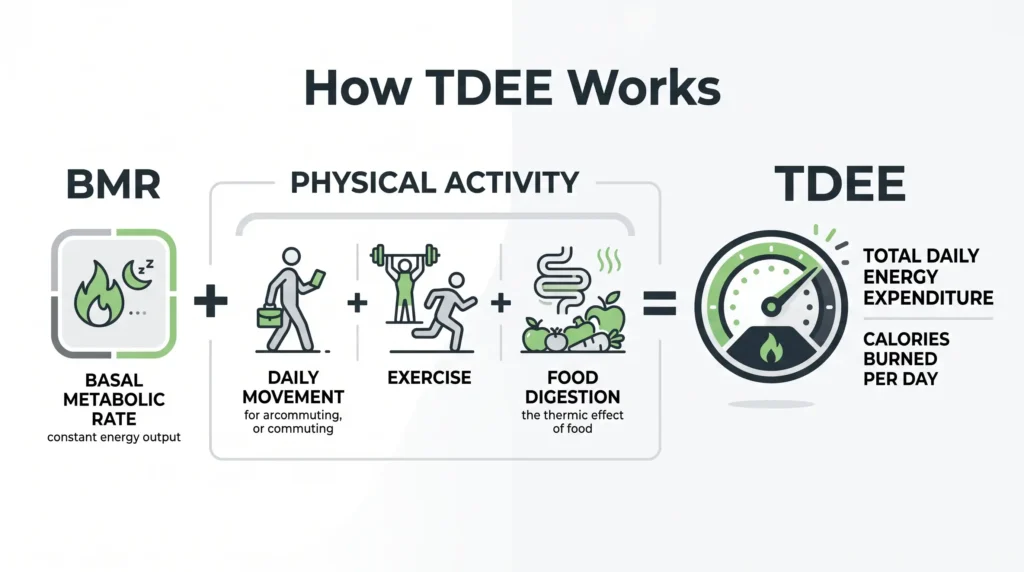
TDEE stands for Total Daily Energy Expenditure. It is an estimate of the total amount of energy your body uses over a 24-hour period. In simple terms, your TDEE represents approximately how many calories you burn during a normal day.
Your daily calorie expenditure is not limited to exercise. Your body uses energy to keep your heart beating, maintain body temperature, breathe, digest food, move around, work, walk, exercise, and perform countless other activities throughout the day.
This is why your TDEE is generally higher than your BMR (Basal Metabolic Rate) . BMR represents the energy your body needs at rest, while TDEE accounts for your estimated total daily energy expenditure.
Understanding TDEE is particularly useful because it provides a reference point for setting calorie targets. If your calorie intake is close to your TDEE over time, your body weight may remain relatively stable. Eating below your estimated TDEE can create a calorie deficit, while eating above it can create a calorie surplus.
Why Is TDEE Important?
Calories are one of the most important factors to consider when managing body weight. However, the number of calories you need is different for everyone.
Two people can have completely different calorie requirements even if they are the same age or similar in height. Differences in body weight, body composition, activity, exercise, and lifestyle can all affect estimated energy expenditure.
This is where a TDEE Calculator can be useful. Instead of choosing an arbitrary calorie target, you can start with an estimate based on your personal information.
Your TDEE can then become the starting point for different goals:
- Weight maintenance: Eat around your estimated TDEE.
- Weight loss: Create a reasonable calorie deficit.
- Muscle gain: Consume a controlled calorie surplus.
- Body recomposition: Combine appropriate calories with resistance training and sufficient protein.
The calculator does not determine the perfect calorie intake for you. It provides an estimate that can be tested and adjusted according to your real-world progress.
How Does a TDEE Calculator Work?
A typical TDEE calculation starts by estimating your Basal Metabolic Rate. Your BMR is then adjusted according to your activity level to estimate your total daily energy expenditure.
A simplified version of the calculation is:
The first part of the calculation estimates how much energy your body requires at rest. The second part accounts for the additional energy associated with your normal activity.
Many modern calculators use the Mifflin-St Jeor equation to estimate BMR and then apply an activity multiplier. The exact method can vary between calculators, especially when additional information such as body fat percentage is available.
For this reason, you should think of a TDEE result as an estimate rather than an exact measurement.
What Is BMR and How Is It Different From TDEE?
BMR stands for Basal Metabolic Rate. It describes the amount of energy your body requires to support basic physiological functions while at rest.
These functions include processes such as breathing, circulation, and maintaining basic body functions.
TDEE goes beyond BMR by estimating the calories associated with your overall daily activity.
Resting Energy
Estimates the calories your body needs to support essential functions at rest.
Total Daily Energy
Estimates the calories your body uses throughout a normal day, including activity.
If you want to calculate your resting metabolic rate separately, visit the BMR Calculator for a dedicated estimate.
Understanding TDEE Activity Levels
Your activity level can have a significant effect on your estimated TDEE. Choosing an activity level that accurately reflects your usual lifestyle is therefore important.
When selecting an activity level, consider your overall movement during the week rather than focusing only on your gym sessions.
Sedentary
A sedentary lifestyle generally means spending most of the day sitting and doing little structured exercise. This may apply to people with desk-based work and limited daily movement.
Lightly Active
Lightly active usually describes people who perform some regular exercise or walking but do not have a highly active lifestyle.
Moderately Active
Moderately active generally describes people who exercise regularly during the week and have a reasonably active daily routine.
Very Active
Very active individuals typically perform frequent or intense exercise, participate in demanding sports, or have a physically active lifestyle.
Extremely Active
Extremely active generally refers to very high levels of physical activity, such as demanding physical work combined with frequent intense training.
Do not automatically select a high activity level simply because you exercise. Consider your complete daily routine, including work, walking, household activities, exercise, and other movement.
How to Use TDEE for Weight Loss
If your goal is to lose weight, your estimated TDEE can be used as the starting point for creating a calorie deficit.
A calorie deficit means consuming fewer calories than your body uses over time. When a deficit is maintained consistently, it can support a reduction in body weight.
For example, if your estimated TDEE is 2,400 calories per day, eating somewhat below that level would create a calorie deficit.
There is no universal calorie deficit that works perfectly for everyone. Your starting target should take into account your body size, current weight, activity level, goals, and ability to maintain the plan.
You can use our Calorie Deficit Calculator to explore a calorie target based on your weight-loss goal.
Your calorie target should also be realistic enough to maintain over time. Extremely aggressive dieting may make it harder to maintain energy, training performance, and adherence.
How to Use TDEE for Weight Maintenance
If your goal is to maintain your current weight, your estimated TDEE can serve as a starting point for your daily calorie intake.
Maintenance calories are not necessarily a single perfect number. Your energy expenditure can change depending on your daily movement, exercise, body weight, and lifestyle.
This means your actual maintenance intake may be somewhat different from the number provided by a calculator.
One practical approach is to use your calculated TDEE for several weeks while monitoring your weight trend. If your average weight remains relatively stable, your calorie intake may be close to your actual maintenance level.
If your weight consistently changes in one direction, you can adjust your calorie intake accordingly.
How to Use TDEE for Muscle Gain
TDEE can also be useful when your goal is to gain muscle or increase body weight.
Instead of eating at maintenance, you can use your estimated TDEE as a baseline and add a controlled amount of calories.
Combining an appropriate calorie intake with resistance training and sufficient protein can provide a better foundation for muscle growth than simply eating as many calories as possible.
Protein is particularly important when planning a muscle-building diet. Use our Protein Calculator to estimate your daily protein needs.
You can also use the Macro Calculator to explore a daily distribution of protein, carbohydrates, and fats.
Does Body Composition Affect TDEE?
Body composition can influence energy expenditure. Muscle tissue and body fat contribute differently to your overall metabolism, which is one reason why two people with the same height, weight, age, and activity level may still have different actual calorie requirements.
Standard TDEE calculators generally rely on population-based equations and activity estimates. These formulas are useful for creating a starting estimate, but they cannot capture every individual difference.
If you are interested in understanding your body composition, you can also use the Body Fat Calculator to estimate your body fat percentage.
Remember that body fat estimates from online calculators are also approximations and should not be treated as laboratory measurements.
How Many Calories Do You Need Per Day?
There is no single calorie number that is appropriate for everyone. Daily calorie needs vary according to factors such as age, sex, height, weight, activity, and individual differences in energy expenditure.
A TDEE Calculator can help estimate your personal daily calorie needs instead of relying on a general calorie recommendation.
Your estimated TDEE is especially useful when combined with your specific goal. For example, someone trying to maintain their weight may use TDEE as a maintenance target, while someone trying to lose weight may start below TDEE.
If you want another way to estimate your daily calorie requirements, you can also explore our Calorie Calculator .
TDEE Calculation Example
Imagine a person whose estimated BMR is approximately 1,600 calories per day.
If an activity factor of 1.55 is used, the estimated TDEE would be:
This means the person’s estimated TDEE would be around 2,480 calories per day.
This number is an estimate, not a guarantee that the person’s body burns exactly 2,480 calories every day. Real-world energy expenditure can vary, which is why monitoring progress over time is important.
How Accurate Is a TDEE Calculator?
A TDEE Calculator can provide a useful estimate, but it cannot directly measure how many calories your body burns.
Your actual daily energy expenditure can change from day to day. Exercise, walking, work activity, sleep, body weight, diet, and changes in your lifestyle can all influence your calorie needs.
Therefore, the best way to use a TDEE result is to treat it as a starting point.
Track Your Progress
After choosing a calorie target based on your estimated TDEE, monitor your body weight and overall progress over several weeks.
Look at trends rather than reacting to a single day’s measurement. Body weight naturally fluctuates because of water, food volume, sodium, glycogen, and other factors.
Adjust When Necessary
If your results are consistently different from what you expected, your actual maintenance calories may differ from the calculator’s estimate. You can then make small adjustments to your calorie intake.
Use the calculator to establish a starting estimate, then use your real-world weight and progress trends to refine your calorie target.
Common TDEE Calculator Mistakes
Choosing the Wrong Activity Level
One of the most common mistakes is selecting an activity level that is too high. Going to the gym a few times per week does not necessarily mean you have a highly active lifestyle if you spend most of the rest of the day sitting.
Thinking TDEE Is an Exact Number
Your TDEE result is an estimate. Treating it as an exact measurement can lead to unnecessary frustration when your actual weight trend does not perfectly match the prediction.
Ignoring Changes in Body Weight
Your calorie needs can change as your body weight changes. A person who loses a significant amount of weight may eventually need fewer calories than they did at the beginning of their weight-loss journey.
Changing Calories Too Quickly
Making large calorie changes based on a few days of scale fluctuations can be misleading. It is usually more useful to look at longer-term trends before making adjustments.
TDEE and Macronutrients
TDEE tells you approximately how much energy you use, while macronutrients describe where those calories come from.
The three main macronutrients are:
- Protein – important for maintaining and building body tissues.
- Carbohydrates – an important source of energy for many forms of activity.
- Fat – an essential nutrient involved in many important body functions.
Once you have a calorie target, determining an appropriate macro distribution can make your nutrition plan more structured.
Use the Macro Calculator to explore your estimated daily macronutrient targets.
TDEE, Weight Goals, and Ideal Weight
TDEE is useful for calorie planning, while your target body weight can provide another reference point when setting long-term goals.
If you are interested in exploring estimated weight ranges, visit the Ideal Weight Calculator .
Keep in mind that a healthy body weight is not determined by a single formula. Body composition, muscle mass, lifestyle, fitness level, and individual circumstances can all matter.
How to Use a TDEE Calculator Correctly
Getting the most useful result starts with entering accurate information. Follow these steps:
- Enter your age accurately.
- Select the appropriate sex option used by the calculator.
- Enter your current body weight.
- Enter your height accurately.
- Select the activity level that best represents your normal lifestyle.
- Calculate your estimated TDEE.
- Use the result as a starting point for your calorie target.
- Monitor your progress and adjust when necessary.
For the easiest way to get your personalized estimate, use the FitCalculatorAI TDEE Calculator .
Frequently Asked Questions About TDEE
What does TDEE stand for?
TDEE stands for Total Daily Energy Expenditure. It is an estimate of the total calories your body uses during a typical day.
Is TDEE the same as maintenance calories?
In practical nutrition planning, TDEE is commonly used as an estimate of maintenance calories. It represents the approximate energy required to maintain your current body weight when your activity and other factors remain relatively stable.
What is the difference between TDEE and BMR?
BMR estimates the calories your body needs at rest, while TDEE estimates your total daily calorie expenditure after accounting for your normal activity.
Can TDEE help me lose weight?
Yes. Your estimated TDEE can be used as a starting point for creating a calorie deficit. Consistently consuming fewer calories than you expend can support weight loss.
Can TDEE help me gain muscle?
Yes. TDEE can help you estimate your maintenance calories. From there, you can plan an appropriate calorie surplus while following a suitable resistance training program and eating enough protein.
How often should I recalculate my TDEE?
You do not necessarily need to recalculate it every day. Consider checking your estimate again after a meaningful change in body weight, activity level, or lifestyle.
Why does my actual calorie maintenance differ from my TDEE result?
TDEE calculators use equations and activity estimates based on population data. Individual energy expenditure can vary, so your actual maintenance calories may be different from the calculator’s estimate.
Is a TDEE Calculator accurate for everyone?
A TDEE Calculator can provide a useful starting estimate, but no calculator can perfectly predict the exact calories every person burns. Tracking your real-world progress can help you refine the estimate.
Should I eat below my TDEE to lose weight?
A calorie intake below your estimated TDEE creates a calorie deficit, which is commonly used for weight loss. The size of the deficit should be appropriate for your individual situation and goals.
Should I eat above my TDEE to gain weight?
Eating above your estimated TDEE creates a calorie surplus and can support weight gain. For muscle-focused goals, calorie intake should be combined with appropriate strength training and sufficient protein.
Calculate Your TDEE and Find Your Daily Calorie Needs
Your TDEE is a useful starting point for understanding your daily calorie needs. Whether you want to lose weight, maintain your current weight, or support muscle gain, knowing your estimated daily energy expenditure can help you make more informed nutrition decisions.
Enter your personal information and activity level to get your estimated daily calorie needs.
Calculate Your TDEE