
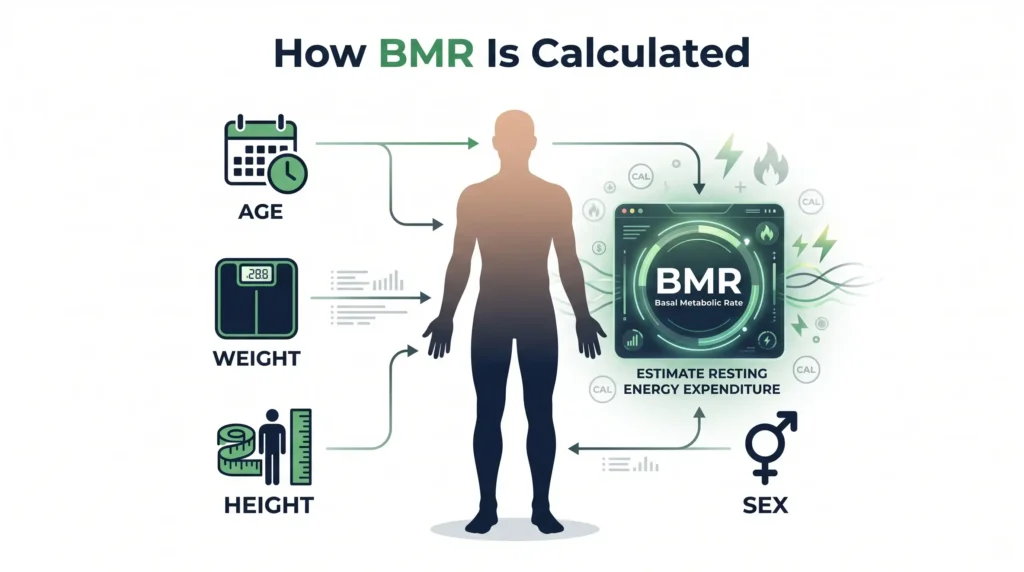
Understanding your Basal Metabolic Rate (BMR) can help you estimate how much energy your body needs at rest. A BMR calculation provides a useful starting point for estimating daily calorie needs, planning nutrition goals, and understanding how your metabolism contributes to total energy expenditure.
In this guide, you will learn what BMR means, how a BMR Calculator works, how the Mifflin-St Jeor equation estimates resting energy expenditure, how BMR differs from TDEE, and how you can use your result when planning weight loss, maintenance, or muscle gain.
What Is BMR?
BMR stands for Basal Metabolic Rate. It refers to the amount of energy your body needs to support essential functions while at rest. These functions include breathing, circulation, maintaining body temperature, and supporting normal organ activity.
Your body continues using energy even when you are not exercising. In other words, calorie expenditure does not stop when you sit, sleep, or relax. Your body needs energy to keep its basic systems functioning.
A BMR estimate can therefore provide a useful baseline when calculating your overall daily calorie requirements.
What Does a BMR Calculator Do?
A BMR Calculator estimates your resting energy needs using information such as age, sex, height, and body weight. The calculator then produces an estimated number of calories your body may require each day to support basic physiological functions.
Our BMR Calculator uses the Mifflin-St Jeor equation, a commonly used predictive equation for estimating resting energy expenditure.
The equation was developed from measurements of resting energy expenditure in healthy adults and uses body weight, height, age, and sex as its main variables. :contentReference[oaicite:1]{index=1}
How Is BMR Calculated?
One of the most commonly used equations for estimating BMR or resting metabolic rate is the Mifflin-St Jeor equation. The original research was published in 1990 in the American Journal of Clinical Nutrition. :contentReference[oaicite:2]{index=2}
Mifflin-St Jeor Formula for Men
Mifflin-St Jeor Formula for Women
The published equation uses kilograms for weight, centimeters for height, and age in years. :contentReference[oaicite:3]{index=3}
BMR Example
Suppose a 30-year-old man weighs 70 kg and is 175 cm tall. Using the Mifflin-St Jeor equation:
BMR = 700 + 1093.75 − 150 + 5
Estimated BMR ≈ 1,649 calories/day
This does not mean that the person should automatically eat 1,649 calories every day. BMR represents a resting baseline, while daily activities, walking, exercise, digestion, and other factors contribute to total energy expenditure.
BMR vs TDEE: What Is the Difference?
BMR and TDEE are related, but they are not the same measurement.
| Term | What It Represents |
|---|---|
| BMR | Estimated energy required to support basic functions while at rest. |
| TDEE | Estimated total daily energy expenditure including activity and movement. |
To estimate your total daily calorie needs, your BMR can be combined with an activity factor. This produces an estimate known as Total Daily Energy Expenditure (TDEE).
If you want to continue from your BMR result and estimate your maintenance calories, use the TDEE Calculator .
Why Is BMR Important?
BMR is useful because it gives you an estimate of the energy your body requires before accounting for most daily physical activity. It can therefore serve as one of the starting points for building a calorie target.
For example, someone trying to lose body fat may first estimate their total daily energy expenditure and then create a reasonable calorie deficit. Someone trying to gain muscle may instead use their estimated energy needs as a starting point for a calorie surplus.
However, BMR alone should not be treated as your recommended daily calorie intake.
What Factors Affect BMR?
BMR varies from person to person. Body size, age, body composition, and other physiological factors can influence resting energy expenditure.
Body Weight and Size
Larger bodies generally require more energy to maintain basic physiological functions. Weight is therefore included in the Mifflin-St Jeor equation.
Height
Height is another variable included in the equation. Two people with the same weight can have different estimated resting energy needs because their heights and other characteristics differ.
Age
Age is also included in the equation. The Mifflin-St Jeor formula subtracts a portion of the estimate as age increases.
Body Composition
Body composition can also influence energy expenditure. Fat-free mass is an important contributor to resting energy expenditure, although a standard BMR equation cannot perfectly capture every individual’s body composition.
This is one reason why a calculated BMR should be considered an estimate rather than an exact measurement. Research comparing predictive equations has found that the Mifflin-St Jeor equation performs well overall, but individual errors can still occur. :contentReference[oaicite:4]{index=4}
How to Use Your BMR for Weight Loss
BMR can be useful as the first step in understanding your calorie requirements, but weight-loss planning normally requires an estimate of your total daily energy expenditure rather than BMR alone.
Start by calculating your BMR, then account for your usual activity level to estimate your TDEE. From there, a moderate calorie deficit can be considered depending on your individual goals and circumstances.
You can also use our Calorie Calculator to explore estimated daily calorie needs and compare different calorie targets.
How to Use Your BMR for Muscle Gain
If your goal is to gain muscle or body weight, BMR can again serve as a starting point rather than a final calorie target.
After estimating your daily energy expenditure, you can build a nutrition plan around an appropriate calorie intake and sufficient protein. Resistance training, recovery, and consistent nutrition are also important parts of a muscle-building strategy.
For a more detailed nutrition breakdown, you can use our Macro Calculator to estimate protein, carbohydrates, and fat targets.
Can BMR Tell You How Fast Your Metabolism Is?
Not exactly. A BMR calculator provides an estimate based on population-derived equations. It does not directly measure your metabolism.
Your actual resting energy expenditure can be different from the calculator’s estimate. The Mifflin-St Jeor equation is useful, but predictive equations have unavoidable individual-level limitations. Direct measurement using indirect calorimetry can provide a more individualized measurement when clinically appropriate. :contentReference[oaicite:5]{index=5}
BMR and Body Fat Percentage
Body composition can provide additional context when interpreting metabolic estimates. Two people with the same weight may have different amounts of lean mass and body fat.
If you want to estimate your body composition, our Body Fat Calculator can provide an additional estimate that you can consider alongside your BMR.
Is a Higher BMR Better?
A higher BMR is not automatically better. BMR is influenced by several characteristics, including body size and composition. A larger person may naturally have a higher estimated resting energy expenditure than a smaller person.
Instead of trying to maximize a single BMR number, it is more useful to focus on sustainable nutrition, regular physical activity, adequate recovery, and goals that match your individual needs.
How Accurate Is a BMR Calculator?
A BMR calculator can provide a useful estimate, but it cannot guarantee an exact number of calories your body burns at rest.
Research evaluating predictive equations has found the Mifflin-St Jeor equation to be one of the more reliable commonly used equations for estimating resting metabolic rate, although meaningful individual differences can remain. :contentReference[oaicite:6]{index=6}
For this reason, use your calculated BMR as a starting point. Your real-world weight trends, energy levels, activity, and nutritional intake can provide additional information when adjusting your calorie targets over time.
Frequently Asked Questions About BMR
What does BMR stand for?
BMR stands for Basal Metabolic Rate. It is an estimate of the energy your body requires to support essential functions while at rest.
What is a normal BMR?
There is no single normal BMR number for everyone. BMR depends on factors such as age, sex, height, body weight, and body composition. A calculator should therefore be interpreted based on your individual characteristics.
Is BMR the same as maintenance calories?
No. BMR represents resting energy needs, while maintenance calories generally refer to the amount of energy needed to maintain body weight after accounting for daily activity and movement.
What formula does the BMR Calculator use?
The calculator uses the Mifflin-St Jeor equation, which estimates resting energy expenditure using weight, height, age, and sex. :contentReference[oaicite:7]{index=7}
Should I eat my BMR calories?
BMR is not intended to be used automatically as your daily calorie target. Your total calorie needs also depend on physical activity and other components of daily energy expenditure.
Can BMR change over time?
Yes. Changes in body weight, body composition, age, and other physiological factors can affect resting energy expenditure. This means your estimated BMR can change as your body and lifestyle change.