
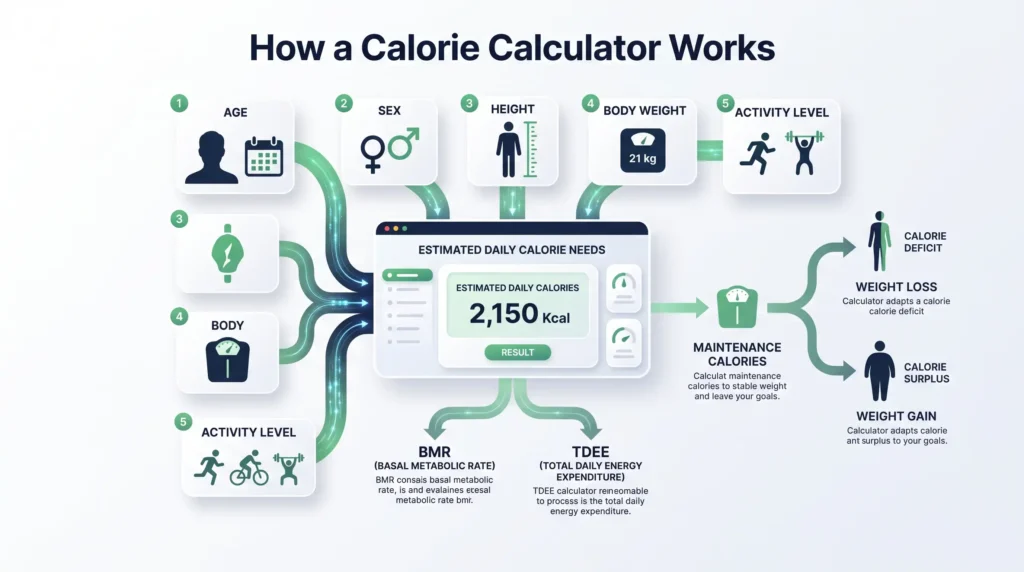
Understanding how many calories you need each day can make nutrition and weight-management goals much easier to plan. A calorie estimate can help you create a realistic starting point for maintaining your weight, losing body fat, or gaining weight.
In this guide, you will learn how a Calorie Calculator works, what factors affect your calorie needs, the difference between BMR and TDEE, and how to use estimated calorie requirements for different goals.
What Is a Calorie Calculator?
A Calorie Calculator is a tool that estimates how many calories your body may need each day. The calculation usually considers information such as age, sex, height, body weight, and physical activity level.
Because people have different body sizes and activity patterns, daily calorie needs can vary significantly from one person to another. A calculator provides an individualized estimate instead of relying on a single calorie target for everyone.
Our Calorie Calculator can be used as a starting point for estimating your daily energy requirements.
Why Do You Need to Know Your Daily Calorie Needs?
Calories provide energy for everything your body does, from basic physiological functions to walking, working, exercising, and digesting food.
Knowing your estimated calorie needs can help you understand whether your current food intake is likely to support weight maintenance, weight loss, or weight gain.
However, calorie requirements are not fixed. Your energy needs can change as your body weight, activity level, training routine, and other factors change.
How Does a Calorie Calculator Work?
Most calorie calculators use a two-step process. First, they estimate the energy your body requires at rest. This is commonly called Basal Metabolic Rate, or BMR.
The calculation then considers your physical activity to estimate your total daily energy expenditure, commonly called TDEE.
BMR estimates your resting energy needs.
TDEE estimates your total daily energy expenditure.
Your daily calorie target can then be adjusted according to
your personal goal.
What Is BMR?
BMR stands for Basal Metabolic Rate. It represents an estimate of the energy your body needs to support essential functions while at rest.
Your body continuously uses energy to support processes such as breathing, circulation, temperature regulation, and normal organ function.
If you want to understand this part of the calculation in more detail, read our BMR Calculator Guide .
What Is TDEE?
TDEE stands for Total Daily Energy Expenditure. It represents the estimated amount of energy you use throughout the day after considering your resting metabolism and physical activity.
TDEE is particularly useful when setting a calorie target because it provides a better picture of your total daily energy expenditure than BMR alone.
You can calculate your estimated total daily energy expenditure using our TDEE Calculator .
What Factors Affect Calorie Needs?
Age
Age is one of the variables used by many calorie estimation equations. Energy requirements can change throughout life as body size, body composition, and activity patterns change.
Sex
Many commonly used energy equations use sex as one of their inputs because average differences in body composition and energy expenditure can affect estimated calorie requirements.
Height
Height contributes to estimated energy requirements because body size is related to how much energy the body uses.
Body Weight
Body weight is another important variable. As body weight changes, estimated energy requirements may change as well.
Physical Activity
Activity level can have a major effect on total calorie expenditure. Someone with a mostly sedentary lifestyle generally requires fewer calories than someone who exercises frequently and remains active throughout the day.
Common Activity Levels
Calorie calculators often group activity into several categories. The exact definitions can vary slightly between calculators.
| Activity Level | General Description |
|---|---|
| Sedentary | Little or no structured exercise and mostly sedentary daily activity. |
| Lightly Active | Light exercise or physical activity several days per week. |
| Moderately Active | Regular moderate exercise or an active daily routine. |
| Very Active | Frequent exercise combined with a relatively active lifestyle. |
| Extra Active | Very demanding training or highly physical daily work. |
How Many Calories Do You Need to Maintain Your Weight?
Your estimated maintenance calories are generally related to your TDEE. If your average calorie intake is close to your actual energy expenditure over time, body weight may remain relatively stable.
A calculator can provide a useful starting estimate, but your real maintenance level may be different. Tracking your body-weight trend over several weeks can help you understand how your actual calorie intake compares with your estimated needs.
Daily changes in body weight are normal and can be affected by hydration, food volume, sodium intake, and other factors. For that reason, looking at longer-term trends is generally more useful than focusing on a single day’s measurement.
Using a Calorie Calculator for Weight Loss
Weight loss generally requires your average energy intake to be lower than your total energy expenditure over time.
A practical approach is to first estimate your TDEE and then use that estimate as a reference point when choosing a calorie deficit. The appropriate deficit can vary depending on your starting weight, goals, activity level, and individual circumstances.
A calorie calculator should therefore be treated as a starting tool, not as a guarantee of how quickly your weight will change.
Very aggressive calorie restriction is not automatically better. Sustainable nutrition and adequate nutrient intake are important when trying to reduce body weight.
Using a Calorie Calculator for Weight Gain
If your goal is to gain weight, your average calorie intake generally needs to be higher than your energy expenditure.
A calorie calculator can help estimate your maintenance requirements. You can then use that estimate to build a controlled calorie surplus while focusing on nutrient-dense foods and adequate protein.
People who are specifically interested in building muscle may also benefit from tracking their macronutrients.
Our Macro Calculator can help estimate protein, carbohydrate, and fat targets based on your chosen goals.
Calories and Muscle Building
Calories are only one part of a muscle-building plan. Resistance training, sufficient protein, recovery, and progressive training are also important.
Someone trying to gain muscle may need a calorie surplus, but the ideal amount can vary. A gradual approach can make it easier to monitor changes in body weight and adjust intake when necessary.
How Accurate Is a Calorie Calculator?
Calorie calculators provide estimates rather than direct measurements of energy expenditure.
Predictive equations are useful because they allow people to estimate calorie requirements without laboratory testing. However, individual energy expenditure can differ from the calculated value.
Factors such as body composition, daily movement, exercise intensity, sleep, and other individual characteristics can influence actual energy expenditure.
For this reason, your calculator result should be considered a starting point. Monitoring your results over time can help you determine whether your estimated calorie target is appropriate.
How to Use Your Calorie Result
Once you have an estimated daily calorie requirement, the next step is to connect that number with your specific goal.
- Maintenance: use your estimated maintenance calories as a starting point for maintaining your current weight.
- Weight loss: consider a sustainable calorie deficit based on your individual circumstances.
- Weight gain: consider a controlled calorie surplus while maintaining a balanced diet.
- Muscle building: combine appropriate calorie intake with resistance training, adequate protein, and recovery.
Calories Are Not the Only Part of Nutrition
Two diets can contain the same number of calories while having very different nutritional qualities.
In addition to total calories, consider the overall quality of your diet, including protein, carbohydrates, fats, fiber, vitamins, minerals, and adequate hydration.
This is particularly important when your calorie target is being used for an extended period.
Calorie Calculator vs BMR Calculator
| Calculator | Main Purpose |
|---|---|
| BMR Calculator | Estimates energy requirements at rest. |
| TDEE Calculator | Estimates total daily energy expenditure after considering activity. |
| Calorie Calculator | Helps estimate daily calorie requirements based on personal information and goals. |
Can Your Calorie Needs Change?
Yes. Your calorie requirements can change as your body and lifestyle change.
Losing or gaining body weight, changing your training frequency, becoming more or less active, or changing your daily routine can affect the amount of energy you use.
This is why it can be useful to reassess your estimated calorie requirements periodically rather than assuming that one number will remain accurate forever.
How to Get Better Results From a Calorie Calculator
The quality of your result depends partly on the information you provide. Use your current body weight, accurate height, correct age, and an activity level that realistically reflects your typical week.
Avoid choosing a higher activity category simply because you exercise occasionally. Your selected activity level should represent your overall routine, including daily movement.
After choosing a calorie target, monitor your progress over time. If your results consistently differ from your expectations, your actual energy needs may be different from the initial estimate.
Frequently Asked Questions About Calorie Calculators
How many calories should I eat per day?
There is no single calorie target that works for everyone. Daily calorie needs depend on factors such as age, sex, height, weight, activity level, and personal goals. A calorie calculator can provide an individualized estimate to use as a starting point.
How many calories should I eat to lose weight?
Weight loss generally requires a calorie deficit over time. The appropriate calorie target depends on your estimated energy expenditure, current body size, activity level, and individual circumstances.
Is 2,000 calories a day enough?
It depends on the individual. A 2,000-calorie diet may be appropriate for one person and too much or too little for another. Your calorie requirements are influenced by body size, activity, age, sex, and goals.
What is the difference between calories and TDEE?
Calories are a unit of energy, while TDEE is an estimate of the total amount of energy your body uses during a typical day.
Should I eat exactly the number shown by the calculator?
A calculator result is an estimate, not an exact prescription. Use it as a starting point and consider your actual weight trend, activity, hunger, performance, and other relevant factors when evaluating your calorie intake.
Can I use a calorie calculator for muscle gain?
Yes. A calorie calculator can help estimate maintenance needs, which can then be used as a reference when planning a calorie surplus for weight or muscle gain.
Can calorie needs change after losing weight?
Yes. As body weight changes, energy requirements can also change. Activity levels and other lifestyle factors can change as well, so calorie estimates may need to be reassessed over time.
What should I do after calculating my calories?
Use the estimate as a starting point for your goal. You can then combine it with an appropriate nutrition plan, regular physical activity, and progress tracking. Your results over several weeks can help determine whether adjustments are needed.