
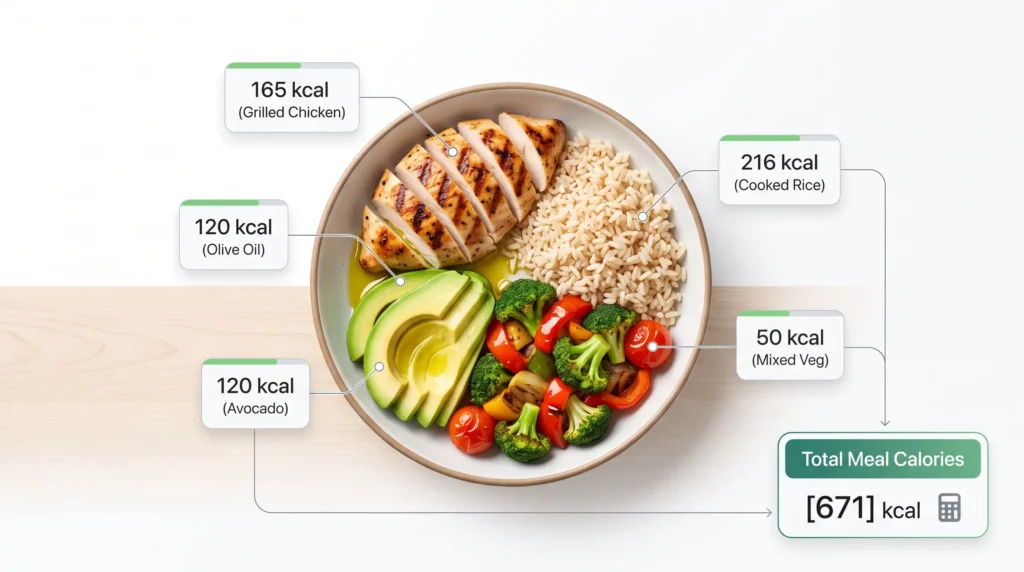
Knowing how many calories are in a meal can make it easier to understand your overall food intake and plan meals around your personal nutrition goals.
A Meal Calorie Calculator helps estimate the calories in a meal by combining the calorie values of its ingredients and portions.
This guide explains how meal calories are calculated, how serving sizes affect the result, how to calculate calories from individual ingredients, and how meal calories fit into your daily nutrition needs.
What Is a Meal Calorie Calculator?
A Meal Calorie Calculator is a nutrition tool designed to estimate the total calories contained in a meal.
Instead of looking at only one food, a meal calculator can combine several ingredients to provide an estimated total for the complete meal.
For example, a breakfast containing eggs, bread, avocado, and fruit can be calculated by adding the estimated calories from each food according to the amount consumed.
You can use our Meal Calorie Calculator to estimate the calories in your meals and better understand your daily calorie intake.
Why Calculate the Calories in a Meal?
Knowing the approximate calorie content of your meals can be useful for several nutrition goals.
- Understanding your overall calorie intake.
- Planning meals around a calorie target.
- Comparing different meal options.
- Tracking food intake more consistently.
- Supporting weight management goals.
- Understanding how portion sizes affect calorie intake.
Calories are only one part of nutrition, but they provide useful information about the amount of energy a meal can contribute to your daily intake.
How Meal Calories Are Calculated
The basic principle behind calculating meal calories is simple: estimate the calories for each ingredient and then add them together.
Total Meal Calories = Calories from Ingredient 1 + Ingredient 2 + Ingredient 3 + all other ingredients
The accuracy of the calculation depends largely on the amount of each ingredient used and the quality of the nutrition information.
Example of Calculating a Meal
Imagine a simple meal containing grilled chicken, cooked rice, vegetables, and olive oil.
| Ingredient | Estimated Calories |
|---|---|
| Grilled chicken | 330 kcal |
| Cooked rice | 205 kcal |
| Mixed vegetables | 80 kcal |
| Olive oil | 120 kcal |
| Total | 735 kcal |
The actual calorie total can vary depending on the exact portions, ingredients, cooking methods, and brands used.
Why Portion Size Matters
Portion size is one of the biggest factors affecting meal calorie calculations.
A food may have a relatively low calorie value per serving, but eating several servings can significantly increase the total calorie intake.
For example, if a serving of a particular food contains 150 calories and you eat two servings, the meal contributes approximately 300 calories from that food.
Measuring or weighing ingredients can make calorie calculations more consistent, especially when you are tracking your food intake closely.
Calories Per Ingredient
When calculating a meal, each ingredient should be considered separately.
Common ingredients that can contribute significant calories include oils, sauces, cheese, nuts, seeds, dressings, grains, meat, and other calorie-dense foods.
Vegetables and fruits can also contribute calories, although their calorie density is often lower than foods rich in added fats.
Cooking Methods Can Change Meal Calories
The way food is prepared can affect the final calorie content of a meal.
For example, frying food in oil can add calories compared with cooking the same food without added oil.
- Grilling
- Baking
- Steaming
- Boiling
- Pan cooking
- Deep frying
The cooking method itself may not always add calories, but added ingredients such as oil, butter, sauces, and sugar can increase the total.
Hidden Calories in Meals
Some of the calories in a meal can be easy to overlook because they come from small additions.
Cooking Oils
Olive oil, vegetable oil, butter, and other cooking fats can contribute a substantial amount of energy even when used in relatively small quantities.
Sauces and Dressings
Sauces, mayonnaise, creamy dressings, and other condiments can add calories to an otherwise relatively low-calorie meal.
Sugar and Sweeteners
Sugar added to drinks, sauces, desserts, and other foods can also increase the calorie content of a meal.
When calculating a meal, remember to include oils, sauces, dressings, toppings, and drinks instead of counting only the main ingredients.
Meal Calories and Macronutrients
Calories are important, but a balanced meal also contains macronutrients such as protein, carbohydrates, and fat.
Looking at both calories and macronutrients can provide a more complete picture of the nutritional composition of your meal.
If you want to estimate your daily protein, carbohydrate, and fat targets, use our Macro Calculator .
Protein in a Meal
Protein is an important macronutrient that contributes to the maintenance and repair of body tissues.
Common protein-rich meal ingredients include chicken, turkey, fish, eggs, Greek yogurt, cottage cheese, tofu, beans, and lentils.
If you are specifically trying to increase your protein intake, our Protein Calculator can help estimate your daily protein needs.
Carbohydrates in a Meal
Carbohydrates are found in foods such as rice, potatoes, oats, bread, pasta, fruits, vegetables, and legumes.
The calorie contribution of carbohydrates depends on the amount consumed and the specific food.
Whole grains, fruits, vegetables, and legumes can also provide fiber and other nutrients alongside carbohydrates.
Fat in a Meal
Dietary fat is calorie-dense and can therefore have a noticeable impact on the total calorie content of a meal.
Common sources include olive oil, avocado, nuts, seeds, cheese, fatty fish, and other foods containing dietary fat.
Healthy eating does not require eliminating dietary fat. Instead, focus on overall food quality, portions, and dietary balance.
Meal Calories and Daily Calorie Needs
A meal is only one part of your total daily calorie intake. Your daily calorie needs depend on factors such as age, body size, activity level, and personal goals.
To estimate your daily calorie requirements, use our Calorie Calculator .
You can also use the TDEE Calculator to estimate your total daily energy expenditure.
How Many Calories Should a Meal Have?
There is no universal calorie amount that every meal should contain. Your ideal meal size depends on your total daily calorie needs, eating schedule, activity level, and personal goals.
Someone with higher daily energy requirements may need larger meals, while someone with lower energy requirements may prefer smaller portions.
Instead of asking whether a meal contains a specific number of calories, consider how that meal fits into your total daily calorie and nutrition needs.
Meal Calorie Calculator for Weight Loss
A Meal Calorie Calculator can be useful when trying to create meals that fit within a calorie deficit.
Weight loss generally requires maintaining a consistent calorie deficit over time, although individual results can vary.
Our Calorie Deficit Calculator can help estimate a calorie target based on your estimated maintenance needs.
Remember that food quality, protein, fiber, physical activity, sleep, and long-term consistency also matter.
Meal Calorie Calculator for Muscle Building
People trying to build muscle may need enough total calories, protein, carbohydrates, and dietary fat to support their goals.
Calculating meal calories can help you understand whether your meals provide enough energy throughout the day.
Combining calorie tracking with a protein target can be especially useful when planning meals around resistance training.
How to Use a Meal Calorie Calculator
Using a Meal Calorie Calculator is simple. The exact inputs depend on the calculator, but the general process involves entering the foods and quantities included in your meal.
- Choose the foods or ingredients in your meal.
- Enter the quantity or serving size.
- Include cooking oils, sauces, and toppings.
- Calculate the estimated calories.
- Review the total and available macronutrient information.
- Compare the meal with your daily nutrition goals.
For the most useful estimate, use accurate portion sizes whenever possible.
How to Make Calorie Tracking More Accurate
Use a Food Scale
A kitchen food scale can help you measure ingredients more consistently than estimating portions by eye.
Check Food Labels
Packaged foods usually provide nutrition information that can help you determine calories per serving.
Measure Cooking Oils
Oils and other fats are easy to underestimate. Measuring them can improve the accuracy of meal calculations.
Consider Raw vs Cooked Weight
Some foods change weight significantly during cooking because of water absorption or water loss. Make sure the nutrition information corresponds to the measurement you are using.
Meal Calorie Calculator for Homemade Meals
Homemade meals can be more difficult to calculate because they often contain several ingredients.
The easiest approach is to calculate each ingredient separately, add the totals together, and then divide the result by the number of servings.
Example: If a complete recipe contains 2,400 calories and produces four equal servings, each serving contains approximately 600 calories.
Meal Calories for Restaurants and Takeout
Restaurant meals can be harder to estimate because ingredient quantities, cooking oils, sauces, and portion sizes may not be clearly known.
When nutrition information is available from the restaurant, use those values when possible.
When it is not available, a calculator can provide an estimate based on the ingredients and portion sizes you believe were used.
Common Mistakes When Calculating Meal Calories
- Forgetting cooking oils.
- Ignoring sauces and dressings.
- Using the wrong serving size.
- Forgetting drinks and snacks.
- Assuming restaurant portions are standard.
- Confusing raw and cooked food weights.
- Relying on visual estimates for large portions.
Meal Calories and Fiber
Fiber is another useful part of a meal’s nutrition profile. Fiber-rich foods can include vegetables, fruits, legumes, whole grains, nuts, and seeds.
If you want to estimate your daily fiber needs, visit our Fiber Intake Calculator .
Meal Calories and Omega-3
Some foods can provide calories together with beneficial nutrients such as omega-3 fatty acids.
Fatty fish such as salmon and sardines can provide EPA and DHA, while foods such as chia seeds, flaxseeds, and walnuts provide ALA.
You can learn more about your omega-3 intake using our Omega-3 Intake Calculator .
Frequently Asked Questions About Meal Calories
What is a Meal Calorie Calculator?
A Meal Calorie Calculator estimates the total calories in a meal by combining the calorie values of its ingredients and portions.
How do I calculate calories in a homemade meal?
List each ingredient, determine its quantity and calorie value, add the calories together, and divide by the number of servings if the recipe makes multiple portions.
Do cooking oils count toward meal calories?
Yes. Cooking oils contain calories and should be included when estimating the total calorie content of a meal.
How many calories should one meal contain?
There is no universal calorie target for every meal. The appropriate amount depends on your total daily calorie needs, eating schedule, activity level, and personal goals.
Can a Meal Calorie Calculator help with weight loss?
It can help you estimate meal calories and plan your food intake, which may make it easier to stay within an appropriate calorie target.
Can I calculate calories for an entire recipe?
Yes. Add the calories from all ingredients in the recipe, then divide the total by the number of servings to estimate calories per serving.
Are Meal Calorie Calculator results exact?
No. Results are estimates because food composition, brands, cooking methods, portion sizes, and ingredient quantities can vary.
Should I track every calorie I eat?
Detailed calorie tracking can be useful for some people, but it is not necessary for everyone. Your overall eating pattern and long-term habits are also important.