
Understanding your weight in relation to your height can be a useful first step when learning more about your overall health. One of the simplest measurements used for this purpose is Body Mass Index, commonly known as BMI.
This BMI Calculator Guide explains what BMI means, how to calculate it, how to understand the different BMI categories, and why your BMI result should be viewed as one part of a bigger picture rather than a complete measure of health.
If you want to calculate your BMI right away, you can use the free BMI Calculator on FitCalculatorAI.
What Is BMI?
BMI stands for Body Mass Index. It is a number calculated using your body weight and height. For adults, BMI is commonly used as a screening measurement to help categorize weight relative to height.
Unlike a scale that only tells you how much you weigh, BMI takes your height into account. This makes it possible to put body weight into a standardized context.
BMI is widely used because it is simple, inexpensive, and easy to calculate. You do not need special equipment or laboratory testing to determine your BMI. All you need is your weight and height.
However, BMI does have important limitations. It does not directly measure body fat, muscle mass, or where fat is stored in the body. For this reason, BMI is best used as a starting point rather than a complete assessment of your health.
How Does a BMI Calculator Work?
A BMI Calculator uses your body weight and height to calculate your Body Mass Index. The calculation is based on a standard mathematical formula.
When using the FitCalculatorAI BMI Calculator , you enter the required measurements and the calculator calculates your BMI automatically.
Depending on the calculator, you may be able to choose between metric and imperial measurements. Metric measurements normally use kilograms and centimeters, while imperial measurements use pounds, feet, and inches.
Using a calculator can reduce the chance of making mistakes when converting measurements or performing the mathematical calculation manually.
What Is the BMI Formula?
The standard BMI formula for adults using metric measurements is:
BMI = weight in kilograms ÷ height in meters²
In other words, you divide your body weight in kilograms by your height in meters multiplied by itself.
For example, imagine an adult who weighs 70 kilograms and has a height of 1.75 meters.
The calculation would be:
70 ÷ (1.75 × 1.75) = 22.9
The resulting BMI would therefore be approximately 22.9.
Instead of calculating this manually, you can simply enter your measurements into the BMI Calculator and get the result instantly.
BMI Categories for Adults
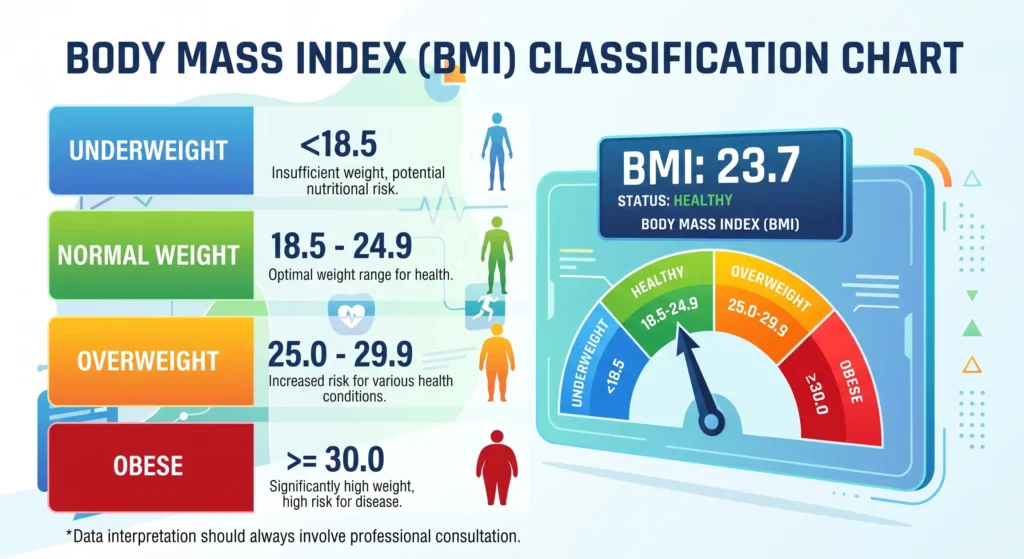
Once your BMI has been calculated, the number can be compared with commonly used adult BMI categories.
| BMI | Adult Category |
|---|---|
| Below 18.5 | Underweight |
| 18.5 – 24.9 | Healthy Weight |
| 25.0 – 29.9 | Overweight |
| 30.0 or higher | Obesity |
These categories are commonly used for screening adults. A BMI result, however, should not automatically be interpreted as a diagnosis or a complete description of an individual’s health.
What Is a Healthy BMI?
For adults, a BMI between 18.5 and 24.9 is generally classified as the healthy weight range.
This range can provide a useful general reference when evaluating weight relative to height. However, there is no single BMI number that represents perfect health for every individual.
Factors such as muscle mass, body composition, age, activity level, and fat distribution can affect how meaningful a BMI result is for a particular person.
If you want to explore the commonly used healthy weight range associated with your height, you can also try the Healthy Weight Range Calculator .
Why Is BMI Useful?
One of the main advantages of BMI is its simplicity. It provides a quick way to compare body weight with height without requiring specialized equipment.
BMI can be useful for:
- Getting a general screening measurement of weight status
- Tracking changes in body weight over time
- Understanding weight relative to height
- Starting a discussion about weight and health
- Identifying whether additional measurements may be useful
For example, someone who is tracking a long-term weight-loss or weight-gain goal may monitor BMI alongside body weight and other measurements.
Why BMI Does Not Tell the Whole Story
BMI is useful, but it has an important limitation: it does not directly measure body fat.
Your BMI is calculated from height and weight, meaning it cannot distinguish between muscle, fat, bone, and other components that contribute to total body weight.
This can be particularly relevant for people who have a significant amount of muscle mass. An athletic person may have a relatively high BMI while having a relatively low body fat percentage.
On the other hand, someone can have a BMI within a commonly accepted range while still having a higher amount of body fat.
This is why BMI should be considered together with other useful measurements whenever a more complete picture of body composition is needed.
BMI vs. Body Fat Percentage
BMI and body fat percentage are not the same measurement.
BMI evaluates the relationship between your height and total body weight. Body fat percentage estimates how much of your body weight is made up of fat.
If you want another perspective on your body composition, you can use the Body Fat Calculator .
Looking at BMI together with body fat percentage can sometimes provide more useful context than relying on BMI alone.
BMI and Waist Measurements
BMI does not tell you where body fat is stored. Waist measurements can provide additional information about body composition and fat distribution.
Two useful measurements are waist-to-height ratio and waist-to-hip ratio.
You can calculate your waist-to-height ratio with the Waist-to-Height Ratio Calculator .
You can also explore your waist-to-hip ratio using the Waist-to-Hip Ratio Calculator .
BMI and Ideal Weight
Many people search for their BMI because they want to know whether they are at a healthy weight or what their ideal weight might be.
However, BMI does not provide one exact “ideal weight” for every person. Instead, it can be used to identify a general weight range relative to height.
If you want to explore different estimates of ideal body weight, try the Ideal Weight Calculator .
Remember that an ideal weight estimate is only a reference. Your healthy weight can depend on many individual factors.
BMI and Weight Loss
If your BMI is above the commonly used healthy range, you may be interested in losing weight. BMI can be one measurement to monitor during a weight-management journey.
However, healthy weight loss is about more than simply trying to reach a particular BMI number.
Nutrition, physical activity, sleep, sustainable eating habits, and gradual changes can all play important roles in long-term weight management.
If weight loss is your goal, the Weight Loss Calculator can help you explore a personalized calorie and weight-loss target.
BMI and Weight Gain
BMI can also be useful for people who are trying to gain weight.
If your BMI is below the commonly used healthy range and you are trying to increase your body weight, your goal should not necessarily be to gain weight as quickly as possible.
A gradual approach that includes adequate nutrition and appropriate resistance training may be more useful for people whose goal is to increase lean mass.
You can explore your estimated weight-gain needs with the Weight Gain Calculator .
BMI, BMR, TDEE, and Daily Calories
One common misunderstanding is that BMI tells you how many calories you should eat each day. It does not.
BMI measures weight relative to height, while calorie calculations focus on energy expenditure and energy needs.
Your BMR Calculator can estimate your basal metabolic rate, which represents the approximate amount of energy your body needs at rest.
Your TDEE Calculator estimates your total daily energy expenditure by taking activity into account.
You can also use the Calorie Calculator to explore your estimated daily calorie needs based on your goals.
How to Use Your BMI Result
After calculating your BMI, avoid judging your health based on the number alone.
Instead, consider your result together with other relevant information such as your waist measurement, body composition, activity level, nutrition, weight history, and overall health.
For example, someone with a BMI of 27 who regularly strength trains may have a very different body composition from another person with the same BMI who has a lower level of muscle mass.
The BMI number is therefore best treated as one piece of information rather than a final judgment about your health.
Frequently Asked Questions About BMI
What is a normal BMI?
For adults, a BMI between 18.5 and 24.9 is commonly classified as the healthy weight range. However, BMI is a screening measurement and should not be considered a complete assessment of health.
How do I calculate my BMI?
Using metric measurements, divide your weight in kilograms by your height in meters squared. You can also use the BMI Calculator to perform the calculation automatically.
Is BMI the same for men and women?
The standard adult BMI formula is the same for men and women. However, BMI does not account for differences in body composition between individuals.
Is BMI accurate for athletes?
BMI can be less informative for highly muscular people because it cannot distinguish muscle mass from body fat. Additional measurements such as body fat percentage can provide useful context.
Does BMI measure body fat?
No. BMI is calculated from height and weight and does not directly measure body fat percentage. A dedicated Body Fat Calculator can provide an estimate of body fat percentage.
Can BMI tell me my ideal weight?
BMI can help identify a commonly used healthy weight range for a person’s height, but it does not determine one exact ideal weight for everyone.
Can children use adult BMI categories?
Adult BMI categories should not simply be applied to children and adolescents. BMI interpretation for younger people uses age- and sex-specific growth references.
Calculate Your BMI With FitCalculatorAI
Ready to check your Body Mass Index?
Use the free FitCalculatorAI BMI Calculator to calculate your BMI using your height and weight.
After calculating your BMI, you can continue exploring your health and fitness metrics with the FitCalculatorAI Health & Fitness Calculators .
For more personalized guidance across nutrition, fitness, weight management, and other health-related goals, you can also explore the AI Health & Fitness Advisor .
Medical Disclaimer
This guide and the FitCalculatorAI BMI Calculator are provided for general educational and informational purposes only. BMI is a screening measurement and is not a diagnosis of body fatness, health status, or disease. Individual health needs vary, and calculator results should not replace professional medical advice, diagnosis, or treatment. If you have concerns about your weight, nutrition, symptoms, or overall health, consult a qualified healthcare professional.