
Losing weight is often described as simply eating fewer calories than your body uses, but creating a realistic and sustainable weight-loss plan involves more than choosing an arbitrary calorie target.
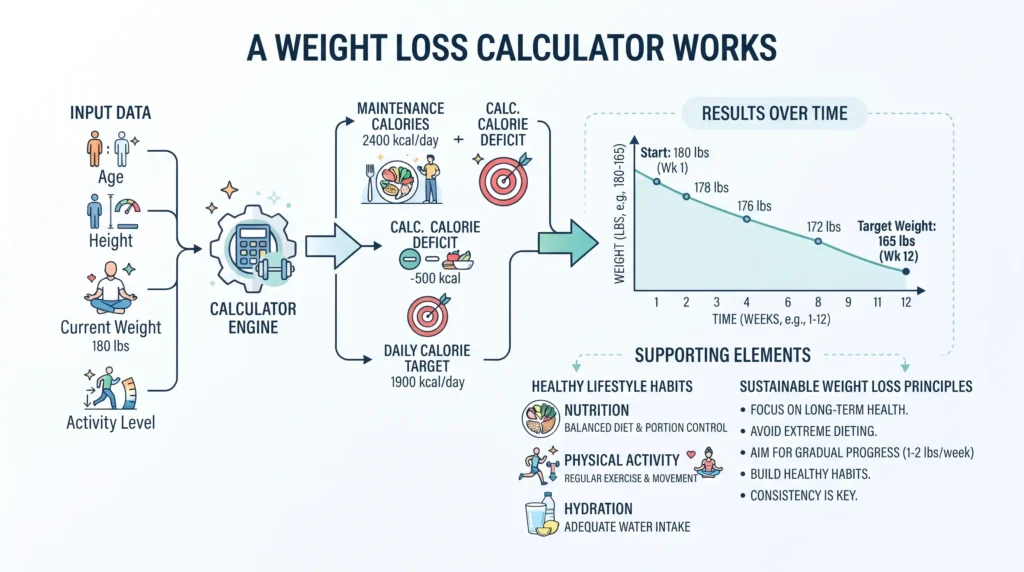
A Weight Loss Calculator can help estimate how many calories you may need each day to work toward a weight-loss goal. Depending on the calculator, the estimate can take into account factors such as age, sex, height, current weight, activity level, target weight, and desired rate of weight loss.
In this Weight Loss Calculator Guide, you’ll learn how calorie deficits work, how daily calorie needs are estimated, how to choose a realistic weight-loss goal, why weight can fluctuate during a diet, and how to approach fat loss without relying on extreme restrictions.
If you want to calculate your estimated calorie target now, use the FitCalculatorAI Weight Loss Calculator .
What Is a Weight Loss Calculator?
A Weight Loss Calculator is an online tool that estimates the amount of energy you may need to consume to support a weight-loss goal.
Instead of using the same calorie target for everyone, a calculator can personalize the estimate using information about your body and lifestyle.
Common inputs include current weight, height, age, sex, activity level, target weight, and sometimes the desired rate of weight loss.
The result is an estimate rather than a guaranteed prescription. Your actual calorie needs can change over time as your body weight, activity, and energy expenditure change.
How Does a Weight Loss Calculator Work?
Most weight-loss calculators begin by estimating how much energy your body uses each day.
The process commonly starts with your Basal Metabolic Rate (BMR), which represents the estimated amount of energy your body needs to support basic physiological functions at rest.
Your activity level is then used to estimate your Total Daily Energy Expenditure (TDEE).
Your TDEE provides an estimate of how many calories you may need to maintain your current weight.
A calorie deficit can then be introduced to create a lower calorie target for weight loss.
You can learn more about your resting energy requirements with the BMR Calculator and estimate your total daily energy expenditure with the TDEE Calculator .
What Is a Calorie Deficit?
A calorie deficit occurs when you consume less energy than your body expends over time.
When a sustained energy deficit exists, the body must obtain some of the energy it needs from stored sources, which can contribute to a reduction in body weight.
However, the change in scale weight is not always entirely body fat. Changes in water, glycogen, digestive contents, and lean tissue can also influence body weight during a diet.
This is why weight loss should be evaluated over time rather than based on individual daily measurements.
To explore the calorie-deficit concept directly, use the Calorie Deficit Calculator .
How Many Calories Should You Eat to Lose Weight?
There is no single calorie target that is appropriate for everyone.
Your calorie needs depend on your body size, age, sex, activity level, and other individual factors.
A common approach is to estimate your maintenance calories and then create a moderate calorie deficit.
For example, if a person’s estimated maintenance intake is 2,500 calories per day, a weight-loss plan may use a lower daily intake rather than attempting an extremely restrictive diet.
The exact calorie target should be interpreted as a starting estimate and adjusted according to real-world progress.
How Fast Should You Lose Weight?
A gradual rate of weight loss is generally easier to maintain than trying to lose weight as quickly as possible.
The appropriate rate depends on your starting weight, body composition, calorie intake, activity level, health status, and personal circumstances.
Rapid changes on the scale can also reflect water and glycogen changes, particularly during the first weeks of a diet.
Instead of focusing entirely on a specific number of kilograms per week, monitor your longer-term trend and how you feel and perform.
Weight Loss Does Not Always Mean Fat Loss
The number on the scale represents total body weight, not body fat alone.
During weight loss, changes can occur in fat mass, lean mass, body water, glycogen, and digestive contents.
This is particularly important when interpreting short-term changes.
Someone may lose several kilograms quickly at the beginning of a diet without losing the same amount of body fat.
For a more complete picture of body composition, consider using the Body Fat Calculator alongside your weight measurements.
Weight Loss and Body Fat
If your primary goal is improving body composition, body fat percentage can provide information that scale weight alone cannot.
Two people can have the same body weight but very different proportions of fat and lean tissue.
This is especially relevant for people who perform resistance training and are trying to preserve or build muscle while reducing body fat.
You can also estimate lean body mass with the Lean Body Mass Calculator .
Why Protein Matters During Weight Loss
Protein is an important part of a weight-loss diet, particularly for people who want to preserve lean muscle while reducing body fat.
Your protein requirements can vary depending on body weight, activity level, training status, and goals.
A balanced weight-loss diet should not focus only on reducing calories. It should also provide adequate protein, fiber, vitamins, minerals, and other essential nutrients.
Use the Protein Calculator to estimate a personalized daily protein target.
Weight Loss and Macronutrients
Calories play a central role in weight change, but macronutrient distribution can influence diet quality, satiety, exercise performance, and adherence.
The three main macronutrients are protein, carbohydrates, and dietary fat.
Protein supports tissue maintenance, carbohydrates provide an important source of energy, and dietary fat contributes concentrated energy and supports several physiological functions.
The Macro Calculator can help you organize your estimated calorie intake into protein, carbohydrate, and fat targets.
Choosing a Realistic Weight-Loss Goal
A good weight-loss goal should be realistic and sustainable rather than based on an arbitrary number.
Your current body weight, height, body composition, activity level, and lifestyle can all influence what a realistic target looks like.
It can also be useful to divide a large goal into smaller milestones.
Instead of focusing only on the final target weight, monitor your progress along the way and adjust your strategy when necessary.
The Body Weight Planner can help you organize a target weight and monitor your progress over time.
Healthy Weight Range and Weight Loss
Your weight-loss target should also be considered in the context of your height and overall health.
BMI is commonly used as a screening measurement to classify adult weight categories.
You can calculate your BMI with the BMI Calculator .
If you want to explore a commonly used healthy weight interval based on height, use the Healthy Weight Range Calculator .
An Ideal Weight Calculator can also provide a reference estimate, but an ideal-weight formula should not be treated as a mandatory target.
Weight Loss and Exercise
Physical activity can support weight management by increasing energy expenditure and improving fitness.
Exercise also provides benefits that go beyond calorie burning, including improvements in cardiovascular fitness, strength, mobility, and overall physical function.
Resistance training can be particularly useful during weight loss because it provides a stimulus for maintaining muscle mass.
Cardiovascular activities such as walking, running, cycling, and swimming can also contribute to overall activity levels.
If you want to estimate calories burned during different activities, try the Calories Burned Calculator .
Why Your Weight Can Stop Decreasing
Weight loss does not always occur at a perfectly consistent rate.
As body weight decreases, energy requirements can also change. In addition, changes in physical activity, food portions, water retention, digestion, and adherence can affect the scale.
A short period without a decrease in body weight does not necessarily mean that your overall strategy has failed.
Look at the trend over several weeks rather than judging your progress from one or two measurements.
How to Track Weight Loss Progress
Consistent measurements can make it easier to understand your progress.
Consider weighing yourself under similar conditions and recording the results over time.
Because daily body weight can fluctuate considerably, comparing weekly or longer-term trends can be more informative than comparing individual days.
You can also track waist measurements, body composition, exercise performance, and how your clothes fit.
Using several indicators can provide a more complete picture of changes in body composition.
Common Weight Loss Mistakes
Creating an Extremely Large Calorie Deficit
A very aggressive calorie restriction can make a diet difficult to maintain and may reduce energy availability for normal daily activities and exercise.
A moderate, sustainable approach is generally more practical for long-term weight management.
Focusing Only on the Scale
Scale weight is useful, but it does not tell you exactly how much body fat or muscle you have.
Body composition and fitness should also be considered.
Removing Entire Food Groups Without a Reason
Weight loss primarily depends on maintaining an appropriate energy balance. Eliminating entire food groups is not automatically necessary for successful weight management.
Ignoring Protein and Nutrient Quality
A calorie deficit should not mean ignoring nutritional quality. A balanced diet can provide protein, fiber, vitamins, minerals, and other nutrients while supporting your calorie goal.
Expecting Daily Weight Loss
Body weight naturally fluctuates. Water retention, sodium intake, carbohydrate intake, digestion, and hormonal changes can all affect the scale.
Weight Loss vs. Fat Loss
The terms weight loss and fat loss are often used interchangeably, but they are not exactly the same.
Weight loss refers to a reduction in total body weight, while fat loss specifically refers to a reduction in stored body fat.
If improving body composition is your main goal, preserving lean mass while reducing body fat can be more meaningful than simply trying to make the number on the scale as small as possible.
People who want to monitor muscularity relative to height can also explore the FFMI Calculator .
Frequently Asked Questions About Weight Loss
What is a Weight Loss Calculator?
A Weight Loss Calculator estimates your daily calorie needs for a weight loss goal using information such as your current weight, height, age, sex, activity level, and target weight.
How many calories should I eat to lose weight?
The appropriate calorie intake depends on your individual energy requirements. A calculator can estimate maintenance calories and then provide a lower target based on your desired weight-loss goal.
What is a calorie deficit?
A calorie deficit occurs when you consume less energy than your body expends over time. A sustained energy deficit can lead to a reduction in body weight.
How quickly can I lose weight?
The rate of weight loss varies between individuals. Gradual and sustainable progress is generally more practical than attempting extremely rapid weight loss.
Why am I not losing weight even though I am eating less?
Weight can fluctuate because of water retention, digestion, sodium, carbohydrate intake, activity, and other factors. If your longer-term weight trend is not changing, your actual calorie intake or energy expenditure may differ from your estimate.
Can I lose weight without exercising?
Weight loss can occur through dietary changes that create an energy deficit. However, physical activity provides important health and fitness benefits and can support long-term weight management.
Should I track calories to lose weight?
Calorie tracking can be useful for some people because it provides a clearer understanding of energy intake. However, it is not the only way to improve eating habits or manage body weight.
Can I use a Weight Loss Calculator every day?
The calculator is most useful as a planning tool. Your calorie needs do not necessarily need to be recalculated every day, but your plan can be reassessed as your weight, activity level, and goals change.
Start Your Weight Loss Plan With FitCalculatorAI
A successful weight-loss strategy is not simply about eating as little as possible. It is about creating a realistic calorie deficit while maintaining adequate nutrition, activity, recovery, and consistency.
Start by using the FitCalculatorAI Weight Loss Calculator to estimate a daily calorie target based on your personal information and goal.
You can then combine it with the Calorie Deficit Calculator , TDEE Calculator , Protein Calculator , and Body Fat Calculator to better understand your calorie needs, nutrition, and body composition.
If you want to monitor your target weight and progress over time, use the Body Weight Planner .
Explore the complete collection of FitCalculatorAI Health & Fitness Calculators for additional tools covering weight, nutrition, calories, fitness, and supplements.
For broader personalized health and fitness guidance, visit the AI Health & Fitness Advisor .
Medical Disclaimer
This guide and the FitCalculatorAI Weight Loss Calculator are provided for general educational and informational purposes only. Calculator results are estimates and should not be considered medical advice, diagnosis, or treatment. Individual calorie and nutritional needs vary. If you are pregnant, under 18, have a medical condition, have a history of an eating disorder, or are experiencing unexplained weight changes, consult a qualified healthcare professional or registered dietitian for personalized guidance.