
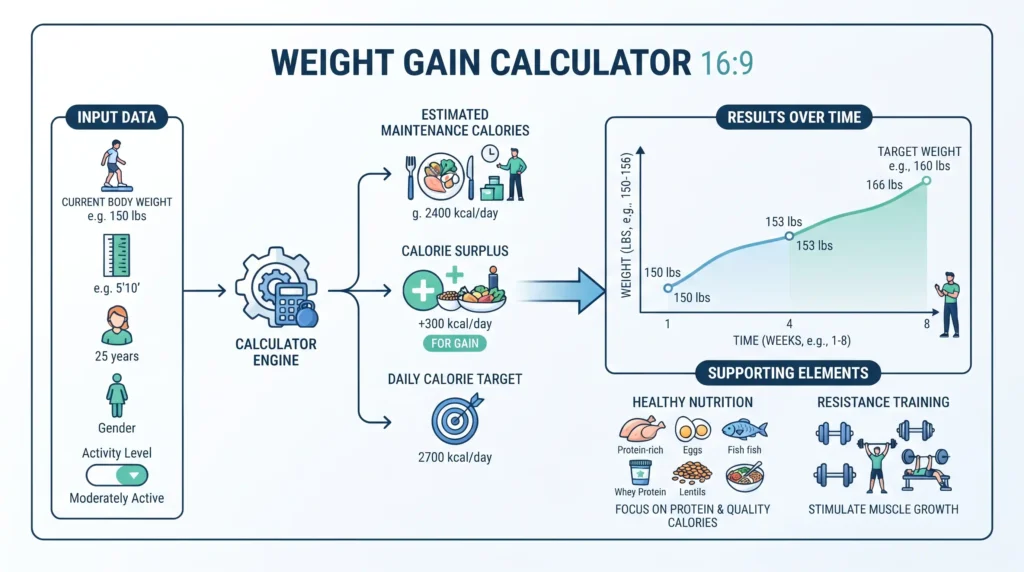
Gaining weight can be just as challenging as losing it, especially for people who have a naturally low body weight, high activity levels, a small appetite, or a goal of building muscle. Simply eating as much as possible is not necessarily the best strategy. A structured approach can help you increase your calorie intake gradually while maintaining good nutrition.
A Weight Gain Calculator can help estimate how many calories you may need to support a weight-gain goal based on factors such as your current weight, height, age, sex, activity level, and desired rate of gain.
In this Weight Gain Calculator Guide, you’ll learn how weight gain works, how calorie surplus affects body weight, how to estimate your maintenance calories, how much protein you may need, and how to approach weight gain in a sustainable way.
If you want to calculate your estimated calorie needs now, try the FitCalculatorAI Weight Gain Calculator .
What Is a Weight Gain Calculator?
A Weight Gain Calculator is an online tool designed to estimate the calorie intake that may support an increase in body weight.
Instead of simply telling you to “eat more,” the calculator uses your personal information to estimate your energy requirements and then adjusts the estimated calorie target according to your weight-gain goal.
Depending on the calculator, you may enter your age, sex, height, current weight, activity level, target weight, and desired rate of weight gain.
The result is an estimate rather than a guarantee. Actual weight gain can vary because energy expenditure, appetite, food intake, digestion, activity, metabolism, and body composition differ between individuals.
How Does a Weight Gain Calculator Work?
Most weight-gain calculators begin by estimating how much energy your body uses each day.
This usually involves estimating your Basal Metabolic Rate (BMR) and then accounting for your physical activity to estimate Total Daily Energy Expenditure (TDEE).
A calorie surplus is then added to your estimated maintenance intake to create a calorie target for weight gain.
The BMR Calculator can help you estimate your basal energy requirements.
The TDEE Calculator can then help estimate your total daily energy expenditure based on your activity level.
The FitCalculatorAI Weight Gain Calculator combines this type of information into a practical starting point for planning weight gain.
What Is a Calorie Surplus?
A calorie surplus occurs when you consume more energy than your body uses over time.
When a sustained surplus exists, the additional energy can contribute to an increase in body weight.
However, not all weight gained during a calorie surplus is necessarily muscle. Depending on your diet, training, genetics, and the size of the surplus, weight gain can include muscle, body fat, water, glycogen, and other components.
This is why the goal should generally be controlled and gradual weight gain rather than simply maximizing calories.
How Many Calories Do You Need to Gain Weight?
There is no single calorie target that works for everyone.
Your calorie needs depend on your current body weight, height, age, sex, activity level, metabolism, and other factors.
A useful starting point is to estimate your maintenance calories and then create a moderate surplus.
For example, if your estimated maintenance intake is 2,400 calories per day, a weight-gain plan might use a higher daily intake rather than immediately increasing calories by a very large amount.
Your individual response should then be monitored over time.
The Calorie Calculator can help you estimate your daily calorie requirements.
You can also use the Calorie Deficit Calculator to understand the opposite concept of an energy deficit and how calorie balance influences body weight.
How Fast Should You Gain Weight?
A slower, controlled rate of weight gain is generally easier to manage than rapid weight gain.
The appropriate rate depends on your starting weight, body composition, training experience, health, and specific goal.
Someone focused primarily on building muscle may want to minimize unnecessary fat gain, while someone who is significantly underweight may have different nutritional priorities.
Instead of trying to gain as much weight as possible in the shortest amount of time, focus on a sustainable trend and adjust your intake according to your progress.
Weight Gain Does Not Always Mean Muscle Gain
One of the most important things to understand is that increasing your body weight does not automatically mean you are building muscle.
Muscle growth requires appropriate resistance training, sufficient energy, adequate protein, recovery, and time.
A large calorie surplus without appropriate training can result in more body-fat gain than desired.
If you are interested in monitoring body composition, use the Body Fat Calculator alongside your weight measurements.
You can also explore your estimated lean body mass with the Lean Body Mass Calculator .
Weight Gain and Protein Intake
Protein is an important nutrient for people who want to build or preserve muscle mass.
Your protein needs depend on factors such as body weight, activity level, training, and overall goals.
Instead of simply increasing calories from any available food, a balanced weight-gain diet should include adequate protein alongside carbohydrates, fats, fruits, vegetables, and other nutrient-rich foods.
The Protein Calculator can help you estimate a daily protein target based on your personal information and goals.
Best Foods for Healthy Weight Gain
Healthy weight gain does not require relying entirely on processed foods or sugary snacks.
Nutrient-dense foods can help you increase calorie intake while also providing important vitamins, minerals, protein, fiber, and healthy fats.
Protein-rich foods
- Eggs
- Chicken and turkey
- Fish
- Lean meat
- Greek yogurt
- Cottage cheese
- Milk
- Beans and lentils
- Tofu and other soy foods
Calorie-dense foods
- Nuts and nut butters
- Avocado
- Olive oil
- Whole grains
- Rice
- Oats
- Dried fruit
- Seeds
Combining protein-rich foods with calorie-dense carbohydrates and healthy fats can make it easier to increase energy intake without relying entirely on highly processed foods.
How to Eat More Calories Without Feeling Too Full
People with a small appetite may find weight gain difficult because eating large meals can feel uncomfortable.
In this situation, spreading food intake across several meals and snacks may be easier than trying to consume a very large amount at once.
Calorie-dense foods can also help because they provide more energy in a smaller volume.
Smoothies and other nutritious liquid meals may be useful for some people because drinking calories can sometimes feel easier than eating a large solid meal.
Weight Gain and Strength Training
If your goal is to gain muscle rather than simply increase scale weight, resistance training is an important part of the process.
Strength training provides a stimulus for muscle adaptation, while adequate energy and protein provide nutritional support for recovery and growth.
Tracking your strength and training performance can therefore provide useful information alongside your body weight.
If you want to estimate your maximum strength for a particular exercise, the One Rep Max Calculator can help estimate your one-repetition maximum.
Weight Gain and Macros
Calories are important for weight gain, but macronutrient distribution can also help structure your diet.
The three main macronutrients are protein, carbohydrates, and dietary fat.
Protein supports tissue maintenance and muscle development, carbohydrates provide an important source of energy, and dietary fat provides concentrated energy while supporting several physiological functions.
The Macro Calculator can help you estimate a macronutrient distribution based on your calorie target and goal.
Weight Gain and Meal Planning
Having a structured meal plan can make it easier to consistently reach your calorie target.
If you frequently underestimate how much you eat, tracking meals for a period of time can help you understand your actual intake.
The Meal Calorie Calculator can help you estimate the calorie content of meals.
You can also explore individual food nutrition information using the Nutrition Facts Calculator .
How to Track Weight Gain Progress
Tracking your progress is important because calculator results are only starting estimates.
Try to weigh yourself under similar conditions and focus on the trend over time rather than reacting to individual daily measurements.
Body weight naturally fluctuates because of changes in hydration, food intake, glycogen, sodium, digestion, and other factors.
If your average weight is not increasing after consistently following your plan, your calorie intake may need to be adjusted.
On the other hand, if your weight is increasing much faster than intended, you may want to reassess your calorie surplus and overall diet.
How to Know if You Are Gaining Muscle
Scale weight alone cannot tell you whether your weight gain is primarily muscle, fat, water, or a combination of these.
Some useful indicators include:
- Increasing strength in resistance exercises
- Gradual increases in muscle measurements
- Changes in body composition
- Improved training performance
- Consistent body-weight trends
You can use the FFMI Calculator as an additional reference for fat-free mass relative to height.
Common Weight Gain Mistakes
Eating an excessively large calorie surplus
More calories do not automatically mean more muscle. An unnecessarily large surplus can increase unwanted body-fat gain.
Ignoring protein intake
Calories are important, but protein also plays an important role in supporting muscle tissue and recovery.
Relying only on junk food
Highly processed foods can make it easy to consume calories, but a healthy weight-gain plan should still provide a wide variety of nutrients.
Skipping resistance training
If your goal is muscle gain, nutrition alone is not enough. Resistance training provides an important stimulus for muscle development.
Expecting immediate results
Meaningful changes in body weight and muscle mass take time. Consistency is generally more important than trying to accelerate the process.
Who May Benefit From a Weight Gain Calculator?
A weight-gain calculator can be useful for adults who want to structure a weight-gain goal, including people who are naturally lean, highly active, or interested in gaining muscle.
However, unexplained weight loss or difficulty gaining weight despite adequate food intake can sometimes have an underlying medical or nutritional cause.
If you are unexpectedly losing weight, have persistent digestive symptoms, or cannot gain weight despite consistently eating enough, speaking with a qualified healthcare professional is important.
Frequently Asked Questions About Weight Gain
What is a Weight Gain Calculator?
A Weight Gain Calculator estimates the calories you may need to consume to support an increase in body weight based on information such as your current weight, height, age, sex, activity level, and goal.
How many calories should I eat to gain weight?
Your calorie needs depend on your individual energy expenditure. A common approach is to estimate maintenance calories and then add a moderate calorie surplus rather than dramatically increasing food intake.
Can I gain weight without gaining fat?
It is difficult to guarantee that every kilogram gained will be muscle. A controlled calorie surplus, adequate protein, resistance training, and appropriate recovery can help support muscle gain while limiting unnecessary fat gain.
How quickly should I gain weight?
The appropriate rate depends on your body size, starting composition, training experience, health, and goal. Gradual progress is generally easier to control than rapid weight gain.
Do I need to eat protein to gain weight?
Protein is an important nutrient, particularly if your goal includes muscle growth. However, total calorie intake and overall diet quality also matter.
Can I gain weight by eating junk food?
Highly processed foods can increase calorie intake, but relying heavily on them is not an ideal long-term strategy. A balanced diet provides more nutrients to support overall health and training.
Why am I not gaining weight even though I eat a lot?
You may be consuming fewer calories than you think, or your energy expenditure may be higher than expected. Appetite, activity, digestion, and individual differences can also affect weight gain. Persistent unexplained difficulty gaining weight should be discussed with a healthcare professional.
Start Your Weight Gain Plan
Healthy weight gain is about more than simply increasing the number on the scale. A good plan considers calorie intake, food quality, protein, resistance training, recovery, and long-term consistency.
Start by using the FitCalculatorAI Weight Gain Calculator to estimate your calorie needs and create a starting point for your goal.
You can then combine it with the TDEE Calculator , Protein Calculator , Macro Calculator , and Body Fat Calculator to build a more complete picture of your progress.
If you want to plan your target weight and track your progress over time, visit the Body Weight Planner .
Explore the complete collection of FitCalculatorAI Health & Fitness Calculators for additional tools covering weight, calories, nutrition, fitness, and supplements.
For broader personalized guidance, visit the AI Health & Fitness Advisor .
Medical Disclaimer
This guide and the FitCalculatorAI Weight Gain Calculator are provided for general educational and informational purposes only. Calculator results are estimates and should not be considered medical advice, diagnosis, or treatment. Individual calorie and nutritional needs vary. If you are underweight, experiencing unexplained weight loss, have difficulty gaining weight, or have a medical condition that affects nutrition or digestion, consult a qualified healthcare professional or registered dietitian for personalized advice.