
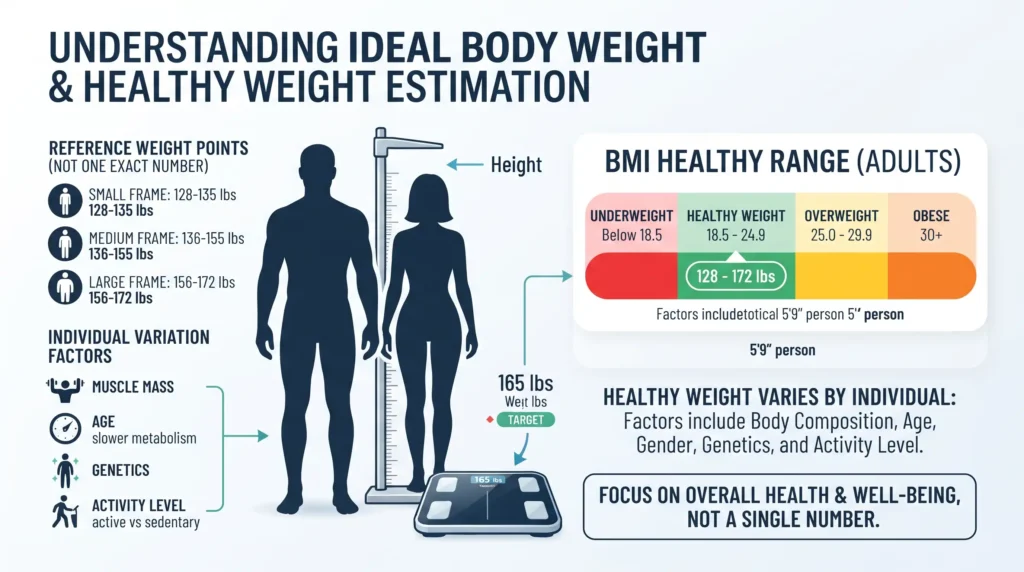
Many people search for an ideal weight because they want to know whether their current body weight is appropriate for their height. However, there is no single body weight that is perfect for every person.
An Ideal Weight Calculator can provide a useful estimate based on your height and other personal information. It can help you understand commonly used reference ranges and give you a starting point for thinking about your weight-management goals.
In this Ideal Weight Calculator Guide, you will learn what ideal weight means, how different formulas estimate it, how BMI can help determine a healthy weight range, and why your personal healthy weight may not be exactly the same as a calculator’s estimate.
What Is Ideal Weight?
The term ideal weight is often used to describe an estimated body weight considered appropriate for a person’s height and other basic characteristics.
Unlike your actual body weight, ideal weight is not a directly measured physical value. It is an estimate produced using one or more mathematical formulas or reference ranges.
This distinction is important because there is no universally accepted single ideal weight for every individual.
Your healthy weight can be influenced by factors such as body composition, muscle mass, age, sex, genetics, activity level, and overall health.
Therefore, an ideal weight calculator should be used as a reference rather than as a strict target that everyone must reach.
How Does an Ideal Weight Calculator Work?
An Ideal Weight Calculator typically uses your height and may also consider factors such as sex or age, depending on the formula being used.
Different formulas have been developed over the years to estimate ideal or reference body weight. Because these formulas use different assumptions, they can produce different results for the same person.
This means that seeing slightly different ideal-weight estimates from different calculators does not necessarily mean that one of them is wrong.
The FitCalculatorAI Ideal Weight Calculator is designed to make this process simple by calculating an estimated reference weight based on the information you provide.
Why Is There More Than One Ideal Weight Formula?
There is no universal mathematical formula that can determine the perfect body weight for every person.
Several formulas have been developed for estimating ideal body weight, including commonly referenced formulas such as the Devine, Robinson, Miller, and Hamwi formulas.
These formulas were developed using different populations and assumptions, so their results can vary.
This is why an ideal weight result is better understood as a reference estimate rather than an exact biological target.
How Is Ideal Weight Calculated?
One commonly referenced approach is the Devine formula. It estimates ideal body weight based primarily on height and sex.
The traditional Devine formulas are:
- Men: 50 kg + 2.3 kg for each inch over 5 feet
- Women: 45.5 kg + 2.3 kg for each inch over 5 feet
Other formulas use different starting values and coefficients. As a result, two ideal-weight formulas can give different estimates for the same height.
This is one reason why you should not treat one formula as a definitive answer about your health.
Ideal Weight vs. Healthy Weight Range
An ideal-weight estimate and a healthy weight range are not necessarily the same thing.
An ideal-weight formula may give you one estimated number. A healthy weight range provides a broader interval within which body weight may generally fall relative to height.
For adults, BMI is commonly used to identify a healthy weight range.
You can calculate your BMI with the BMI Calculator .
If you want to see a weight range associated with your height, try the Healthy Weight Range Calculator .
What Is the Healthy BMI Range?
For adults, a BMI between 18.5 and 24.9 is commonly classified as the healthy weight range.
Because BMI is calculated using height and weight, you can mathematically determine the body-weight range that corresponds to this BMI interval for a particular height.
However, BMI is a screening measurement and does not directly measure body fat or distinguish between muscle and fat.
A muscular person may therefore have a higher BMI without necessarily having excessive body fat.
Why Your Ideal Weight May Be Different From the Calculator
Your body is more complex than a mathematical formula.
A calculator may use only a few variables, while your actual body composition is influenced by many factors.
Two people who have the same height can have different healthy body weights because they may have different amounts of muscle, bone mass, body fat, and other body components.
Someone who regularly performs resistance training may weigh more than another person of the same height while still having a healthy body composition.
For this reason, an ideal-weight result should always be interpreted in context.
Ideal Weight and Body Composition
Body composition is one of the most important reasons to avoid focusing on ideal weight alone.
Your total body weight consists of several components, including fat mass, muscle, bone, body water, organs, and other tissues.
Two people can have exactly the same body weight but very different body compositions.
If you want to estimate your body fat percentage, use the Body Fat Calculator .
You can also explore your estimated non-fat body mass using the Lean Body Mass Calculator .
For people interested in muscularity and fat-free mass relative to height, the FFMI Calculator can provide another useful reference.
Ideal Weight for Men
Ideal-weight formulas for men often use height as the primary variable and may produce a reference body weight based on traditional population formulas.
However, the result should not be considered a universal target.
A tall man who has significant muscle mass may naturally weigh more than the estimate produced by an ideal-weight formula.
Similarly, an older adult with less muscle mass may have different body composition at the same body weight.
This is why body composition and overall health are important when interpreting an ideal-weight estimate.
Ideal Weight for Women
Ideal-weight formulas for women generally use a different reference value than formulas designed for men.
Women naturally tend to have different average body composition and fat distribution than men, which is one reason some formulas use sex-specific calculations.
Even so, an estimated ideal weight should never be interpreted as a mandatory target.
A healthy weight can vary considerably among women with the same height depending on body composition, age, activity level, and individual circumstances.
Does Age Affect Ideal Weight?
Age can influence body composition and the way body weight is interpreted.
As people get older, changes in muscle mass, body fat distribution, bone density, and physical activity can affect body composition.
Some ideal-weight formulas do not account for these changes. This is another reason why a formula-based result should be considered an estimate rather than a precise health target.
Ideal Weight and Weight Loss
If your current weight is above the range you would like to reach, an ideal-weight calculator can help provide a reference point for setting a long-term goal.
However, it is usually more useful to focus on realistic and sustainable changes rather than trying to reach a particular number as quickly as possible.
Your Weight Loss Calculator can help you explore a weight-loss target based on your current information.
You can also use the Calorie Deficit Calculator to understand how an estimated energy deficit relates to weight loss.
Ideal Weight and Weight Gain
An ideal-weight calculator can also be useful for people who are trying to gain weight.
If your current weight is below a commonly used healthy range, a gradual increase in calorie intake may help you move toward a healthier body weight.
People interested in gaining muscle may also want to focus on resistance training and adequate protein rather than simply trying to increase scale weight.
The Weight Gain Calculator can help you explore estimated calorie requirements for a weight-gain goal.
Ideal Weight and Daily Calorie Needs
Knowing your ideal weight does not automatically tell you how many calories you should eat each day.
Daily calorie needs depend on factors such as age, sex, height, weight, and physical activity.
The BMR Calculator can estimate your basal metabolic rate.
Your TDEE Calculator can estimate your total daily energy expenditure based on activity level.
You can also use the Calorie Calculator to explore estimated daily calorie requirements for your goal.
How to Choose a Realistic Target Weight
A realistic target weight should consider more than one calculator result.
Start by looking at your current body weight, height, body composition, activity level, and overall health.
Instead of choosing an arbitrary number, consider a range that is realistic and sustainable for your lifestyle.
If you are currently far from your desired weight, setting smaller milestones can also make the process easier to manage.
A Body Weight Planner can help you organize your current weight, target weight, and progress over time.
Why You Should Not Chase One Number
It can be tempting to believe that reaching one specific number on the scale automatically means you are healthy.
In reality, health is influenced by many factors beyond body weight.
Physical activity, cardiovascular fitness, strength, nutrition, sleep, mental well-being, medical history, and body composition can all be important.
Your ideal weight should therefore be viewed as one potential reference point rather than the definition of good health.
Common Mistakes When Using an Ideal Weight Calculator
Treating the result as an exact target
Ideal-weight formulas produce estimates. They should not be interpreted as an exact weight that every person of a particular height must reach.
Ignoring body composition
Muscle and fat contribute differently to body composition, but a basic weight-based formula cannot distinguish between them.
Comparing yourself with another person
Two people with the same height can have different healthy body weights. Comparing your ideal-weight estimate with another person’s is therefore unlikely to provide useful information.
Using weight as the only measure of progress
If your goal is to improve your physique or fitness, track other indicators such as waist measurements, body fat estimates, strength, and physical performance.
Frequently Asked Questions About Ideal Weight
What is an ideal weight?
Ideal weight is a general term for an estimated body weight considered appropriate for a person’s height and other characteristics. Different formulas can produce different estimates.
How is ideal weight calculated?
Several formulas can estimate ideal body weight using height and, in some cases, sex. Common historical formulas include Devine, Robinson, Miller, and Hamwi.
Is there one ideal weight for my height?
No. There is no single body weight that is perfect for everyone at a given height. Body composition, muscle mass, age, genetics, activity, and health can all affect an individual’s healthy weight.
Is ideal weight the same as healthy weight?
Not necessarily. An ideal-weight formula may provide one estimated number, while a healthy weight can represent a broader range based on height and other individual factors.
Can BMI help determine ideal weight?
BMI can be used to estimate a commonly used healthy weight range for adults, but it should not be treated as a perfect measure of health or body composition.
Should muscular people use an ideal weight calculator?
They can use it as a reference, but the result may not accurately reflect their ideal body weight because many formulas do not account for unusually high muscle mass.
Can I use an ideal weight calculator for weight loss?
Yes. It can provide a general reference when setting a weight-management goal. However, a sustainable target should consider your individual health, body composition, and lifestyle.
Calculate Your Ideal Weight With FitCalculatorAI
Want to see what your estimated ideal body weight may be?
Use the free FitCalculatorAI Ideal Weight Calculator to get an estimate based on your personal measurements.
For a broader understanding of your weight and body composition, you can also use the BMI Calculator , Body Fat Calculator , and Healthy Weight Range Calculator .
If you are planning a longer-term weight goal, explore the Body Weight Planner as well.
You can find all of these tools and more in the FitCalculatorAI Health & Fitness Calculators .
For broader personalized guidance across health, nutrition, fitness, and weight-management goals, visit the AI Health & Fitness Advisor .
Medical Disclaimer
This guide and the FitCalculatorAI Ideal Weight Calculator are provided for general educational and informational purposes only. Ideal-weight estimates are mathematical references and should not be considered medical advice, diagnosis, or treatment. Individual healthy weight can vary significantly based on body composition, age, sex, health status, activity level, and other factors. Consult a qualified healthcare professional if you have concerns about your body weight, nutrition, or health.