
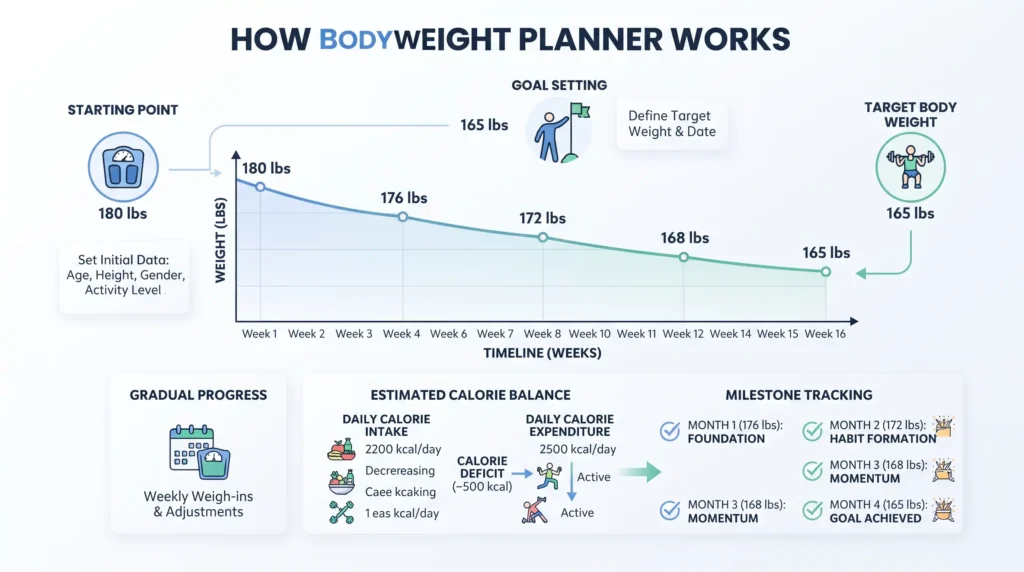
Reaching a healthy body weight is usually easier when you have a clear goal, a realistic timeline, and a way to monitor your progress. Instead of focusing only on today’s number on the scale, a structured plan can help you understand where you are starting, where you want to go, and how your habits may affect your progress over time.
A Body Weight Planner is designed to help organize this process. Depending on the calculator and information provided, it can help you explore a target weight, expected changes over time, calorie needs, and the relationship between your current weight and your goal.
In this Body Weight Planner Guide, you’ll learn how body weight planning works, how to set realistic goals, how calories influence weight change, why progress is not always linear, and how to combine a weight planner with other health and fitness calculators.
If you already know your current measurements and want to start planning, try the FitCalculatorAI Body Weight Planner .
What Is a Body Weight Planner?
A Body Weight Planner is a tool that helps you organize and estimate a weight-management goal based on your current situation and desired outcome.
Rather than looking at body weight as a single number, a planner can help turn your goal into a longer-term process.
For example, someone may want to lose weight gradually, maintain their current weight, or gain weight while building lean mass. Each goal requires a different approach.
A planner can provide a framework for thinking about these changes without assuming that everyone’s body will respond in exactly the same way.
How Does a Body Weight Planner Work?
A body weight planning tool generally starts with information such as your current weight, height, age, sex, activity level, and goal.
Depending on the calculator, you may also enter a target weight and a preferred timeline.
The tool can then use these inputs to estimate energy needs and create a useful reference point for your goal.
The FitCalculatorAI Body Weight Planner can be used as part of a broader approach to understanding weight management.
It is important to remember that calculator results are estimates. Real changes in body weight depend on factors such as food intake, activity, sleep, genetics, water balance, adherence, and changes in energy expenditure.
Why Plan Your Body Weight Goal?
Setting a specific goal can make weight management easier to understand.
A vague goal such as “I want to get healthier” can be difficult to measure. A more specific goal might involve reaching a certain weight range, improving body composition, increasing strength, or reducing excess body fat.
A body weight planner can help turn that general objective into measurable milestones.
Planning can also help you avoid extreme approaches. Instead of trying to change your weight as quickly as possible, you can think about sustainable progress over a realistic period.
Starting Weight vs. Target Weight
The starting weight is the body weight you have when you begin your plan. The target weight is the weight you would like to reach.
The difference between these two numbers can help define the overall scale of your goal.
However, target weight should not be selected based only on appearance or a single calculator result.
Your height, body composition, activity level, age, personal preferences, and health circumstances can all influence what a reasonable target may be.
You can use the Healthy Weight Range Calculator to explore a commonly used healthy weight range based on height.
You can also use the Ideal Weight Calculator for another estimate of a reference weight.
How BMI Can Help With Weight Planning
BMI can provide additional context when planning body weight because it relates body weight to height.
The BMI Calculator can help you determine your current BMI and understand which standard adult BMI category your result falls into.
However, BMI should not be treated as a perfect target. It does not directly measure body fat or distinguish muscle from fat.
For this reason, a body weight goal is often more useful when combined with other measurements such as waist circumference and body composition.
Body Weight Planning and Body Fat
Scale weight alone cannot tell you what is happening to your body composition.
Two people can weigh exactly the same amount while having very different proportions of muscle and body fat.
If your goal is to improve body composition, consider using the Body Fat Calculator alongside your body weight measurements.
You can also use the Lean Body Mass Calculator to explore another aspect of body composition.
Understanding Calories and Body Weight
Changes in body weight are strongly influenced by energy balance over time. Your body uses energy every day for basic physiological functions, physical activity, digestion, and other processes.
When energy intake and energy expenditure are not equal over time, body weight can change.
This does not mean that weight changes occur in a perfectly predictable straight line. Water retention, glycogen, digestive contents, hormonal changes, and other factors can cause short-term fluctuations.
This is why a body weight planner should be treated as a planning tool rather than a promise of exactly what the scale will show on a specific day.
Using BMR and TDEE for Weight Planning
Understanding your estimated energy needs can make a body weight plan more useful.
Your basal metabolic rate, or BMR, represents the approximate amount of energy your body requires to support basic functions at rest.
You can estimate this using the BMR Calculator .
Total Daily Energy Expenditure, or TDEE, goes a step further by considering physical activity and other components of daily energy expenditure.
The TDEE Calculator can help estimate your daily energy expenditure based on your activity level.
These estimates can then provide useful context when creating a calorie target for weight loss, maintenance, or weight gain.
Planning for Weight Loss
If your goal is weight loss, a planner can help you establish a reasonable direction rather than focusing on rapid changes.
Sustainable weight management generally involves creating habits that you can maintain over time.
Nutrition, physical activity, sleep, stress management, and consistency can all influence your results.
The Weight Loss Calculator can help you explore a potential weight-loss goal.
You can also use the Calorie Deficit Calculator to understand how an estimated calorie deficit relates to weight-loss planning.
Planning for Weight Gain
Body weight planning is not only for weight loss. Some people need or want to increase their body weight.
If your goal is weight gain, the focus should be on creating a sustainable increase in energy intake while supporting overall nutrition.
People who want to build muscle may also combine adequate nutrition with resistance training.
The Weight Gain Calculator can help you explore estimated calorie needs for a weight-gain goal.
If muscle development is an important part of your goal, tracking lean body mass can provide additional information beyond scale weight.
How Fast Should You Change Your Weight?
There is no single rate of weight change that is appropriate for everyone.
Your starting body weight, goal, nutrition, activity level, age, health status, and previous dieting history can all influence an appropriate approach.
Extremely aggressive goals can be difficult to maintain and may increase the risk of losing valuable lean mass during weight loss.
For this reason, it is usually better to focus on gradual and sustainable progress rather than trying to reach a target as quickly as possible.
Why Your Weight May Not Change Exactly as Planned
Even when you follow your plan consistently, your scale weight may not change exactly according to a calculator’s prediction.
Daily weight can fluctuate because of:
- Water retention
- Changes in carbohydrate intake
- Salt intake
- Digestive contents
- Exercise-related changes
- Hormonal fluctuations
- Changes in calorie intake
These short-term fluctuations do not necessarily mean that your long-term plan is failing.
How to Track Your Weight Progress
Consistent tracking can make it easier to understand long-term changes.
Instead of reacting to every individual weigh-in, look at the broader trend over time.
Try to measure your weight under reasonably consistent conditions, such as at a similar time of day and using the same scale.
You can also track other indicators such as waist measurements, body fat estimates, strength, fitness performance, clothing fit, and overall well-being.
Body Weight vs. Body Composition
One of the biggest limitations of using body weight alone is that the scale cannot identify what caused the change.
A person can lose weight while losing both fat and lean tissue. Another person may gain weight while increasing muscle mass.
Therefore, someone interested in improving body composition may benefit from tracking several measurements rather than using scale weight as the only indicator of progress.
The FFMI Calculator can also provide an additional perspective for people interested in fat-free mass relative to height.
Body Weight Planning and Nutrition
Nutrition is one of the most important parts of a weight-management plan.
Calories influence changes in body weight, but food quality and nutrient intake also matter for overall health.
Depending on your goal, you may want to monitor protein, carbohydrates, fats, fiber, and other nutrients.
The Macro Calculator can help you explore estimated macronutrient targets.
You can also use the Protein Calculator if you want to estimate your daily protein needs based on your personal information and goals.
When Should You Adjust Your Plan?
A body weight plan does not need to remain identical forever.
Your energy needs can change as your body weight changes, particularly during a longer weight-loss or weight-gain phase.
Your activity level may also change. A new training routine, a more active job, or a change in daily movement can affect your total energy expenditure.
Rather than making frequent large adjustments based on one weigh-in, look at your progress over a reasonable period and then decide whether a change is appropriate.
Common Body Weight Planning Mistakes
Setting an unrealistic target
A target that is too aggressive can make it difficult to stay consistent. A realistic goal should take your starting point and personal circumstances into account.
Focusing only on the scale
Body weight is useful, but it does not provide complete information about body composition, fitness, or health.
Changing the plan too frequently
Daily fluctuations are normal. Constantly changing your calorie target or strategy based on short-term changes can make it harder to evaluate what is actually working.
Ignoring nutrition quality
Calories matter for body weight, but a healthy eating pattern should also provide adequate protein, fiber, vitamins, minerals, and other nutrients.
Expecting a perfectly linear result
Real body weight rarely follows a perfectly straight line. Temporary increases or decreases can occur even when your long-term trend is moving in the desired direction.
Frequently Asked Questions About Body Weight Planning
What is a Body Weight Planner?
A Body Weight Planner is a tool that helps you organize a weight-management goal using information such as current weight, height, activity level, target weight, and sometimes a desired timeline.
Can a Body Weight Planner tell me my exact future weight?
No. Calculator predictions are estimates rather than guarantees. Actual changes depend on many factors, including energy intake, activity, water balance, metabolism, adherence, and individual differences.
Can I use a Body Weight Planner for weight loss?
Yes. A body weight planner can help you organize a weight-loss goal and understand how calorie intake and activity may influence progress.
Can I use it for weight gain?
Yes. Weight planning can also be used to structure a gradual weight-gain goal and estimate the additional energy intake that may be required.
Should I use BMI when planning my weight?
BMI can provide useful context because it relates weight to height, but it should not be used as the only measurement when setting a body weight goal.
Should I track body fat while following a weight plan?
Tracking body fat can provide additional information about changes in body composition. However, body fat estimates are not perfectly precise, so trends are generally more useful than individual readings.
Why does my weight change from day to day?
Daily changes can be caused by water retention, food and fluid intake, carbohydrate and sodium intake, digestion, exercise, and other normal physiological factors.
Start Planning Your Weight Goals
A clear goal can make your weight-management journey easier to understand and monitor.
Use the free FitCalculatorAI Body Weight Planner to explore your current weight, target weight, and overall planning needs.
You can then combine your results with other FitCalculatorAI tools such as the BMI Calculator , Body Fat Calculator , Weight Loss Calculator , and Weight Gain Calculator .
To explore more health, nutrition, fitness, and body-composition tools, visit the complete FitCalculatorAI Health & Fitness Calculators .
For broader personalized guidance, you can also explore the AI Health & Fitness Advisor .
Medical Disclaimer
This guide and the FitCalculatorAI Body Weight Planner are provided for general educational and informational purposes only. Calculator results are estimates and should not be considered medical advice, diagnosis, or treatment. Weight-management goals should take individual health, nutritional needs, medications, activity levels, and other personal factors into account. Consult a qualified healthcare professional if you have concerns about your weight, nutrition, or health.