
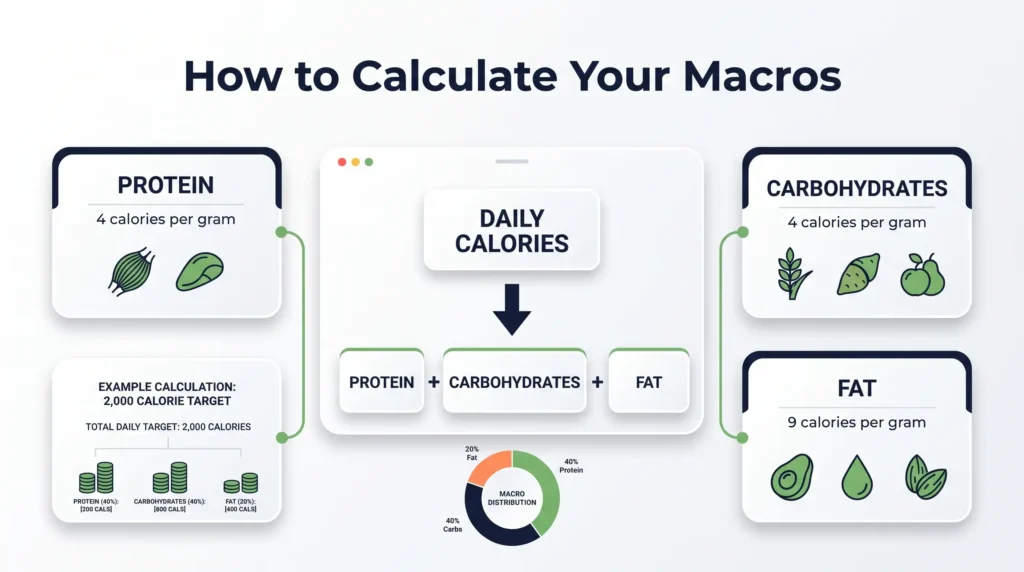
Calories are important for managing energy balance, but the foods that provide those calories also matter. The three main macronutrients — protein, carbohydrates, and fat — provide energy and play different roles in the body.
A Macro Calculator can help estimate how many grams of protein, carbohydrates, and fat you may need each day based on your calorie needs, activity level, and personal goal.
This guide explains what macros are, how macro calculations work, how calories are converted into macronutrients, and how to use your results for weight loss, maintenance, or muscle building.
What Is a Macro Calculator?
A Macro Calculator is a tool that estimates your daily macronutrient requirements. The three primary macronutrients are protein, carbohydrates, and dietary fat.
Each macronutrient has a different role in nutrition and provides a different amount of energy per gram. By combining your estimated calorie requirements with a selected macro distribution, a calculator can provide daily protein, carbohydrate, and fat targets.
You can use our Macro Calculator to estimate your daily macronutrient targets.
What Are Macronutrients?
Macronutrients are nutrients that the body needs in relatively large amounts. The three main macronutrients are protein, carbohydrates, and fat.
Protein
Protein is made from amino acids and plays an important role in maintaining and repairing body tissues. It is especially relevant for people who exercise regularly or are trying to maintain muscle while losing weight.
Protein also contributes to satiety and supports many biological processes throughout the body.
Carbohydrates
Carbohydrates are an important source of energy. They can be found in foods such as fruits, vegetables, grains, legumes, and other carbohydrate-containing foods.
Carbohydrates are particularly useful for supporting higher-intensity physical activity and exercise performance.
Dietary Fat
Dietary fat provides concentrated energy and plays important roles in cell structure, hormone production, and the absorption of fat-soluble vitamins.
Healthy sources of dietary fat can include nuts, seeds, olive oil, avocado, and certain fish.
How Many Calories Does Each Macro Provide?
Each macronutrient provides a different amount of energy per gram. This makes it possible to convert macro targets into total calories.
| Macronutrient | Calories per gram |
|---|---|
| Protein | 4 calories |
| Carbohydrates | 4 calories |
| Fat | 9 calories |
How Does a Macro Calculator Work?
A macro calculation generally starts by estimating how many calories you need each day. This can be based on your estimated total daily energy expenditure and your personal goal.
The calculator then divides those calories between protein, carbohydrates, and fat according to a selected macro distribution.
Protein calories = Protein grams × 4
Carbohydrate calories = Carbohydrate grams × 4
Fat calories = Fat grams × 9
The calories contributed by each macronutrient can then be combined to estimate the total calorie intake represented by your macro targets.
Why TDEE Matters for Your Macros
Your macronutrient targets are closely connected to your overall calorie needs. For this reason, estimating your TDEE can be a useful first step.
TDEE stands for Total Daily Energy Expenditure and represents an estimate of the calories your body uses during a typical day.
Use our TDEE Calculator to estimate your daily energy expenditure before setting your calorie and macro targets.
What Is BMR?
BMR stands for Basal Metabolic Rate. It estimates the amount of energy your body needs to support essential functions while at rest.
BMR is different from TDEE because TDEE also accounts for activity and other components of daily energy expenditure.
You can learn more about this concept with our BMR Calculator Guide .
How Much Protein Do You Need?
Protein requirements can vary depending on body weight, activity level, training status, age, and personal goals.
People who regularly perform resistance training often pay particular attention to protein intake because adequate protein can support muscle maintenance and recovery.
During weight loss, sufficient protein may also help support muscle retention when combined with appropriate resistance training.
For a more focused estimate, use our Protein Calculator .
How Many Carbohydrates Do You Need?
Carbohydrate requirements can vary significantly depending on your total calorie intake, activity level, exercise volume, and personal preferences.
People who perform frequent endurance or high-intensity training may benefit from a higher carbohydrate intake because carbohydrates can provide readily available energy for exercise.
There is no single carbohydrate target that is ideal for everyone. Your overall diet, training demands, and goals should be considered.
How Much Dietary Fat Do You Need?
Dietary fat is an important part of a balanced diet. It contributes energy and supports several important biological functions.
When setting macros, fat should not simply be removed to make room for more protein or carbohydrates. A balanced approach can help ensure that your diet remains nutritionally adequate.
Foods such as olive oil, nuts, seeds, avocado, and oily fish can provide useful sources of dietary fat.
Macros for Weight Loss
When your goal is weight loss, total calorie intake remains an important factor. A calorie deficit means that your average energy intake is lower than your energy expenditure over time.
Macro targets can help you organize those calories into a balanced nutrition plan while prioritizing adequate protein and other essential nutrients.
If you want to calculate your calorie deficit first, use our Calorie Deficit Calculator .
After determining your calorie target, you can use a Macro Calculator to divide those calories between protein, carbohydrates, and fat.
Macros for Muscle Building
Building muscle generally requires resistance training, adequate recovery, sufficient protein, and enough energy to support training and tissue growth.
Some people choose a moderate calorie surplus when trying to gain muscle. The exact calorie target depends on the individual and should be adjusted according to progress.
Protein is particularly important for people following a structured resistance-training program.
Macros for Weight Maintenance
If your goal is to maintain your current weight, your calorie intake will generally be close to your total energy expenditure over time.
Macro targets can then be used to organize those calories into protein, carbohydrates, and fat according to your nutritional needs and preferences.
Maintenance does not mean that every day must contain exactly the same number of calories. Daily intake and expenditure naturally fluctuate.
Example of a Macro Calculation
Imagine someone has a daily calorie target of 2,000 calories and chooses an example distribution of 30% protein, 40% carbohydrates, and 30% fat.
Protein: 2,000 × 30% = 600 calories
Carbohydrates: 2,000 × 40% = 800 calories
Fat: 2,000 × 30% = 600 calories
Converting those calories into grams gives approximately:
- Protein: 600 ÷ 4 = 150 g
- Carbohydrates: 800 ÷ 4 = 200 g
- Fat: 600 ÷ 9 = approximately 67 g
This is only an example to demonstrate the calculation. Individual macro targets should be based on personal calorie requirements, goals, activity, and nutritional needs.
Should You Track Macros Every Day?
Macro tracking can be useful for people who want more control over their nutrition, but it is not essential for everyone.
Some people prefer detailed tracking because it gives them a clearer understanding of their calorie and nutrient intake. Others prefer using general portion guidelines and focusing on food quality.
The best approach is the one that you can follow consistently without creating unnecessary stress around food.
Macro Tracking vs Calorie Tracking
| Approach | Main Focus |
|---|---|
| Calorie Tracking | Focuses primarily on total daily energy intake. |
| Macro Tracking | Tracks calories while also monitoring protein, carbohydrates, and fat. |
| Flexible Eating | Uses general nutrition principles without necessarily tracking every gram. |
Common Macro Tracking Mistakes
Focusing Only on Percentages
Macro percentages can be useful, but the actual grams of protein, carbohydrates, and fat also matter. Two diets can have the same percentages but very different calorie totals.
Ignoring Total Calories
Macro targets still contribute calories. If your overall goal is weight loss or weight gain, total energy intake remains important.
Changing Macros Too Often
Nutrition results take time to evaluate. Constantly changing your targets based on a few days of results can make it difficult to understand what is actually working.
Ignoring Food Quality
Hitting macro numbers does not automatically make a diet nutritionally complete. Vitamins, minerals, fiber, hydration, and overall food quality remain important.
Do Macros Matter More Than Calories?
Calories and macronutrients serve different purposes. Total calorie intake is closely related to changes in body weight, while the distribution of those calories can influence factors such as protein intake, exercise performance, satiety, and dietary preferences.
For many people, the most useful approach is to consider both total calories and macronutrient balance rather than focusing exclusively on one number.
How to Use a Macro Calculator Correctly
Start by entering accurate information into the calculator. Your current body weight, height, age, sex, and activity level should reflect your actual situation.
- Use your current body weight.
- Select a realistic activity level.
- Choose your main goal.
- Use your estimated calorie needs as the foundation.
- Review the resulting protein, carbohydrate, and fat targets.
- Adjust your nutrition based on long-term progress when needed.
How to Adjust Your Macros Over Time
Your macro targets do not have to remain identical forever. Changes in body weight, training volume, calorie requirements, and goals can all affect your nutritional needs.
For example, someone who loses a significant amount of weight may eventually need to reassess their calorie intake and macro targets.
Similarly, increasing training volume may change carbohydrate or overall calorie requirements.
Frequently Asked Questions About Macro Calculators
What is a Macro Calculator?
A Macro Calculator estimates daily protein, carbohydrate, and fat requirements based on calorie needs, activity level, and personal goals.
How many calories are in protein?
Protein provides approximately 4 calories per gram.
How many calories are in carbohydrates?
Carbohydrates provide approximately 4 calories per gram.
How many calories are in fat?
Dietary fat provides approximately 9 calories per gram.
What are the best macros for weight loss?
There is no single macro ratio that works for everyone. A useful plan should provide an appropriate calorie target, adequate protein, and a balanced intake of carbohydrates and fats that you can maintain consistently.
What are the best macros for muscle gain?
Muscle gain generally benefits from adequate protein, sufficient total calories, and enough carbohydrates and fats to support training and recovery. The ideal distribution varies between individuals.
Do I need to hit my macros exactly every day?
Not necessarily. Macro targets are estimates and small daily variations are normal. Consistency over time is generally more important than hitting every number perfectly.
Should I calculate macros based on my current weight?
Many macro calculations use current body weight as one of their inputs, but the appropriate method can depend on the specific goal and calculation approach.