
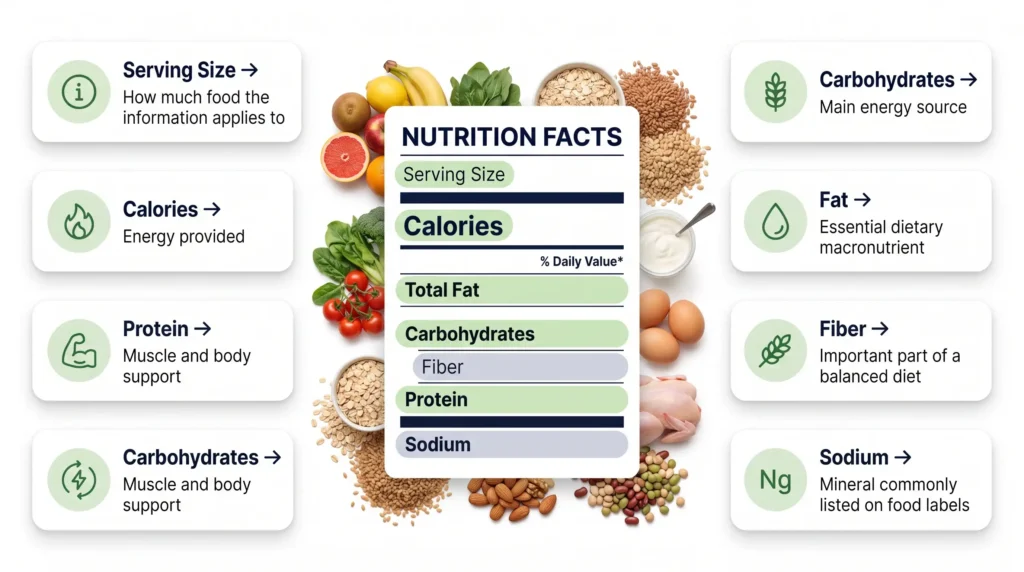
Understanding the nutrition information in the foods you eat can make it easier to manage calories, macronutrients, fiber, and other important parts of your diet.
A Nutrition Facts Calculator can help you organize and understand nutrition information by looking at calories, serving size, protein, carbohydrates, fat, fiber, and other nutrients.
This guide explains how nutrition facts work, how to read a nutrition label, what serving size means, and how nutrition information can fit into your daily eating goals.
What Is a Nutrition Facts Calculator?
A Nutrition Facts Calculator is a tool that helps you estimate or organize nutritional information for foods and meals. Depending on the calculator, it may provide information about calories, macronutrients, fiber, sugar, sodium, and other nutrients.
Nutrition calculators can be especially useful when you want to understand how individual foods or meals contribute to your overall daily nutrition.
You can use the Nutrition Facts Calculator to estimate and review nutrition information based on the inputs requested by the tool.
Why Nutrition Facts Matter
Nutrition facts provide useful information about the energy and nutrients contained in a food. Learning how to interpret this information can help you make more informed food choices.
Instead of looking only at calories, it is useful to consider the complete nutrition profile of a food, including protein, carbohydrates, fat, fiber, sodium, and other nutrients.
Calories
Calories represent the amount of energy provided by food. Your body uses energy from food to support basic functions, physical activity, and everyday movement.
Protein
Protein is an essential macronutrient involved in maintaining and repairing body tissues. Foods such as eggs, dairy products, fish, meat, legumes, and some grains can provide protein.
Carbohydrates
Carbohydrates are an important source of energy and are found in foods such as fruits, vegetables, grains, legumes, and dairy products.
Fat
Dietary fat provides energy and helps the body absorb certain vitamins. Different foods contain different types and amounts of fat.
How to Read a Nutrition Facts Label
Reading a nutrition label becomes easier when you look at the information in a consistent order.
- Start with the serving size.
- Check the number of calories per serving.
- Look at protein, carbohydrates, and total fat.
- Check fiber and sugar when relevant.
- Pay attention to sodium.
- Compare the information with your overall dietary goals.
Understanding Serving Size
Serving size is one of the most important parts of a Nutrition Facts label because the rest of the nutritional information is generally based on that amount.
If a package contains two servings and you eat the entire package, you may need to multiply the calories and nutrients listed per serving by two.
If one serving contains 200 calories and the package contains two servings, eating the entire package would provide approximately 400 calories.
Always check serving size before comparing two foods or calculating the nutrition of an entire meal.
Calories Per Serving
Calories tell you how much energy is provided by a serving of food. However, calories alone do not tell you whether a food is nutritious or suitable for your individual goals.
A nutrient-dense food can contain calories while also providing protein, fiber, vitamins, minerals, and other useful nutrients.
To estimate your overall daily calorie needs, you can also use our Calorie Calculator .
Protein on Nutrition Facts Labels
Protein is commonly listed in grams on nutrition labels. It can be useful to compare protein content when building meals or planning a diet around a specific protein target.
People who exercise regularly may pay particular attention to protein intake because protein contributes to maintaining and repairing muscle tissue.
If you want to estimate your daily protein needs, use the Protein Calculator .
Carbohydrates and Fiber
Total carbohydrates include several types of carbohydrates. Fiber is one component that is commonly listed separately on nutrition labels.
Foods that provide fiber include fruits, vegetables, legumes, whole grains, nuts, and seeds.
If you want to learn more about your daily fiber needs, check the Fiber Intake Calculator .
Understanding Dietary Fat
Total fat is another important part of nutrition information. Labels may also provide information about saturated fat and other types of fat.
Fat is an essential nutrient and plays several important roles in the body. The quality and overall balance of dietary fat matter more than simply trying to eliminate fat from the diet.
Foods such as nuts, seeds, fish, avocado, and olive oil can provide dietary fats as part of a balanced eating pattern.
Understanding Sugar on a Nutrition Label
Nutrition labels may distinguish between total sugars and added sugars, depending on the labeling system used in your country.
Naturally occurring sugars can be found in foods such as fruit and milk, while added sugars are incorporated into foods or beverages during processing or preparation.
Looking at the overall food rather than focusing on one nutrient can provide a more useful picture of its nutritional value.
Sodium and Nutrition Facts
Sodium is commonly listed on nutrition labels. It is an essential mineral, but excessive sodium intake can be a concern for some people.
Processed foods, packaged meals, sauces, snacks, and some canned foods can contribute significant amounts of sodium to the diet.
Checking sodium on nutrition labels can therefore be useful when comparing similar products.
Nutrition Facts and Daily Calorie Needs
Nutrition labels provide information about individual foods, while your daily calorie needs depend on several factors such as age, body size, activity level, and goals.
For a more complete estimate of your daily energy expenditure, you can use the TDEE Calculator .
Your TDEE represents an estimate of the calories your body uses throughout the day based on your basal energy needs and activity level.
Nutrition Facts and Macronutrients
The three main macronutrients are protein, carbohydrates, and fat. Each provides energy and has different roles in a balanced diet.
| Macronutrient | Calories Per Gram | Main Role |
|---|---|---|
| Protein | 4 kcal | Growth and tissue maintenance |
| Carbohydrates | 4 kcal | Important source of energy |
| Fat | 9 kcal | Energy and essential body functions |
If you want to estimate your daily macronutrient targets, our Macro Calculator can provide a personalized estimate based on your information and selected goals.
How to Calculate Nutrition for an Entire Meal
When preparing a meal from several ingredients, you can estimate the nutrition of the entire meal by combining the nutrition information from each ingredient.
- Record the amount of each ingredient.
- Check the nutrition information for each ingredient.
- Adjust the values according to the amount used.
- Add the calories and nutrients together.
- Divide the total by the number of portions if needed.
Weighing ingredients can make nutrition calculations more consistent, especially when you are tracking calories or macronutrients closely.
Nutrition Facts for Weight Management
Nutrition information can be useful when trying to manage body weight because it helps you understand how much energy and how many nutrients you are getting from your food.
However, successful weight management is not about avoiding one particular food or nutrient. Overall calorie intake, food quality, physical activity, sleep, and long-term consistency all matter.
If your goal is fat loss, the Calorie Deficit Calculator can help you estimate a calorie target based on your maintenance needs.
Nutrition Facts for Muscle Building
People who are trying to build muscle may pay particular attention to calories and protein while also maintaining adequate carbohydrate and fat intake.
Nutrition labels can make it easier to compare foods and build meals that support your overall calorie and protein targets.
A nutrition calculator should be used as a planning tool rather than as a replacement for professional dietary advice.
Common Mistakes When Reading Nutrition Labels
Ignoring Serving Size
One of the most common mistakes is assuming that the entire package represents one serving.
Looking Only at Calories
Calories are important, but protein, fiber, carbohydrates, fat, sodium, and other nutrients can also affect the nutritional quality of a food.
Comparing Different Serving Sizes
Two products may appear very different simply because their serving sizes are not the same. Comparing equivalent quantities can provide a more useful comparison.
Forgetting Drinks and Snacks
Beverages, sauces, snacks, and small additions to meals can contribute calories and nutrients that are easy to overlook.
How to Use a Nutrition Facts Calculator
Using a Nutrition Facts Calculator is generally simple. Enter the information requested by the calculator and review the estimated nutrition values.
- Enter the food or meal information requested.
- Enter the serving size or quantity.
- Review calories and macronutrients.
- Check fiber, sugar, sodium, or other available nutrients.
- Compare the result with your daily nutrition goals.
Remember that calculator results are estimates and can vary depending on food brands, preparation methods, portion sizes, and the accuracy of the information entered.
Tips for Building a Balanced Diet
Nutrition facts are most useful when they are considered as part of an overall eating pattern.
- Include a variety of fruits and vegetables.
- Choose quality protein sources.
- Include whole grains and other carbohydrate sources.
- Include healthy sources of dietary fat.
- Pay attention to fiber intake.
- Stay aware of portion sizes.
- Limit highly processed foods when appropriate.
- Drink enough fluids throughout the day.
Frequently Asked Questions About Nutrition Facts
What is a Nutrition Facts Calculator?
A Nutrition Facts Calculator is a tool that helps estimate or organize nutrition information such as calories, protein, carbohydrates, fat, fiber, and other nutrients.
What does serving size mean?
Serving size is the amount of food that the nutrition information on a label is based on. It is important because eating more than one serving also increases the calories and nutrients consumed.
Should I focus only on calories?
No. Calories are useful for understanding energy intake, but protein, carbohydrates, fat, fiber, sodium, and overall food quality can also be important.
How do I calculate calories for a whole meal?
Estimate the calories of each ingredient according to the quantity used, then add the values together. If the meal is divided into several portions, divide the total accordingly.
What are the three main macronutrients?
The three main macronutrients are protein, carbohydrates, and fat. They provide energy and have different functions in the body.
Can a Nutrition Facts Calculator help with weight loss?
It can help you understand the calorie and nutrient content of foods, which may make calorie and meal planning easier. Weight management also depends on overall energy balance and lifestyle habits.
Can nutrition labels be inaccurate?
Nutrition information is generally provided using standardized methods, but actual nutrient values can vary because of ingredients, brands, preparation methods, and portion sizes.
How can I calculate my daily calorie needs?
Your daily calorie needs depend on factors such as age, height, weight, sex, and activity level. A calorie calculator or TDEE calculator can provide an estimate.