
Heart rate is one of the most useful measurements for understanding exercise intensity. Whether you are walking, running, cycling, or doing another form of cardio, your heart rate can help you understand how hard your body is working.
A Heart Rate Zone Calculator estimates your training heart rate zones using information such as age and estimated maximum heart rate. These zones can help you structure workouts around different intensity levels.
In this guide, you will learn what heart rate zones are, how they are calculated, what each zone means, and how to use heart rate zones for cardio, endurance, fat-loss, and fitness training.
What Is a Heart Rate Zone Calculator?
A Heart Rate Zone Calculator is an online tool that estimates different exercise intensity zones based on your heart rate. It commonly starts with an estimated maximum heart rate and then calculates percentages of that value for different training zones.
Instead of treating every workout as simply “easy” or “hard,” heart rate zones provide a practical way to organize exercise intensity.
You can use the Heart Rate Zone Calculator to estimate your training zones before planning your next cardio workout.
What Are Heart Rate Zones?
Heart rate zones are ranges of heartbeats per minute that correspond to different levels of exercise intensity.
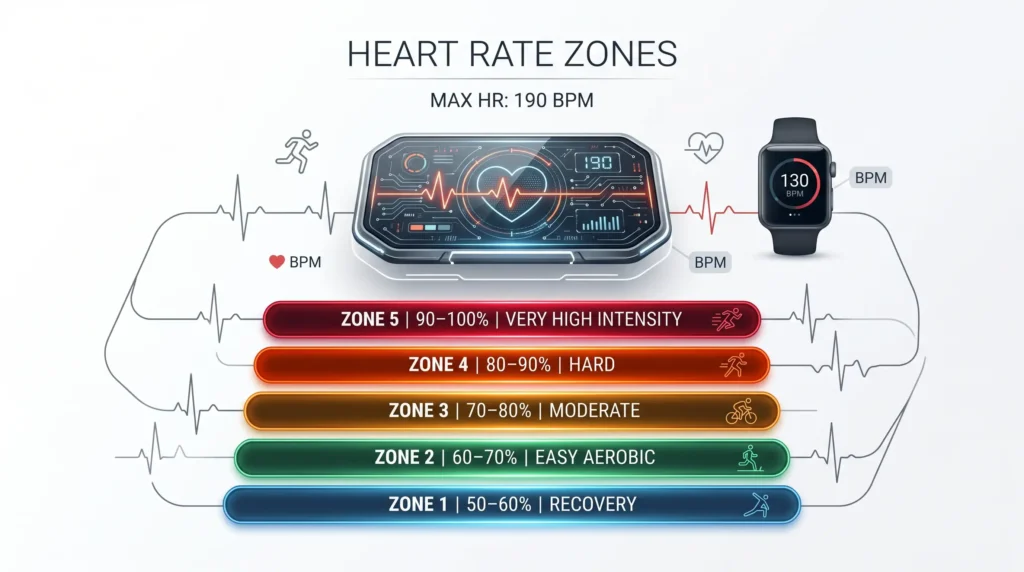
A common five-zone model ranges from very easy activity in Zone 1 to very high-intensity effort in Zone 5.
| Zone | Approximate Intensity | Typical Training Focus |
|---|---|---|
| Zone 1 | 50–60% | Recovery and easy movement |
| Zone 2 | 60–70% | Easy aerobic endurance |
| Zone 3 | 70–80% | Moderate aerobic training |
| Zone 4 | 80–90% | Hard threshold-focused training |
| Zone 5 | 90–100% | Very high-intensity effort |
These percentages are general examples based on a common five-zone model. Different training systems may use slightly different zone boundaries.
How Is Maximum Heart Rate Estimated?
Heart rate zone calculations often begin by estimating your maximum heart rate, sometimes abbreviated as HRmax.
One traditional formula is:
Estimated Maximum Heart Rate = 220 − Age
For example, a 30-year-old person would have an estimated maximum heart rate of approximately 190 beats per minute using this formula.
However, maximum heart rate varies considerably between individuals. Age-based formulas provide an estimate rather than a direct measurement of your personal maximum heart rate.
How Are Heart Rate Zones Calculated?
Once estimated maximum heart rate is available, each training zone can be calculated using a percentage of that value.
Example:
If estimated maximum heart rate is 190 bpm, a 70% training intensity would be approximately:
190 × 0.70 = 133 bpm
A calculator can perform these calculations automatically and display the estimated range for each training zone.
What Is Zone 1?
Zone 1 represents very light exercise intensity. It is generally suitable for warm-ups, cool-downs, recovery sessions, and light physical activity.
You should normally be able to maintain a comfortable conversation while exercising at this intensity.
Use Zone 1 for recovery days, warm-ups, cool-downs, and gentle movement.
What Is Zone 2?
Zone 2 is commonly associated with easy aerobic endurance training. It is popular among runners, cyclists, walkers, and other endurance athletes.
At this intensity, breathing is elevated but controlled, and many people can maintain a conversation.
Zone 2 training is often used for building aerobic fitness while keeping exercise intensity relatively manageable.
If you are a runner, you can combine heart rate zones with pace information using the Running Pace Calculator .
What Is Zone 3?
Zone 3 represents moderate aerobic exercise. Breathing becomes noticeably harder than in Zone 2, but the intensity can still be maintained for a reasonable period depending on fitness level.
This zone can be useful for moderate cardio sessions and improving the ability to sustain a faster aerobic pace.
What Is Zone 4?
Zone 4 represents high-intensity exercise. Breathing is harder and maintaining the intensity for a long period becomes increasingly challenging.
Structured interval workouts may include periods in Zone 4 to challenge cardiovascular fitness and improve performance.
High-intensity training should be introduced progressively, especially if you are new to structured cardio exercise.
What Is Zone 5?
Zone 5 represents very high-intensity effort and is generally associated with short periods of hard exercise.
This intensity is difficult to sustain for long periods and is more commonly used for short intervals or maximal-effort training.
Zone 5 should not be necessary for every workout. Most people can build substantial fitness using a combination of easier and moderate training.
Heart Rate Zones for Running
Heart rate zones can be useful for runners because they provide another way to monitor training intensity besides pace.
Your running pace can change depending on terrain, temperature, fatigue, and other conditions, while heart rate provides additional information about how your body is responding to the effort.
For example, an easy endurance run may be performed primarily at a lower heart rate zone, while interval sessions may involve higher zones.
You can use the Calories Burned Calculator to estimate the energy expenditure associated with physical activity.
Heart Rate Zones for Fat Loss
Heart rate zones are sometimes described using terms such as the “fat burning zone.” This can be misleading because fat loss is influenced by overall energy balance rather than a single heart rate zone.
Lower-intensity exercise can use a relatively high proportion of fat as a fuel source during the activity, but total calorie expenditure and long-term energy balance are also important.
If your goal is weight management, combining regular physical activity with appropriate nutrition is generally more important than trying to remain in one specific heart rate zone.
You can estimate your daily energy requirements using the TDEE Calculator and explore calorie targets with the Calorie Deficit Calculator .
Heart Rate Zones for Beginners
Beginners do not need to spend every workout at high intensity. Starting with easier activity can help you build consistency and gradually improve cardiovascular fitness.
- Begin with a comfortable warm-up.
- Use easier heart rate zones for most early workouts.
- Increase duration gradually.
- Add higher-intensity intervals progressively.
- Allow enough recovery between demanding sessions.
Consistency is usually more important than trying to reach the highest heart rate zone during every workout.
Heart Rate Zones and Exercise Intensity
Heart rate is one way to monitor exercise intensity, but it should not be considered in isolation.
Your perceived effort, breathing, exercise pace, fitness level, sleep, stress, temperature, and hydration can all influence how exercise feels.
For this reason, combining heart rate data with how you feel during exercise can provide a more useful picture of training intensity.
Heart Rate During Exercise Can Vary
Your heart rate is not fixed during exercise. It can change due to environmental and physiological factors.
- Hot or humid weather.
- Dehydration.
- Lack of sleep.
- Stress.
- Caffeine.
- Fatigue.
- Training status.
This means the same running pace may produce different heart rates on different days.
Heart Rate Zones and Hydration
Hydration can also influence exercise performance and how you feel during training, particularly in hot environments or during longer workouts.
Use the Water Intake Calculator to estimate your general daily hydration needs.
For longer or sweat-heavy workouts, the Water & Electrolyte Calculator can help you explore hydration and electrolyte considerations.
Heart Rate Zones and Calories Burned
Exercise intensity can influence energy expenditure, although calories burned depend on more than heart rate alone.
Body weight, exercise type, duration, intensity, fitness level, and other factors can all affect calorie expenditure.
For an estimate of calories burned during different activities, try the Calories Burned Calculator .
How to Use a Heart Rate Zone Calculator
Using a heart rate zone calculator is straightforward.
- Enter your age.
- Choose the required calculation settings.
- Calculate your estimated maximum heart rate.
- Review your estimated training zones.
- Use the zones to guide exercise intensity.
Remember that calculated zones are estimates. Your actual physiological thresholds may differ from a simple age-based calculation.
How Accurate Are Heart Rate Zone Calculations?
Heart rate zone calculators are useful for general training guidance, but they are not a substitute for laboratory testing or professionally measured physiological thresholds.
Age-based maximum heart rate formulas can have significant individual variation.
If you use a wearable heart rate monitor, chest strap, or other device, make sure it is fitted correctly and understand that consumer devices can also have measurement limitations.
Frequently Asked Questions
What is a Heart Rate Zone Calculator?
A Heart Rate Zone Calculator estimates exercise intensity zones using information such as age and estimated maximum heart rate. It can help you understand how hard you are exercising.
What is my maximum heart rate?
Maximum heart rate varies between individuals. A commonly used estimate is 220 minus your age, but this is only an estimate and may not accurately represent your personal maximum heart rate.
What heart rate zone is best for beginners?
Beginners can often benefit from spending much of their training at easier intensities while gradually building exercise duration and fitness.
What is Zone 2 training?
Zone 2 generally refers to relatively easy aerobic exercise, commonly around 60–70% of estimated maximum heart rate in a traditional five-zone model.
What heart rate zone is best for fat loss?
There is no single heart rate zone that guarantees fat loss. Long-term fat loss depends primarily on overall energy balance, nutrition, physical activity, and consistency.
Can I use heart rate zones for running?
Yes. Heart rate zones can help runners control training intensity and distinguish easier endurance sessions from harder workouts.
Why is my heart rate higher on some days?
Heart rate can be affected by factors such as heat, dehydration, stress, fatigue, sleep, caffeine, and training status.
Are heart rate zone calculators accurate?
They provide useful estimates, but age-based calculations cannot perfectly determine an individual’s actual maximum heart rate or physiological training thresholds.