
Your one-rep max, commonly called 1RM, is an estimate of the maximum amount of weight you could lift for one complete repetition of a specific strength exercise.
A One Rep Max (1RM) Calculator can estimate your maximum strength without requiring you to perform an actual maximal lift. Instead, it can use a weight you have already lifted and the number of repetitions you completed.
In this guide, you will learn what 1RM means, how it is calculated, how to use your estimated 1RM for training, and how to choose appropriate weights for different strength-training goals.
What Is a One Rep Max?
One Rep Max, or 1RM, refers to the maximum amount of weight a person can theoretically lift for one repetition of a particular exercise with proper technique.
For example, if someone can bench press 80 kg for one technically sound repetition, their actual bench press 1RM would be approximately 80 kg.
However, you do not always need to test your true maximum. An estimated 1RM can be calculated from a submaximal set, such as lifting 70 kg for several repetitions.
You can use the One Rep Max (1RM) Calculator to estimate your strength from a completed set.
Why Is 1RM Important?
1RM is commonly used in strength training to measure maximum strength and to help organize training intensity.
Instead of choosing weights randomly, you can use a percentage of your estimated 1RM to determine an appropriate training load.
This can make strength programs easier to structure and can help you track changes in performance over time.
How Does a 1RM Calculator Work?
A 1RM calculator generally uses two main pieces of information:
- The weight you lifted.
- The number of repetitions you completed.
The calculator then applies a mathematical formula to estimate the amount of weight you could potentially lift for one repetition.
Example:
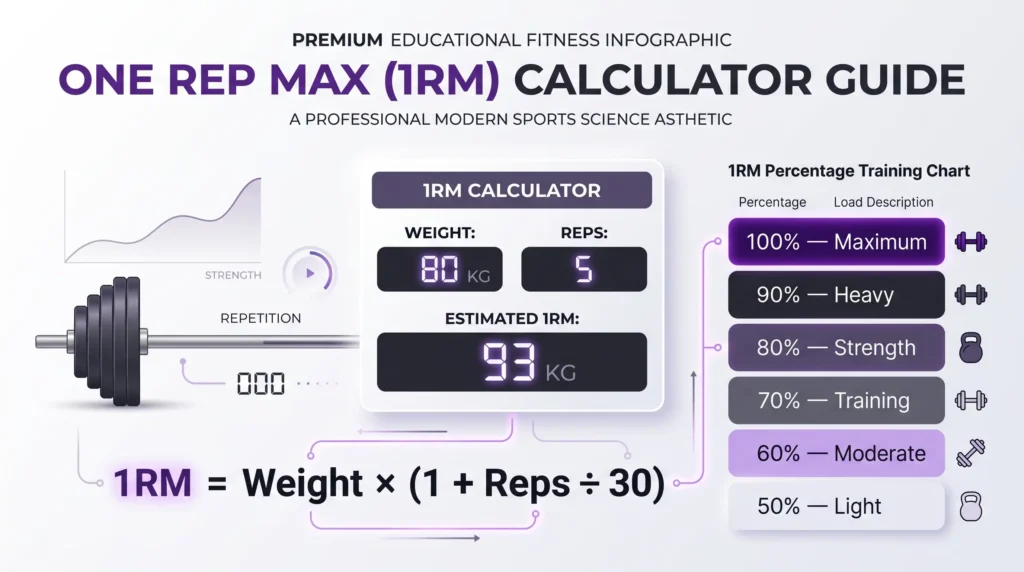
If you lift 80 kg for 5 repetitions, a 1RM formula can use those numbers to estimate your theoretical maximum.
The result is an estimate and may differ from your actual one-repetition maximum.
Popular 1RM Formulas
Several formulas are commonly used to estimate one-repetition maximum. Different formulas can produce slightly different results.
Epley Formula
1RM = Weight × (1 + Reps ÷ 30)
The Epley formula is one of the most widely used equations for estimating 1RM from a submaximal set.
Brzycki Formula
1RM = Weight × 36 ÷ (37 − Reps)
The Brzycki equation provides another method for estimating maximum strength from repetition performance.
Because different equations use different mathematical assumptions, a calculator may produce slightly different results depending on the formula selected.
Example of a 1RM Calculation
Imagine that you perform a bench press with 80 kg and successfully complete 5 repetitions.
Using the Epley formula:
1RM = 80 × (1 + 5 ÷ 30)
1RM ≈ 93.3 kg
This means your estimated one-repetition maximum would be approximately 93 kg. Your actual maximum could be higher or lower depending on technique, fatigue, training experience, and other factors.
What Are 1RM Percentages?
Strength programs often prescribe training loads as a percentage of 1RM. This allows the workout intensity to be adjusted to an individual’s estimated strength.
| 1RM Percentage | General Training Focus |
|---|---|
| 50–60% | Technique, warm-up, lighter training |
| 60–70% | General fitness and higher repetitions |
| 70–80% | Muscle building and strength development |
| 80–90% | Strength-focused training |
| 90%+ | Very heavy strength work |
These ranges are general guidelines. The appropriate percentage depends on the exercise, training program, experience, repetitions, and individual goals.
Using 1RM for Strength Training
Estimated 1RM can help you organize training sessions by giving you a reference point for selecting weights.
For example, a program might prescribe a set at 75% of estimated 1RM rather than simply saying to use a specific number of kilograms.
This makes the program more adaptable because stronger and less experienced lifters can work with different absolute weights while following the same relative intensity.
1RM for Muscle Building
1RM can also be useful when training for muscle growth, although maximizing your one-repetition strength is not the same as maximizing muscle growth.
Hypertrophy-focused programs commonly use moderate loads and multiple repetitions rather than constantly testing maximal strength.
Your estimated 1RM can therefore be used as a reference for selecting appropriate training weights while most of your training remains within a practical repetition range.
If you are planning your nutrition for muscle growth, you can also use the Protein Calculator to estimate daily protein needs.
1RM for Strength and Power
Athletes and strength-focused lifters may use 1RM percentages to organize heavier training sessions.
Higher percentages generally correspond to heavier loads and fewer repetitions, while lower percentages allow more repetitions and may be useful for technique or volume work.
You do not need to train at 90–100% of your 1RM frequently to become stronger. A well-structured program can use a mixture of lighter, moderate, and heavier training loads.
Estimated 1RM vs Actual 1RM
An estimated 1RM is not necessarily the same as your true one-repetition maximum.
Your actual performance can be affected by:
- Training experience.
- Exercise technique.
- Fatigue.
- Sleep and recovery.
- Previous workouts.
- Motivation.
- Equipment and setup.
- Range of motion.
For this reason, treat your calculated 1RM as a useful training estimate rather than an exact measurement.
How Many Repetitions Should I Use?
1RM formulas generally work best when the number of repetitions is within a reasonable submaximal range.
Very high-repetition sets can become increasingly influenced by muscular endurance, cardiovascular fatigue, and exercise technique, which may make a maximum-strength estimate less reliable.
For many practical calculations, a set performed for a relatively low to moderate number of repetitions provides a more useful estimate.
Which Exercises Can Use 1RM?
1RM calculations can be applied to many resistance exercises, including:
- Bench press.
- Squat.
- Deadlift.
- Overhead press.
- Barbell row.
- Leg press.
- Other resistance exercises.
However, the safety and usefulness of testing a true 1RM depends on the exercise, your experience, technique, equipment, and training environment.
How to Use a 1RM Calculator
Using a One Rep Max Calculator is simple:
- Select the exercise you want to evaluate.
- Enter the weight you lifted.
- Enter the number of completed repetitions.
- Calculate your estimated 1RM.
- Use the result to help plan appropriate training loads.
The calculator can save you from having to perform a maximal attempt just to obtain a useful estimate of your strength.
How to Track Your 1RM Over Time
Tracking estimated 1RM can be useful for monitoring strength progression. Rather than testing a true maximum frequently, you can record your weight and repetitions from normal workouts and compare estimated values over time.
For example, if you previously lifted 70 kg for 5 repetitions and later lift 75 kg for 5 repetitions with similar technique, your estimated strength has likely improved.
Try to compare sets performed under similar conditions whenever possible.
1RM and Progressive Overload
Progressive overload means gradually increasing the training challenge over time. This can involve adding weight, increasing repetitions, improving technique, or increasing training volume.
Estimated 1RM can provide one way to monitor whether your strength is progressing.
However, progress should not be judged exclusively by 1RM. Improvements in repetitions, technique, workout quality, and overall training consistency can also be meaningful.
1RM and Recovery
Strength performance depends on more than the weight on the bar. Recovery from training is also important.
Adequate sleep, nutrition, hydration, and sensible training volume can all influence your ability to perform.
For hydration planning, try the Water Intake Calculator .
For overall calorie requirements, the TDEE Calculator can help estimate your daily energy expenditure.
Safety When Training With Heavy Weights
Heavy resistance training requires appropriate technique and sensible progression.
- Warm up before heavy sets.
- Use proper lifting technique.
- Increase loads gradually.
- Use appropriate safety equipment.
- Consider a spotter for exercises where appropriate.
- Do not attempt maximal lifts when excessively fatigued.
A calculated 1RM should not be interpreted as a recommendation to attempt that weight immediately.
Frequently Asked Questions
What does 1RM mean?
1RM means one-repetition maximum. It represents the maximum amount of weight you can lift for one complete repetition of a specific exercise with proper technique.
How does a 1RM Calculator work?
A 1RM Calculator uses the weight you lifted and the number of repetitions completed to estimate your theoretical one-repetition maximum.
What is the Epley 1RM formula?
The Epley formula estimates 1RM using the equation: weight × (1 + repetitions ÷ 30).
Is estimated 1RM accurate?
Estimated 1RM can provide a useful approximation, but it is not guaranteed to match your actual maximum. Individual strength, technique, fatigue, and exercise type can affect the result.
Can I calculate 1RM without lifting my maximum weight?
Yes. A 1RM calculator can estimate your maximum strength from a submaximal set using the weight and repetitions you completed.
What percentage of 1RM is good for muscle growth?
Muscle growth can occur across a relatively broad range of loads when training is appropriately challenging. Many programs use moderate loads and multiple repetitions rather than relying on maximal lifting.
Should I test my actual 1RM?
You do not need to test your true maximum frequently. An estimated 1RM can often provide enough information for planning training intensity while reducing the need for maximal attempts.
Can beginners use a 1RM Calculator?
Beginners can use estimated strength calculations, but they should prioritize learning proper exercise technique and building a solid training foundation before attempting very heavy lifts.