
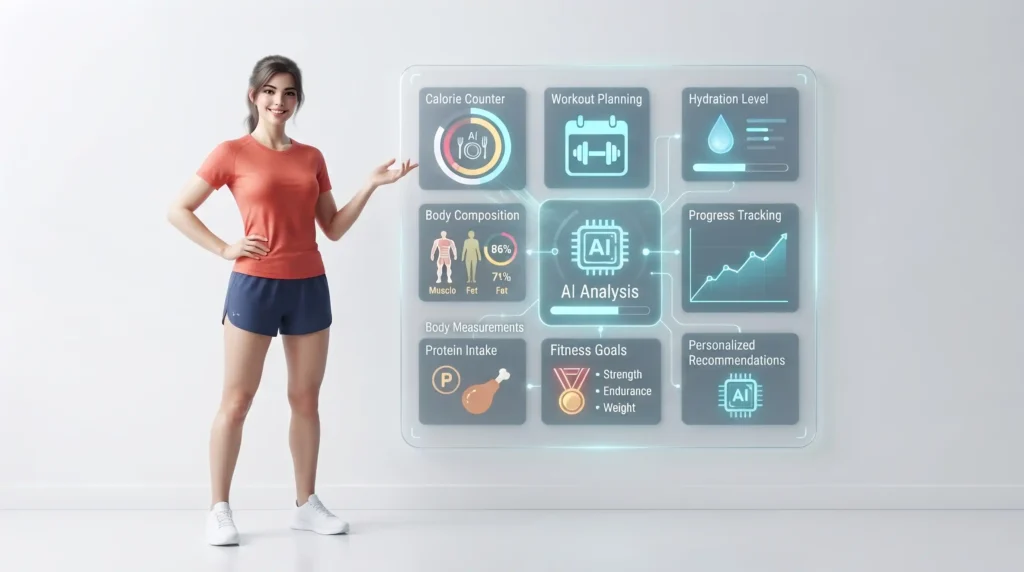
Getting started with fitness can be confusing. You may have questions about calories, protein, workouts, hydration, weight goals, body composition, or how to organize everything into one practical plan.
A Smart Fitness Advisor can help bring these different pieces together by analyzing the information you provide and turning it into personalized, easy-to-understand guidance.
Instead of searching through dozens of separate fitness articles, an AI fitness advisor can help you understand your numbers, identify useful starting points, and organize your goals into a more practical approach.
In this Smart Fitness Advisor Guide, you’ll learn what an AI fitness advisor is, how it works, what information you can provide, what types of recommendations it can help with, and why AI guidance should complement rather than replace qualified medical or fitness professionals.
Ready to explore your personalized recommendations? Try the FitCalculatorAI Smart Fitness Advisor .
What Is a Smart Fitness Advisor?
A Smart Fitness Advisor is an artificial-intelligence-powered tool designed to provide personalized educational guidance based on information about your health and fitness goals.
Depending on the tool, you may provide information such as your age, height, weight, activity level, fitness goals, dietary preferences, training experience, or other relevant information.
The AI can then use that information to help organize recommendations related to areas such as nutrition, exercise, calories, hydration, body composition, and fitness planning.
The goal is not simply to give you another generic fitness article. The goal is to make the information more relevant to your individual situation and objectives.
How Does an AI Fitness Advisor Work?
An AI fitness advisor generally follows a simple process:
- You provide relevant information about yourself and your goals.
- The AI analyzes the information you provide.
- It identifies useful calculations, recommendations, or considerations.
- It organizes the information into an understandable response.
- You can use the guidance as a starting point for your fitness planning.
For example, someone trying to lose weight may provide their body measurements, activity level, and goal. The advisor can then help explain calorie requirements, protein intake, activity, and other factors that may support the goal.
What Can a Smart Fitness Advisor Help With?
AI can be useful across several areas of fitness and nutrition. The exact recommendations depend on the information provided and the capabilities of the specific tool.
Calorie Planning
Calories are an important part of weight management. An AI advisor can help explain estimated calorie needs and how calorie intake may relate to goals such as weight loss, maintenance, or weight gain.
You can also calculate your estimated daily calorie needs with the Calorie Calculator .
Protein and Nutrition
Protein plays an important role in maintaining and building body tissues, particularly when combined with resistance training.
The Protein Calculator can help estimate daily protein requirements based on your information and goals.
An AI advisor can then help explain how protein fits into your overall nutrition strategy.
Workout Planning
An AI fitness advisor can help organize exercise ideas around goals such as improving general fitness, building muscle, increasing endurance, or supporting weight management.
Training recommendations should take into account your experience, available equipment, schedule, recovery, and individual limitations.
Hydration
Hydration is another important part of fitness. Fluid requirements can vary depending on factors such as body size, activity, climate, and exercise duration.
You can estimate your daily water needs with the Water Intake Calculator .
Body Composition
Body weight alone does not tell the complete story about body composition. Measurements such as BMI, body-fat percentage, waist circumference, and lean body mass can provide additional context.
FitCalculatorAI provides several tools for exploring these measurements, including the BMI Calculator, Body Fat Calculator, and Lean Body Mass Calculator.
Why Personalized Fitness Guidance Matters
There is no single workout or nutrition strategy that is perfect for everyone.
A beginner who wants to improve general fitness has different needs from an experienced athlete preparing for a race. Likewise, someone trying to gain weight has different calorie requirements from someone trying to lose body fat.
Personalization can therefore make fitness information easier to apply.
An AI advisor can help organize general principles around the information you provide instead of presenting the same generic recommendation to every person.
AI Fitness Advisor vs. Fitness Calculator
Fitness calculators and AI advisors can work particularly well together, but they serve different purposes.
A calculator generally performs a specific calculation.
For example, a TDEE Calculator estimates Total Daily Energy Expenditure based on the information entered.
An AI advisor can help put that result into context by explaining how estimated energy expenditure may relate to a specific goal.
The calculator provides a number. The AI advisor can help you understand what that number may mean.
Using Multiple Fitness Calculators Together
One advantage of an AI fitness platform is the ability to look at several measurements together rather than focusing on one number.
For example, someone interested in weight management might use:
- BMI Calculator
- Body Fat Calculator
- TDEE Calculator
- Calorie Deficit Calculator
- Protein Calculator
- Water Intake Calculator
Looking at these measurements together can provide more context than relying on one calculation alone.
Smart Fitness Advisor for Weight Loss
If your goal is weight loss, an AI advisor can help you understand the relationship between calorie intake, energy expenditure, physical activity, protein, and body composition.
The Weight Loss Calculator can provide an estimate based on your selected goal.
You can also explore your estimated calorie deficit using the Calorie Deficit Calculator .
A sustainable approach generally involves considering nutrition, activity, recovery, and long-term adherence rather than focusing only on rapid changes in scale weight.
Smart Fitness Advisor for Weight Gain
People trying to gain weight may need a different strategy from those trying to lose weight.
A weight-gain approach often involves sufficient calorie intake, adequate protein, resistance training, and appropriate recovery.
The Weight Gain Calculator can help estimate calorie requirements for a weight-gain goal.
For people focused on muscle development, the Creatine Calculator and Protein Calculator may also provide useful information.
AI Fitness Guidance for Running
AI can also be useful for endurance and running goals.
Runners can use the Running Pace Calculator to calculate running pace from distance and time.
The Race Time Predictor can provide an estimated race time based on running performance.
For cardiovascular training, the Heart Rate Zone Calculator can help explain different training intensity zones.
AI and Nutrition Planning
Nutrition involves much more than calories alone.
Depending on your goals, an AI advisor can help you organize information about protein, carbohydrates, fats, fiber, hydration, and selected micronutrients.
You can explore your macronutrient targets with the Macro Calculator .
For dietary fiber, try the Fiber Intake Calculator .
You can also use the Nutrition Facts Calculator to explore nutrition information.
AI Fitness Advice and Progress Tracking
Progress tracking is one of the most useful parts of a structured fitness plan.
Instead of focusing only on body weight, consider tracking several indicators depending on your goal:
- Body weight
- Waist circumference
- Body-fat estimates
- Strength and performance
- Running pace
- Training consistency
- Energy levels
- Nutrition habits
Changes in one measurement do not always tell the complete story. Monitoring multiple indicators can provide a more balanced view of progress.
What Information Should You Give an AI Fitness Advisor?
The quality of personalized guidance depends partly on the quality and relevance of the information provided.
Depending on your goal, useful information may include:
- Age
- Height
- Body weight
- Activity level
- Fitness experience
- Primary fitness goal
- Training frequency
- Available equipment
- Dietary preferences
- Typical daily activity
You should only provide information that is appropriate for the tool and avoid sharing highly sensitive personal information unnecessarily.
How to Get Better Results From AI Fitness Guidance
Be Specific About Your Goal
Instead of simply saying “I want to get fit,” explain whether your main goal is weight loss, muscle gain, strength, endurance, general fitness, or another objective.
Provide Accurate Measurements
Calculations are only as useful as the information entered. Use reasonably accurate measurements for height, weight, activity, and other relevant variables.
Explain Your Training Experience
A beginner and an experienced athlete should not necessarily follow the same training approach.
Mention Available Equipment
Workout recommendations should reflect what you can realistically access, whether that means a full gym, home equipment, or bodyweight exercises.
Ask Follow-Up Questions
AI tools can be particularly useful when you ask follow-up questions that clarify recommendations or help you understand why a particular approach was suggested.
What AI Cannot Replace
AI can be useful for education, calculations, planning, and organizing general fitness information, but it has important limitations.
AI should not replace a doctor, registered dietitian, physiotherapist, certified fitness professional, or other qualified healthcare provider when professional assessment is required.
This is especially important when dealing with medical conditions, injuries, medications, pregnancy, eating disorders, severe symptoms, or other situations requiring individualized professional care.
AI Fitness Advisor vs. Personal Trainer
An AI fitness advisor and a personal trainer can provide different types of support.
AI can provide convenient educational information, calculations, ideas, explanations, and planning assistance.
A qualified personal trainer can observe your exercise technique, provide real-time coaching, adapt exercises during a session, and consider practical factors that an AI system may not be able to observe.
For some people, using AI for planning and education alongside qualified professional support can be a useful combination.
Frequently Asked Questions About Smart Fitness Advisors
A Smart Fitness Advisor is an AI-powered tool that can provide personalized educational guidance based on information about your fitness goals, body measurements, activity, nutrition, and other relevant factors.
AI can help organize a workout plan based on goals, training experience, schedule, and available equipment. However, exercise recommendations should be adapted to individual abilities and limitations.
AI can help explain calorie requirements, activity, nutrition, and other factors involved in weight management. It should be used as an educational planning tool rather than a replacement for professional medical advice.
AI can help organize information about resistance training, protein intake, calories, recovery, and progress tracking. Building muscle also depends on consistent training, nutrition, recovery, and individual factors.
AI can help explain calorie requirements, while dedicated calculators can perform specific estimates. The TDEE Calculator and Calorie Calculator can be used for this purpose.
No. AI can provide planning and educational support, but it cannot fully replace the observation, coaching, professional judgment, and individualized assessment provided by a qualified fitness professional.
AI can provide general health information, but it should not be relied upon to diagnose medical conditions or replace professional medical assessment. Seek qualified healthcare advice when you have medical concerns.
Explore FitCalculatorAI Health & Fitness Tools
A Smart Fitness Advisor becomes even more useful when combined with dedicated calculators that provide specific estimates.
Explore the complete FitCalculatorAI Health & Fitness Calculators collection to find tools for calories, nutrition, body composition, training, running, hydration, and supplements.
You can also visit the FitCalculatorAI Blog for additional health, fitness, nutrition, and calculator guides.
When you’re ready, try the Smart Fitness Advisor to explore personalized health and fitness guidance based on your goals.
Medical Disclaimer
This guide and the FitCalculatorAI Smart Fitness Advisor are provided for general educational and informational purposes only. AI-generated information may contain errors and should not be considered a diagnosis, medical treatment, or a substitute for advice from a qualified healthcare professional. Individual health, nutrition, exercise, and medical needs can vary significantly. Consult an appropriate healthcare or fitness professional when professional assessment or individualized care is needed.