
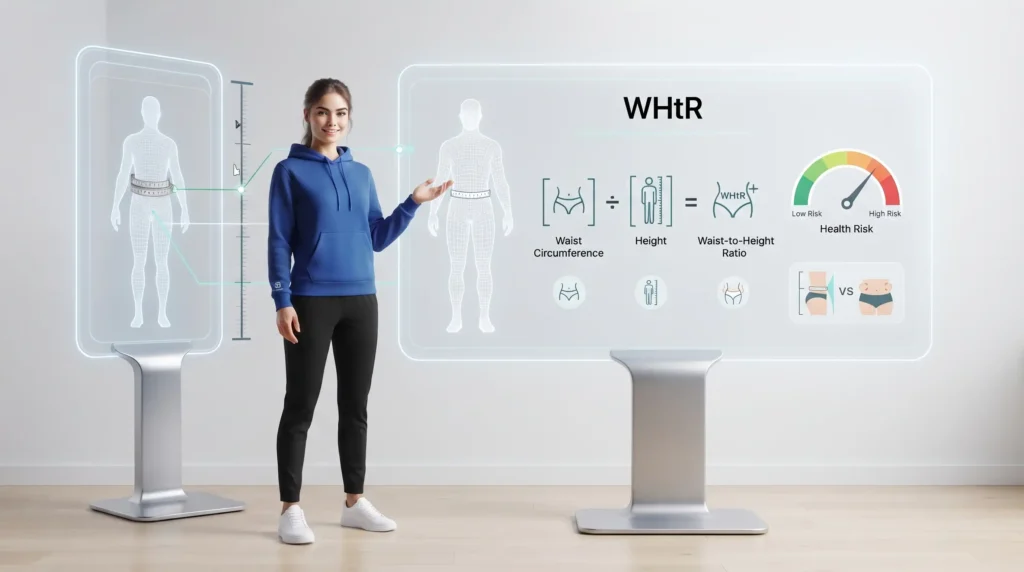
Your body weight is only one part of understanding body size and body composition. Another simple measurement that can provide useful information is the Waist-to-Height Ratio (WHtR).
A Waist-to-Height Ratio Calculator compares your waist circumference with your height and produces a simple ratio. Because it focuses on waist size relative to height, WHtR can provide additional context when evaluating abdominal size and body proportions.
In this Waist-to-Height Ratio Calculator Guide, you’ll learn what WHtR means, how to measure your waist, how to calculate the ratio, how to interpret commonly used reference values, and how WHtR compares with BMI and Waist-to-Hip Ratio.
To calculate your result now, use the FitCalculatorAI Waist-to-Height Ratio Calculator .
What Is Waist-to-Height Ratio?
Waist-to-Height Ratio, commonly abbreviated as WHtR, is a measurement that compares your waist circumference with your height.
The calculation is expressed as a ratio rather than a measurement in kilograms or centimeters.
For example, if your waist measures 80 cm and your height is 170 cm, your WHtR would be:
80 ÷ 170 = 0.47
The resulting number provides a simple way to describe waist size relative to overall height.
What Is a Waist-to-Height Ratio Calculator?
A Waist-to-Height Ratio Calculator is an online tool that automatically calculates WHtR using your waist circumference and height.
You generally only need two measurements:
- Waist circumference
- Height
The calculator divides the waist measurement by the height measurement and returns your estimated Waist-to-Height Ratio.
This makes it easier to calculate and track WHtR without performing the mathematical calculation manually.
How Is Waist-to-Height Ratio Calculated?
The basic WHtR formula is:
Waist-to-Height Ratio = Waist Circumference ÷ Height
Your waist and height must be expressed using the same unit.
For example, if your waist is 84 cm and your height is 175 cm:
WHtR = 84 ÷ 175 = 0.48
Your estimated Waist-to-Height Ratio would therefore be approximately 0.48.
How to Measure Your Waist Correctly
The accuracy of your WHtR depends heavily on the accuracy and consistency of your waist measurement.
To measure your waist:
- Stand upright and relax your abdomen.
- Use a flexible measuring tape.
- Place the tape around your waist using a consistent measurement method.
- Keep the tape horizontal around your body.
- Make sure the tape is snug without compressing your skin.
- Take the measurement after a normal exhalation.
Different organizations and research studies may use slightly different anatomical landmarks for waist measurement. The most important factor when tracking your progress is to use the same method consistently.
How to Measure Height Correctly
Accurate height is also important because it forms the second part of the WHtR calculation.
Ideally, measure your height without shoes while standing upright on a flat surface.
Keep your posture natural and use a consistent measurement method.
If your height is entered in centimeters, your waist should also be entered in centimeters. If you use inches for height, use inches for waist circumference as well.
What Is a Healthy Waist-to-Height Ratio?
WHtR reference values are commonly used as general screening guidelines, but they should not be treated as a diagnosis.
A widely used simple public-health rule is that your waist circumference should be less than half of your height, corresponding to a WHtR below 0.50.
Some research and clinical screening approaches use additional categories, and thresholds can vary according to age, sex, ethnicity, and the specific population being studied.
Therefore, a WHtR value should be interpreted in context rather than viewed as a universal boundary between health and disease.
What Does a WHtR Below 0.5 Mean?
A WHtR below 0.50 means that your waist circumference is less than half of your height.
For example, a person who is 180 cm tall with a waist circumference of 85 cm has:
85 ÷ 180 = 0.47
This is below 0.50.
However, a result below 0.50 does not guarantee that someone is healthy. WHtR is only one screening measurement and should be considered alongside other factors.
What Does a WHtR of 0.5 or Higher Mean?
A WHtR of 0.50 means that waist circumference is approximately half of height.
Higher values indicate that waist circumference represents a larger proportion of height.
Higher waist-to-height ratios have been associated in research with greater cardiometabolic risk in many populations, but a single result cannot determine an individual’s health status.
If your measurement is higher than a commonly used screening threshold, consider discussing your overall health and risk factors with a qualified healthcare professional rather than interpreting the number in isolation.
Why Does Waist-to-Height Ratio Matter?
WHtR is useful because it focuses on waist size relative to height.
Waist circumference can provide information about abdominal fat distribution, while height provides a simple way to put the waist measurement into body-size context.
This makes WHtR different from measurements that only consider total body weight.
Abdominal fat distribution is relevant to metabolic health, which is one reason waist-based measurements are often used as part of broader health screening.
Waist-to-Height Ratio vs. BMI
WHtR and BMI measure different aspects of body size.
BMI compares body weight with height.
WHtR compares waist circumference with height.
BMI does not directly show where body fat is distributed. WHtR provides additional information about waist size relative to height.
You can calculate your BMI with the BMI Calculator .
Using both measurements can provide more context than relying on either number alone.
Waist-to-Height Ratio vs. Waist-to-Hip Ratio
WHtR and Waist-to-Hip Ratio are both waist-based measurements, but they use different comparison measurements.
WHtR: Waist circumference ÷ height
WHR: Waist circumference ÷ hip circumference
You can calculate your WHR with the Waist-to-Hip Ratio Calculator .
These measurements should not be treated as interchangeable because they describe different aspects of body proportions.
Waist-to-Height Ratio vs. Body Fat Percentage
WHtR is not the same as body-fat percentage.
Body-fat percentage estimates how much of your total body weight consists of fat, while WHtR describes waist circumference relative to height.
If you want to estimate body-fat percentage, use the Body Fat Calculator .
Combining several measurements can provide a broader picture of body composition and body size.
Example Waist-to-Height Ratio Calculation
Consider a person who is:
- Height: 175 cm
- Waist circumference: 82 cm
The calculation would be:
82 ÷ 175 = 0.469
The person’s estimated WHtR is approximately 0.47.
This result can then be compared with general reference values, while remembering that WHtR alone cannot determine overall health.
Can Waist-to-Height Ratio Change?
Yes. WHtR can change when waist circumference changes, when height changes during growth, or when body composition changes.
For adults, height generally remains relatively stable, so changes in WHtR are usually driven by changes in waist circumference.
Weight loss, weight gain, changes in body fat, physical activity, and other lifestyle factors can influence waist circumference.
If your goal is weight loss, the Weight Loss Calculator can help estimate calorie requirements for your goal.
If your goal is weight gain, try the Weight Gain Calculator .
How to Track WHtR Over Time
If you want to monitor your WHtR, consistency is more important than taking measurements every day.
- Use the same measuring tape.
- Measure your waist at the same anatomical location.
- Measure under similar conditions.
- Use the same measurement units.
- Measure height consistently when necessary.
- Record your results over time.
Looking at a longer-term trend can be more useful than focusing on small differences between individual measurements.
Common Mistakes When Calculating WHtR
Using Different Units
Waist and height must be expressed in the same unit before calculating the ratio.
Measuring the Waist Inconsistently
Measuring at different locations can produce different waist values. Choose a consistent method and use it each time.
Pulling the Tape Too Tightly
Compressing the abdomen with the measuring tape can make your waist measurement artificially smaller.
Measuring Immediately After Eating
Temporary changes in abdominal fullness can influence the measurement. Measuring under similar conditions makes comparisons more useful.
Treating WHtR as a Diagnosis
WHtR is a screening measurement and cannot diagnose a medical condition by itself.
Frequently Asked Questions About Waist-to-Height Ratio
What is waist-to-height ratio?
Waist-to-height ratio is the circumference of your waist divided by your height using the same unit for both measurements.
How do I calculate WHtR?
Divide your waist circumference by your height. For example, 80 cm waist divided by 170 cm height equals approximately 0.47.
What is a good waist-to-height ratio?
A commonly used simple screening reference is to keep waist circumference below half of height, corresponding to a WHtR below 0.50. However, this is a general guideline and not a diagnosis.
Is 0.5 a healthy waist-to-height ratio?
A WHtR of 0.50 means your waist circumference is half your height. It is commonly used as an important screening threshold, but individual health should not be judged using this number alone.
Is WHtR better than BMI?
Neither is universally better. BMI evaluates body weight relative to height, while WHtR evaluates waist circumference relative to height. They provide different information.
Does WHtR measure body fat?
No. WHtR does not directly measure total body-fat percentage. It is a waist-based body-size measurement that can provide information about abdominal size and body proportions.
Can I calculate WHtR at home?
Yes. You need a flexible measuring tape, your waist circumference, and your height. You can then enter these values into a Waist-to-Height Ratio Calculator.
Can WHtR decrease when I lose weight?
It can decrease if your waist circumference becomes smaller. Because adult height is generally stable, changes in WHtR are usually related to changes in waist size.
Should children use the same WHtR thresholds as adults?
Children and adolescents are still growing, so adult reference thresholds should not simply be applied to them. Pediatric measurements should be interpreted using appropriate age- and sex-specific growth references.
Calculate Your Waist-to-Height Ratio With FitCalculatorAI
Waist-to-Height Ratio is a simple measurement that compares waist circumference with height and can provide additional context about body size and abdominal proportions.
Use the FitCalculatorAI Waist-to-Height Ratio Calculator to calculate your WHtR quickly.
For a broader look at your body measurements, you can also use the Waist-to-Hip Ratio Calculator , BMI Calculator , Body Fat Calculator , and Healthy Weight Range Calculator .
You can also explore the complete collection of FitCalculatorAI Health & Fitness Calculators covering weight, body composition, calories, nutrition, fitness, and supplements.
For broader personalized health and fitness guidance, visit the AI Health & Fitness Advisor .
Medical Disclaimer
This guide and the FitCalculatorAI Waist-to-Height Ratio Calculator are provided for general educational and informational purposes only. WHtR is a screening measurement and cannot diagnose a medical condition or determine an individual’s overall health. Reference values may vary according to age, sex, population, and the guideline being used. If you have concerns about your weight, waist circumference, metabolic health, or other health measurements, consult a qualified healthcare professional.