
A Keto Calculator can help estimate your daily calorie, protein, carbohydrate, and fat targets when following a ketogenic or very low-carbohydrate eating pattern.
Instead of choosing macronutrient targets randomly, a keto calculator uses information such as your age, sex, height, weight, activity level, and goal to create a practical starting point.
This guide explains how a keto calculator works, how ketogenic macronutrients are typically structured, how to calculate your calorie and macro targets, and how to use the results more effectively.
What Is a Keto Calculator?
A Keto Calculator is an online nutrition tool that estimates calorie and macronutrient targets for a ketogenic or low-carbohydrate diet.
Depending on the calculator, it may estimate your daily calorie needs and then divide those calories between protein, carbohydrates, and dietary fat.
The goal is to provide a practical starting point rather than a perfectly individualized nutrition prescription.
How Does a Keto Calculator Work?
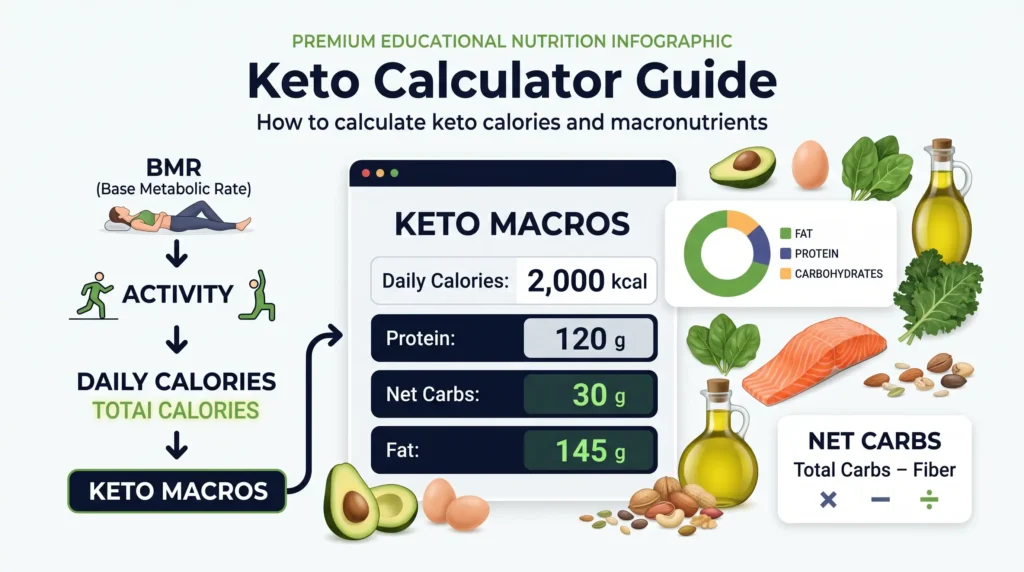
A keto calculator generally begins by estimating your daily energy needs. This can involve calculating your Basal Metabolic Rate (BMR) and then accounting for physical activity.
Your estimated calorie requirement can then be adjusted depending on whether your goal is weight loss, maintenance, or weight gain.
The remaining calories can be distributed between protein, carbohydrates, and fat according to the selected ketogenic approach.
A simplified process looks like this:
BMR → Activity → Daily Calories → Keto Macronutrients
What Is a Ketogenic Diet?
A ketogenic diet is a dietary pattern that substantially restricts carbohydrate intake while providing adequate protein and a relatively high proportion of calories from fat.
Restricting carbohydrates can reduce the body’s available glucose supply and may encourage greater production of ketone bodies.
The exact amount of carbohydrate needed to maintain nutritional ketosis varies between individuals, so there is no single carbohydrate target that works identically for everyone.
Typical Keto Macronutrient Ratios
Traditional ketogenic diets are often described using a high-fat, moderate-protein, very-low-carbohydrate distribution.
| Macronutrient | Common Keto Approach | Role |
|---|---|---|
| Fat | Higher proportion | Major energy source |
| Protein | Moderate | Supports muscle and tissue |
| Carbohydrates | Very low | Kept relatively restricted |
Exact percentages can vary depending on the type of ketogenic diet, individual goals, activity level, and the reason someone is following the diet.
How Many Carbohydrates Are Allowed on Keto?
Many ketogenic diets use a carbohydrate intake of roughly 20–50 grams of net carbohydrates per day, although individual responses can differ.
Some people use total carbohydrates while others track net carbohydrates. Net carbohydrates are generally calculated by subtracting fiber from total carbohydrates, although labeling conventions can vary by country.
A specific carbohydrate target should not be assumed to guarantee ketosis. Individual carbohydrate tolerance and metabolic responses can vary.
What Are Net Carbs?
Net carbohydrates are commonly used in ketogenic dieting to estimate the carbohydrates that remain after accounting for dietary fiber.
Basic calculation:
Net Carbohydrates = Total Carbohydrates − Fiber
Some products also contain sugar alcohols, and their treatment can depend on the specific type and the nutrition-labeling system being used.
How to Use a Keto Calculator
Using a keto calculator usually requires several basic personal and activity measurements.
- Enter your age.
- Select your sex.
- Enter your height and weight.
- Select your activity level.
- Choose your primary goal.
- Calculate your estimated calorie and keto macro targets.
For the most useful starting estimate, enter accurate and up-to-date information.
Calories and the Keto Diet
Following a ketogenic diet does not automatically mean that calories no longer matter.
If your goal is weight loss, your overall energy intake still plays an important role in determining whether body weight decreases over time.
You can estimate your daily energy requirements using the TDEE Calculator .
Your estimated TDEE can provide a useful reference when deciding how aggressive your calorie deficit should be.
Keto for Weight Loss
Many people use a ketogenic diet as part of a weight-loss strategy. Weight loss generally occurs when average energy intake remains below energy expenditure over time.
A keto eating pattern may help some people control hunger or reduce overall food intake, but individual experiences vary.
A moderate calorie deficit is often easier to maintain than an extremely restrictive approach.
If you want to understand your calorie deficit separately, use the Calorie Deficit Calculator .
Protein on a Keto Diet
Protein is an important part of a ketogenic diet because it supports muscle maintenance, tissue repair, and many essential biological functions.
Keto does not mean that protein should be eliminated or kept extremely low.
The appropriate protein intake depends on factors such as body size, activity, training status, age, and goals.
Use the Protein Calculator to estimate a practical daily protein target.
Fat on a Keto Diet
Dietary fat usually provides a large proportion of calories on a ketogenic diet.
However, choosing healthy fat sources can be more important than simply maximizing fat intake.
Useful sources can include foods such as avocado, olive oil, nuts, seeds, fatty fish, eggs, and other minimally processed foods.
The overall quality of the diet still matters even when carbohydrate intake is low.
What Foods Can You Eat on Keto?
A well-planned ketogenic eating pattern can include a wide variety of nutrient-dense foods.
- Eggs.
- Fish and seafood.
- Chicken and other poultry.
- Meat and other protein sources.
- Avocado.
- Olive oil.
- Nuts and seeds.
- Non-starchy vegetables.
- Full-fat or lower-carbohydrate dairy products when tolerated.
Highly processed foods can still be low in carbohydrates while providing relatively little nutritional value, so food quality remains important.
Foods Commonly Limited on Keto
Foods that are high in carbohydrates are generally restricted when following a ketogenic diet.
- Sugary drinks.
- Candy and sweets.
- Most traditional bread.
- Large portions of pasta and rice.
- Many baked goods.
- Sugar-heavy sauces.
- Large portions of high-carbohydrate fruits.
The exact foods and quantities that fit a ketogenic diet depend on the person’s carbohydrate target.
Keto and Fiber
Reducing carbohydrates does not mean eliminating vegetables and fiber. Many low-carbohydrate vegetables can provide important vitamins, minerals, and dietary fiber.
Foods such as leafy greens, broccoli, cauliflower, zucchini, and other non-starchy vegetables can often fit into a low-carbohydrate eating plan.
If you want to estimate your daily fiber intake, try the Fiber Intake Calculator .
Keto and Electrolytes
Changes in carbohydrate intake can affect fluid and electrolyte balance, particularly during the early stages of a ketogenic diet.
Sodium, potassium, magnesium, and adequate fluid intake are important components of normal hydration and physiological function.
Your overall electrolyte needs can vary depending on diet, activity, climate, sweating, medications, and health status.
For a broader hydration reference, you can use the Water & Electrolyte Calculator .
How Accurate Is a Keto Calculator?
A keto calculator provides an estimate rather than a guaranteed nutritional prescription.
Calorie requirements can change as body weight, activity level, muscle mass, training volume, and other factors change.
Your calculator results should therefore be treated as a starting point that can be adjusted according to your progress and individual needs.
How to Adjust Your Keto Calories
If your goal is weight loss, you may start with a reasonable calorie deficit and monitor your progress over several weeks.
If your weight is not moving as expected, consider reviewing your food portions, activity, consistency, and calorie intake rather than making extreme changes immediately.
For muscle gain or performance goals, calorie requirements may need to increase instead.
Look at trends over time instead of judging your progress from one day’s body weight. Daily weight can fluctuate because of hydration, food intake, sodium, and other factors.
Common Keto Calculator Mistakes
Setting Calories Too Low
A very aggressive calorie restriction can make a diet difficult to maintain and may negatively affect energy, training, and adherence.
Ignoring Protein
Focusing only on keeping carbohydrates low can lead some people to overlook adequate protein intake.
Relying Only on Percentages
Macro percentages can be useful, but actual gram targets often provide a more practical way to track daily intake.
Ignoring Food Quality
A low-carbohydrate diet can still contain too many highly processed foods. Nutrient density and overall diet quality remain important.
Changing Targets Too Frequently
Constantly changing calorie and macro targets makes it difficult to understand whether your current plan is actually working.
Keto Macros Example
Consider a hypothetical person whose daily keto calorie target is 2,000 calories.
A calculator might distribute those calories between fat, protein, and carbohydrates according to the selected keto strategy.
Example only:
2,000 daily calories do not automatically mean that everyone should use the same grams of protein, fat, and carbohydrates.
Individual body size, activity level, training goals, food preferences, and dietary approach should be considered when setting macros.
Can Keto Work for Everyone?
No single dietary pattern works equally well for every person.
Some people find a ketogenic diet convenient and sustainable, while others prefer a balanced diet with a higher carbohydrate intake.
The most useful eating pattern is generally one that supports your health goals and that you can follow consistently.
Frequently Asked Questions
What is a Keto Calculator?
A Keto Calculator estimates daily calories and macronutrient targets for a ketogenic or very low-carbohydrate eating pattern.
How many carbs should I eat on keto?
Many ketogenic diets use roughly 20–50 grams of net carbohydrates per day, although the amount that works for maintaining ketosis can vary between individuals.
How much protein should I eat on keto?
Protein needs depend on body size, activity, training status, age, and goals. Keto does not require eliminating protein.
Is keto good for weight loss?
A ketogenic diet can help some people lose weight, particularly when it helps them maintain an appropriate calorie deficit. Individual results vary.
What are net carbs?
Net carbohydrates are commonly calculated by subtracting fiber from total carbohydrates. The treatment of sugar alcohols can vary depending on the type and labeling system.
Can I eat vegetables on keto?
Yes. Many non-starchy vegetables can fit into a ketogenic diet while providing fiber, vitamins, minerals, and other nutrients.
Do keto calories matter?
Yes. Carbohydrate restriction does not completely remove the role of energy balance. Total calorie intake can still influence changes in body weight.
Is a Keto Calculator accurate?
It provides an estimate based on the information entered. Individual calorie and macro needs can differ, so results should be treated as a starting point rather than a medical prescription.