
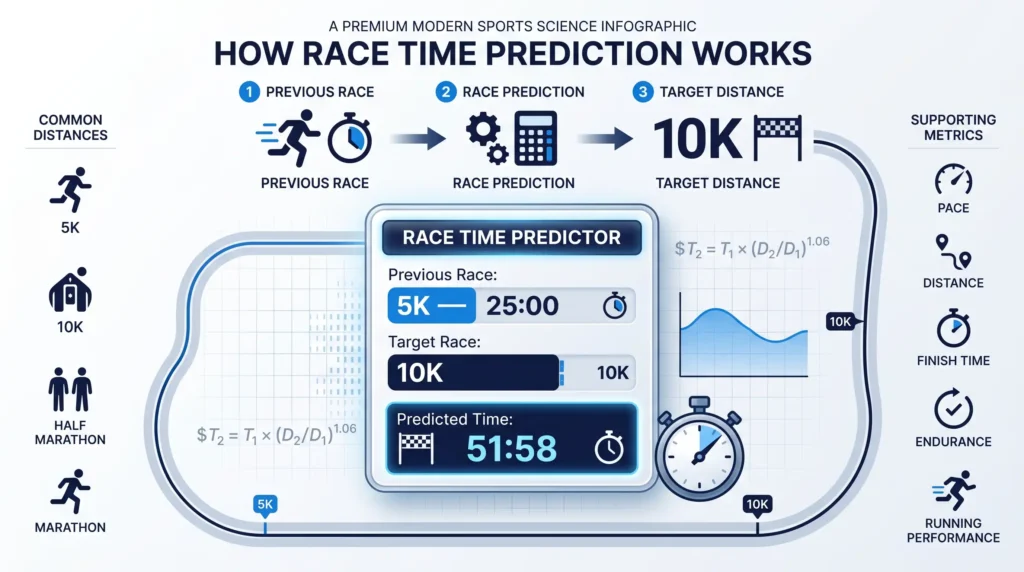
A Race Time Predictor helps runners estimate how long they may take to complete a race based on a previous running performance. It can be useful when preparing for distances such as a 5K, 10K, half marathon, or marathon.
Instead of guessing your potential race time, a race prediction calculator uses a previous race result and estimates how your performance may translate to another distance.
This guide explains how race time prediction works, how to use a Race Time Predictor, what affects predicted race times, and how to use your results when planning your running training.
What Is a Race Time Predictor?
A Race Time Predictor is a running calculator designed to estimate a potential race finish time for a different distance using a known running performance.
For example, if you recently completed a 5K, a race predictor can estimate possible performances for a 10K, half marathon, or marathon.
The prediction is an estimate rather than a guarantee. Longer races require endurance, pacing, fueling, hydration, and race-specific preparation that may not be fully represented by a single previous race.
How Does a Race Time Predictor Work?
Most race prediction methods use a previous race distance and finish time to estimate performance at another distance.
A common approach is based on the relationship between race distance and sustainable running performance. One well-known mathematical model is the Riegel formula.
A simplified version of the Riegel prediction formula is:
T₂ = T₁ × (D₂ ÷ D₁)1.06
Where T₁ is the known race time, D₁ is the known race distance, T₂ is the predicted time, and D₂ is the target distance.
The exact exponent or calculation method can vary between prediction tools. The important idea is that running performance does not scale linearly as race distance increases.
What Information Do You Need?
Depending on the calculator, you may need only a few basic pieces of information:
- Your previous race distance.
- Your previous race time.
- Your target race distance.
Some advanced prediction systems may also consider additional information, but a simple race predictor can provide a useful estimate from previous race performance alone.
Common Race Distances
| Race | Distance |
|---|---|
| 5K | 5 kilometers |
| 10K | 10 kilometers |
| Half Marathon | 21.1 kilometers |
| Marathon | 42.2 kilometers |
These distances are commonly used for recreational and competitive road running and are useful reference points when planning race goals.
How to Use a Race Time Predictor
Using a race prediction calculator is straightforward.
- Enter a recent race distance.
- Enter your actual finish time.
- Select the target race distance.
- Calculate your predicted finish time.
- Use the result as a training reference rather than a guaranteed result.
For the most useful prediction, choose a recent race result that represents your current fitness level.
Why Recent Race Results Matter
Your fitness can change significantly during a training cycle. A race result from several months ago may no longer represent your current ability.
A recent performance from a properly completed race or time trial can give the predictor more relevant information.
Use a race result that was performed at a strong but realistic effort. An unusually slow race caused by illness, weather, injury, or poor pacing may produce a less useful prediction.
Race Time and Running Pace
Race time and running pace are closely connected. If you know the distance and finish time, you can calculate your average pace.
Understanding your pace can make predicted race times easier to apply during training and racing.
Use the Running Pace Calculator to calculate your pace for different running distances and times.
Race Time Prediction Example
Imagine a runner completes a 5K in 25 minutes and wants to estimate a potential 10K performance.
The Race Time Predictor uses the previous distance and time to estimate a corresponding 10K finish time.
Important: The predicted 10K time assumes that the runner’s endurance and ability to maintain performance across the longer distance are reasonably developed.
A runner who has strong speed but limited endurance may find the prediction more difficult to achieve over the longer distance.
What Can Affect Your Predicted Race Time?
A mathematical prediction cannot account for every factor that influences real-world running performance.
Important factors include:
- Current fitness level.
- Weekly running volume.
- Long-run experience.
- Running economy.
- Race pacing.
- Weather and temperature.
- Wind and elevation.
- Hydration and nutrition.
- Sleep and recovery.
- Race-day experience.
Why Longer Race Predictions Can Be Less Accurate
Predicting a short race from another short race can sometimes produce a useful estimate when fitness levels are similar.
However, predicting a marathon from a 5K result can be much less reliable if the runner has not developed sufficient endurance.
Long-distance races place additional demands on energy management, hydration, fueling, muscular endurance, and pacing.
Race Time Predictor for 5K
A 5K is a popular distance for beginners and experienced runners. Because the race is relatively short, speed and aerobic fitness can have a strong influence on performance.
A recent 5K result can also be used as a starting point for estimating longer-distance performances.
Race Time Predictor for 10K
A 10K requires a combination of speed and endurance. A runner preparing for a 10K should gradually become comfortable maintaining a strong pace for a longer period.
Comparing your predicted 10K time with your actual training performances can help you understand whether your current fitness is progressing toward your race goal.
Race Time Predictor for Half Marathon
Half marathon performance depends heavily on endurance and the ability to maintain a controlled pace for an extended period.
A prediction based on a shorter race may overestimate your potential if you have limited long-distance training.
Building weekly mileage gradually and including appropriate long runs can help prepare the body for the demands of a half marathon.
Race Time Predictor for Marathon
Marathon predictions should be treated particularly carefully. A marathon requires substantial endurance and race-specific preparation.
A fast 5K or 10K does not automatically mean that a runner is ready to maintain the corresponding predicted pace for 42.2 kilometers.
Marathon training should include appropriate long runs, recovery, pacing practice, and fueling strategies.
How to Train for a Faster Race Time
Build Consistent Weekly Mileage
Consistency is one of the most important foundations of running development. Gradually increasing training volume can help improve endurance without unnecessarily increasing training stress.
Include Easy Runs
Easy running allows you to build aerobic volume while managing fatigue. Not every training session needs to be performed at a hard intensity.
Add Quality Workouts
Depending on your experience and goal, workouts such as intervals, tempo runs, and threshold sessions can help develop speed and endurance.
Practice Race Pace
Learning what your target pace feels like can help improve pacing control during races.
Prioritize Recovery
Training adaptations occur alongside adequate recovery. Sleep, nutrition, rest days, and sensible progression are important parts of a running plan.
Race Pace and Heart Rate
Heart rate can provide another way to monitor training intensity. However, heart-rate responses vary between individuals and can be affected by heat, dehydration, stress, caffeine, and fatigue.
If you want to organize your training intensity around heart rate, try the Heart Rate Zone Calculator .
Race Performance and VO₂ Max
Aerobic fitness can influence running performance, although VO₂ Max is not the only factor that determines race results.
Running economy, lactate threshold, endurance, pacing, and training experience also contribute to performance.
You can estimate aerobic fitness using the VO₂ Max Calculator .
How Accurate Is a Race Time Predictor?
A Race Time Predictor should be considered a performance estimate rather than a guaranteed race result.
The prediction is generally more useful when the previous race is recent, the runner has similar fitness across distances, and the target distance matches the runner’s endurance level.
Real race conditions can produce a faster or slower result than the mathematical prediction.
How to Use Your Prediction as a Race Goal
Instead of treating the predicted time as a strict requirement, use it as a starting point for developing a realistic race strategy.
- Use the prediction to establish a possible target range.
- Compare it with recent training performances.
- Consider your weekly mileage and endurance.
- Account for the course and expected weather.
- Start conservatively and adjust based on how you feel.
A realistic race goal should consider both your mathematical prediction and your actual training experience.
Frequently Asked Questions
What is a Race Time Predictor?
A Race Time Predictor estimates a potential finish time for one race distance using a previous race performance at another distance.
How does a race prediction calculator work?
It typically uses a mathematical relationship between a known race distance and time and a target distance to estimate a potential finish time.
Can I predict my marathon time from a 5K?
You can estimate a marathon time from a 5K performance, but the prediction may be less reliable if you do not have sufficient marathon-specific endurance training.
Is a Race Time Predictor accurate?
It can provide a useful estimate, but it cannot account for every factor affecting race performance. Training, weather, pacing, endurance, and race conditions can all change the final result.
What is the Riegel formula?
The Riegel formula is a commonly used mathematical method for predicting race performance across different distances based on previous race results.
Can a race predictor help me choose a goal time?
Yes. A predicted time can provide a useful starting point for setting a realistic goal, especially when combined with recent training data and race-specific preparation.
Should I race at my predicted pace from the start?
Not necessarily. Your target pace should also consider your fitness, course, weather, and race strategy. Starting slightly conservatively can help prevent early fatigue.