
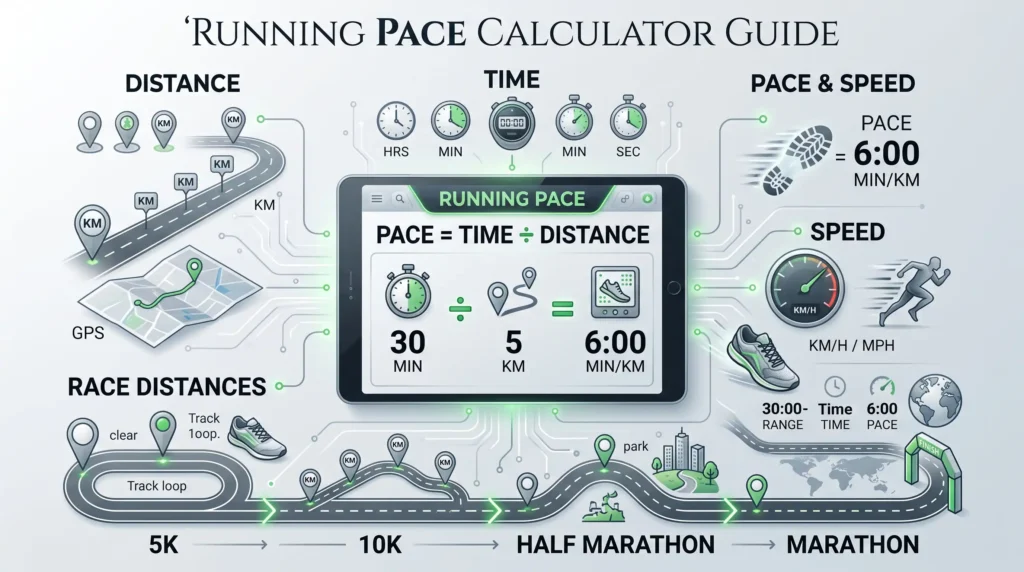
Running pace is one of the most useful measurements for runners. It tells you how long it takes to cover a specific distance and helps you plan workouts, monitor progress, and prepare for races.
A Running Pace Calculator makes it easy to calculate your average pace using your running distance and finish time. Depending on the tool, you can also estimate race finish times and compare different running speeds.
In this guide, you will learn how running pace works, how to calculate it manually, the difference between pace and speed, and how to use your results to improve your running training.
Table of Contents
What Is Running Pace?
Running pace describes how much time you need to cover a specific distance. It is usually expressed in minutes per kilometer (min/km) or minutes per mile (min/mile).
For example, if you run 5 kilometers in 30 minutes, your average running pace is 6 minutes per kilometer.
Simple example:
30 minutes ÷ 5 kilometers = 6:00 min/km
Running pace is useful because it helps you compare performances, control workout intensity, and understand how quickly you are covering a distance.
What Is a Running Pace Calculator?
A Running Pace Calculator is an online tool that calculates your average running pace based on your distance and total running time.
Depending on the calculator, you may also be able to calculate:
- Running pace in minutes per kilometer or mile.
- Average running speed in km/h or mph.
- Running time for a specific distance.
- Distance covered within a given time.
- Estimated finish times for common race distances.
You can use the Running Pace Calculator on FitCalculatorAI to calculate your pace without performing the calculations manually.
How to Calculate Running Pace
Calculating running pace is straightforward. You simply divide your total running time by the distance covered.
Running Pace = Total Running Time ÷ Total Distance
For example, imagine you complete a 10 km run in 55 minutes.
55 minutes ÷ 10 km = 5.5 minutes per kilometer.
Since 0.5 minute equals 30 seconds, your average pace is 5 minutes and 30 seconds per kilometer (5:30 min/km).
This calculation works for different distances, provided you use consistent units and express the final result in the appropriate time format.
Running Pace vs. Running Speed
Running pace and running speed describe the same performance from different perspectives.
Pace measures how much time you need to cover a distance, while speed measures how much distance you cover in a specific amount of time.
| Measurement | What It Means | Example |
|---|---|---|
| Running pace | Time required to cover a distance | 5:30 min/km |
| Running speed | Distance covered per unit of time | Approximately 10.9 km/h |
Runners often use pace to control their effort during workouts and races. Speed can be useful when comparing overall performance or tracking movement with fitness devices.
Why Is Running Pace Important?
Understanding your running pace can help you choose an appropriate effort for different workouts and avoid starting too fast.
Knowing your pace can help you:
- Plan realistic race strategies.
- Control training intensity.
- Monitor improvements over time.
- Estimate potential race finish times.
- Plan interval and tempo workouts.
- Compare performances across different running distances.
Tracking pace consistently can also help you identify patterns in your training. However, pace should not be the only measure of performance because weather, terrain, fatigue, and recovery can influence your results.
How to Use a Running Pace Calculator
Using a Running Pace Calculator is usually simple. Start with a known running distance and your total running time.
Follow these steps:
- Enter your running distance.
- Select the appropriate unit, such as kilometers or miles.
- Enter your total running time.
- Calculate your average pace.
- Review the result and any additional information provided by the calculator.
If the calculator supports race predictions, you may also be able to estimate your finish time for other distances.
For the most useful results, enter an accurate distance and running time. Remember that a mathematical prediction is an estimate, not a guarantee of future race performance.
Common Running Distances and Pace Examples
Different race distances require different pacing strategies. Understanding the relationship between pace and finish time can help you set realistic goals.
The following table provides examples using an average pace of 6:00 minutes per kilometer.
| Distance | Example Pace | Approximate Finish Time |
|---|---|---|
| 1 km | 5:00 min/km | 5 minutes |
| 5 km | 6:00 min/km | 30 minutes |
| 10 km | 6:00 min/km | 60 minutes |
| Half marathon | 6:00 min/km | About 2:06:35 |
| Marathon | 6:00 min/km | About 4:13:10 |
These are mathematical examples rather than recommended training paces. Your appropriate pace depends on your fitness level, training experience, and goals.
Easy Running Pace
Easy runs are generally performed at a comfortable intensity that allows you to maintain a conversation without excessive effort.
Easy running is an important part of many training programs because it helps runners build aerobic fitness while managing fatigue.
Training tip: Your easy pace does not need to match your race pace. Running more slowly on easy days can help you recover and prepare for harder workouts.
Rather than forcing yourself to maintain a particular speed, pay attention to how you feel during the run. Your pace may vary depending on sleep, temperature, terrain, and recovery.
Tempo Running Pace
Tempo runs are typically performed at a faster but controlled intensity than easy runs.
The appropriate tempo pace depends on your fitness, training experience, target race distance, and workout purpose.
Tempo training should feel challenging but sustainable rather than like an all-out sprint. The goal is to maintain a controlled effort throughout the planned session.
If you are a beginner, build a consistent running routine before introducing demanding tempo workouts.
Interval Running Pace
Interval training involves alternating periods of faster running with recovery periods. For example, a session may include several short, faster efforts separated by walking or easy jogging.
Intervals can help runners develop speed, running economy, and the ability to sustain faster efforts.
Because interval sessions can be demanding, incorporate them into a balanced training program with adequate recovery. Beginners should start with manageable efforts and avoid increasing both training volume and intensity too quickly.
How to Improve Your Running Pace
Improving your running pace usually requires consistent training rather than trying to run faster every day.
Several strategies can help you make progress over time.
Build a Consistent Running Routine
Consistency is one of the most important factors in improving running performance. Regular training gives your body opportunities to adapt to the physical demands of running.
Choose a schedule that fits your current fitness level and daily routine. If you are new to running, begin with manageable sessions and allow yourself time to recover.
Include Easy Runs
Easy running helps develop aerobic fitness while managing overall fatigue.
These runs should feel comfortable enough that you can maintain a conversation. Running every session at a high intensity can make recovery more difficult and reduce the quality of your harder workouts.
Add Structured Faster Workouts
Tempo runs, intervals, hill sessions, and other structured workouts can help experienced beginners and intermediate runners improve performance.
Introduce faster sessions gradually and choose workouts that match your goals. You do not need to include every type of workout in the same training week.
Increase Training Gradually
Avoid making sudden, substantial increases in running distance or intensity.
Gradual progression allows you to adapt to training demands and can make your routine more sustainable. If you experience persistent pain or unusual fatigue, reduce your training load and seek appropriate professional advice when necessary.
Running Pace for Weight Management
Running can contribute to daily energy expenditure, but the calories burned during a run depend on several factors, including body weight, distance, pace, terrain, and individual physiology.
If you want to estimate the energy expenditure associated with running and other activities, try the Calories Burned Calculator.
For a broader estimate of your daily energy needs, the TDEE Calculator can help you estimate your total daily energy expenditure.
Running pace alone does not determine whether you lose or maintain weight. Overall energy intake, activity levels, recovery, and other individual factors also matter.
Running Pace and Calories
Running faster does not automatically mean every workout should be performed at a higher intensity. A balanced training plan considers performance, recovery, and the purpose of each session.
Your nutritional needs also depend on your total activity level and personal goals.
The Calorie Calculator can help you estimate your daily calorie requirements. You can use the estimate as a starting point and adjust your intake according to your goals and individual circumstances.
Running Pace for Beginners
Beginners often make the mistake of comparing their pace with that of experienced runners. A better approach is to focus on consistency, comfortable effort, and gradual progress.
If you are new to running, combining running and walking can be an effective way to build fitness gradually.
Keep these tips in mind:
- Start with manageable distances.
- Keep most runs at a comfortable intensity.
- Allow enough recovery between harder sessions.
- Increase training gradually.
- Track your pace and distance over time.
- Focus on consistency instead of comparing yourself with other runners.
Your pace may improve naturally as your fitness develops. Progress can vary from person to person, so give yourself time to adapt.
How to Pace a 5K
A 5K is a popular running distance for both beginners and experienced runners.
If you have a target finish time, divide your total time by 5 to determine the average pace required per kilometer.
Example: To finish a 5K in 30 minutes, you need an average pace of approximately 6:00 min/km.
During an actual race, hills, weather, crowds, and course layout can affect your pace. You may need to adjust your effort according to the conditions.
For your first 5K, prioritize a sustainable effort instead of starting too quickly.
How to Pace a 10K
The 10K requires runners to maintain a sustainable pace over a longer distance than a 5K.
If your goal is to finish a 10K in 60 minutes, your average target pace is approximately 6:00 minutes per kilometer.
Many runners benefit from starting at a controlled effort rather than running the opening kilometers too aggressively.
Your target should reflect your current fitness, training history, and previous race performances. Practicing your intended pace during appropriate training sessions can help you prepare.
How to Pace a Half Marathon
A half marathon covers 21.1 kilometers, making pacing particularly important.
Starting too quickly can make the second half of the race significantly more difficult. A controlled pace can help you conserve energy for the later kilometers.
When choosing a realistic target, consider:
- Your recent race results.
- Your long training runs.
- Your current fitness level.
- The race course and elevation.
- Weather conditions.
- Your fueling and hydration strategy.
If this is your first half marathon, finishing comfortably may be a more useful initial goal than pursuing an aggressive time.
How to Pace a Marathon
A marathon covers 42.195 kilometers. Maintaining a sustainable effort over this distance requires careful preparation and pacing.
Even small differences in average pace can have a substantial effect on your final finish time.
Marathon runners should consider several factors when planning their race:
- Training history and endurance.
- Target pace and previous race results.
- Hydration and fueling.
- Weather and temperature.
- Course elevation.
- Recovery and fatigue management.
Avoid choosing a target pace based only on a short, fast training run. Your marathon goal should reflect your ability to sustain effort over a much longer distance.
Factors That Affect Running Pace
Your running pace can change from one day to another. A slower pace does not necessarily mean your fitness has declined.
Several factors can influence your performance:
- Weather and temperature: Hot conditions can make maintaining your usual pace more difficult.
- Humidity and wind: These conditions can increase effort and affect performance.
- Elevation and hills: Uphill sections often require more effort than flat terrain.
- Running surface: Different surfaces may affect comfort and running efficiency.
- Sleep and recovery: Poor sleep or insufficient recovery can affect performance.
- Nutrition and hydration: Inadequate energy or fluid intake may make running more difficult.
- Training fatigue: Hard sessions and accumulated training load can temporarily slow you down.
- Stress: Mental and physical stress can influence how a run feels.
- Running experience: Fitness, technique, and training history all contribute to pace.
When comparing your results, consider these factors rather than judging progress from a single run.
Running Pace and Heart Rate
Pace is only one way to measure running intensity. Heart rate can provide additional information about how hard your body is working.
Two runners can run at the same pace while experiencing different levels of effort because of differences in fitness, terrain, temperature, and individual physiology.
Combining pace with heart rate and perceived effort can provide a more complete picture of your workout.
For example, if your usual easy pace feels unusually difficult, you may need to consider recovery, weather, stress, or other factors before deciding to increase your training intensity.
Should You Run at the Same Pace Every Day?
No. A balanced running program often includes different sessions performed at different intensities.
Easy runs, recovery runs, long runs, tempo sessions, and intervals serve different purposes. Varying your training can help you balance performance development with recovery.
Remember: Faster is not always better. The right pace depends on the purpose of your workout.
Rather than trying to beat your previous pace every day, focus on completing each session at an intensity that matches your training plan.
Frequently Asked Questions
What Is a Good Running Pace?
A good running pace depends on your fitness level, experience, distance, training goal, and current conditions. There is no single pace that is ideal for every runner.
How Do I Calculate My Running Pace?
Divide your total running time by the distance covered. The result gives your average time per unit of distance.
For example, running 5 kilometers in 30 minutes produces an average pace of 6:00 min/km.
What Is the Difference Between Pace and Speed?
Pace measures how long it takes to cover a distance, while speed measures how much distance you cover in a given amount of time.
Pace is commonly expressed in minutes per kilometer or mile, while speed is expressed in kilometers or miles per hour.
What Pace Is Needed for a 30-Minute 5K?
A 30-minute 5K requires an average pace of approximately 6:00 minutes per kilometer, or about 9:39 minutes per mile.
What Pace Is Needed for a 60-Minute 10K?
A 60-minute 10K requires an average pace of approximately 6:00 minutes per kilometer, or about 9:39 minutes per mile.
Can a Running Pace Calculator Predict My Race Time?
A pace calculator can estimate a finish time mathematically using a selected pace and race distance. However, actual performance can be affected by fitness, weather, terrain, fatigue, fueling, and race conditions.
Treat predicted times as estimates rather than guaranteed results.
Should Beginners Focus on Running Pace?
Beginners can benefit from focusing primarily on consistency, comfortable effort, and gradual progress rather than trying to reach a specific pace immediately.
As your fitness develops, you can begin tracking pace more closely and introducing structured workouts when appropriate.
How Can I Improve My Running Pace?
Consistent training, appropriate recovery, gradual progression, easy runs, and carefully structured faster workouts can all contribute to improved running performance.
The best approach depends on your current fitness, running experience, and goals.
Related Fitness Calculators
Explore more FitCalculatorAI tools to support your running, fitness, calorie, and nutrition planning.
- Running Pace Calculator — Calculate your average running pace from distance and time.
- Calories Burned Calculator — Estimate calories burned during running and other activities.
- TDEE Calculator — Estimate your total daily energy expenditure.
- Calorie Calculator — Estimate your daily calorie requirements.
- Protein Calculator — Estimate daily protein requirements according to your activity level and goals.
- Water & Electrolyte Calculator — Explore hydration needs for an active lifestyle.
Disclaimer
This article and the related calculators are provided for general educational and informational purposes only. Running performance can vary depending on fitness level, health, training history, weather, terrain, recovery, and other individual factors. The information provided does not replace personalized medical advice, professional fitness guidance, or individualized training advice.