
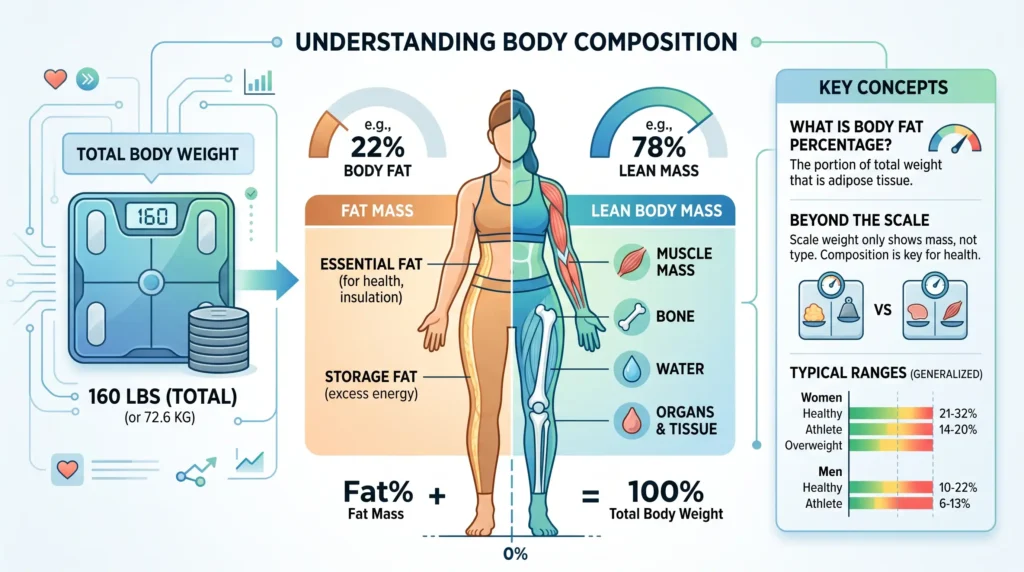
Your body weight tells you how much you weigh, but it does not tell you how much of that weight comes from body fat. This is why body fat percentage can be a useful measurement when you want to understand your body composition in greater detail.
The Body Fat Calculator provides a convenient way to estimate your body fat percentage using information such as body measurements and other relevant inputs, depending on the calculation method used.
In this Body Fat Calculator Guide, you will learn what body fat percentage means, how it is estimated, how to interpret your result, how body fat differs from BMI, and why body composition is more complicated than a single number.
What Is Body Fat Percentage?
Body fat percentage represents the proportion of your total body weight that is made up of fat.
For example, if someone weighs 80 kilograms and has an estimated body fat percentage of 20%, approximately 16 kilograms of their body weight would be fat mass, while the remaining weight would consist of lean tissues and other components of the body.
Body fat is not automatically unhealthy. Your body needs a certain amount of fat for normal physiological functions, including energy storage, hormone production, insulation, and protection of organs.
The goal is therefore not to eliminate body fat, but to understand whether your estimated level is appropriate for your individual circumstances and goals.
What Does a Body Fat Calculator Do?
A Body Fat Calculator estimates the percentage of your body weight that is composed of fat.
Unlike BMI, which uses only height and body weight, body fat estimation can incorporate additional measurements depending on the method being used.
Some estimation methods use measurements such as height, weight, age, sex, and waist circumference. Other methods may use skinfold measurements or specialized body composition equipment.
The FitCalculatorAI Body Fat Calculator is designed to make the estimation process simple and convenient.
How Is Body Fat Percentage Calculated?
There is more than one way to estimate body fat percentage. Different methods can produce somewhat different results because they rely on different assumptions and measurements.
Common approaches include:
- Body circumference measurements
- Skinfold measurements
- Bioelectrical impedance analysis
- DEXA scanning
- Hydrostatic weighing
- Air displacement methods
Laboratory and clinical methods can provide more detailed assessments, but they may be more expensive or less convenient than a calculator-based estimate.
Online calculators are best viewed as estimation tools rather than exact measurements of body composition.
Body Fat Percentage vs. BMI
Body fat percentage and BMI are related to body composition and weight assessment, but they measure different things.
BMI is calculated from height and weight. It does not directly measure body fat.
Body fat percentage, on the other hand, attempts to estimate how much of your total body weight is fat.
This distinction is particularly important for people who exercise regularly or have a relatively high amount of muscle mass.
You can calculate your BMI with the BMI Calculator and compare it with your estimated body fat percentage to get additional context about your body composition.
Why Body Fat Percentage Matters
Body fat percentage can provide information that body weight alone cannot.
Imagine two people who both weigh 75 kilograms. One may have a higher proportion of muscle and a lower amount of body fat, while the other may have less muscle and more body fat.
Their scale weight is identical, but their body composition can be very different.
This is one reason body composition can be useful when tracking fitness, resistance training, weight loss, or changes in physique.
Healthy Body Fat Percentage
There is no single body fat percentage that is ideal for every person. Healthy ranges can vary according to factors such as sex, age, genetics, activity level, and individual circumstances.
In general, women naturally tend to have higher essential and storage body fat levels than men. Body fat requirements also change throughout life.
For this reason, body fat percentage should be interpreted using sex- and age-appropriate reference ranges rather than one universal number.
If your goal is weight management, body fat percentage is best considered alongside your overall health, physical activity, nutrition, and other body measurements.
Essential Body Fat vs. Storage Body Fat
Not all body fat has the same role.
Essential fat is the amount of fat your body needs to support normal physiological functions. It plays important roles in organs, nerves, hormones, cell membranes, and other biological processes.
Storage fat represents additional energy stored in adipose tissue. The body can use stored fat as an energy source when needed.
Trying to reduce body fat to extremely low levels is not automatically healthier. Adequate body fat is necessary for normal biological function.
What Is Fat Mass?
Fat mass refers to the total amount of fat in your body.
You can estimate fat mass using your body weight and estimated body fat percentage.
For example, if you weigh 80 kilograms and your estimated body fat is 20%:
80 × 0.20 = 16 kg of fat mass
This means the estimated fat mass would be approximately 16 kilograms.
The remaining body weight is often referred to broadly as fat-free or lean mass, although lean body mass and fat-free mass are not always defined in exactly the same way.
What Is Lean Body Mass?
Lean body mass represents the non-fat components of the body, including muscle, organs, bones, connective tissues, and body water.
Understanding lean mass can be especially useful if your goal is improving body composition rather than simply reducing the number on the scale.
You can explore this measurement with the Lean Body Mass Calculator .
Another useful metric for people interested in muscularity is FFMI. The FFMI Calculator can provide another way to evaluate fat-free mass relative to height.
How Accurate Are Body Fat Calculators?
The accuracy of a body fat estimate depends heavily on the method used and the quality of the measurements entered.
A calculator based on body measurements is an estimation tool. It does not directly measure every component of your body.
Even professional body composition methods can produce different results because each technique has its own assumptions and sources of measurement variation.
Therefore, it is usually more useful to focus on consistent measurements and trends over time rather than treating one estimated percentage as an exact biological value.
How to Get More Consistent Body Fat Estimates
If you use a body fat calculator regularly, consistency is important.
- Measure yourself using the same units each time.
- Take circumference measurements at the same locations.
- Follow the same measurement technique.
- Avoid comparing results from completely different methods as if they were identical.
- Focus on trends rather than one isolated result.
If your estimated body fat changes significantly from one measurement to another, check whether the measurement conditions or calculation method also changed.
Body Fat Percentage and Weight Loss
Body fat percentage can be particularly useful during a weight-loss phase.
If your goal is to reduce body fat, you generally want to preserve as much lean mass as reasonably possible while reducing excess fat.
This is one reason resistance training and adequate protein intake are often included in body-composition-focused weight-loss strategies.
Your Weight Loss Calculator can help you explore a calorie target for weight loss.
You can also use the Calorie Deficit Calculator to understand the relationship between calorie intake and an estimated energy deficit.
Body Fat Percentage and Muscle Gain
People who are trying to build muscle may also track body fat percentage.
The goal of a muscle-building phase is often to increase lean mass while managing unnecessary increases in body fat.
Body weight alone cannot tell you whether a change on the scale comes from muscle, fat, water, or other components.
Tracking estimated body fat alongside body weight, measurements, strength, and training progress can therefore provide more information.
If gaining weight is your goal, you can also explore the Weight Gain Calculator .
Body Fat Percentage and BMI Together
BMI and body fat percentage can complement each other.
BMI gives you a simple weight-to-height measurement, while body fat percentage provides an estimate of the proportion of your weight that is fat.
For example, two people can have the same BMI but very different body fat percentages because their muscle and fat levels differ.
This is why looking at several measurements can be more informative than focusing on BMI alone.
Body Fat and Waist-to-Height Ratio
Waist measurements can provide additional information about body size and fat distribution.
If you want another simple measurement to complement your body fat estimate, try the Waist-to-Height Ratio Calculator .
You can also calculate your Waist-to-Hip Ratio to explore another body measurement.
Body Fat Percentage and Daily Calories
Body fat percentage does not tell you how many calories you should consume every day.
If you want to estimate your daily energy requirements, you need other measurements and calculations.
The BMR Calculator can estimate your basal metabolic rate.
The TDEE Calculator can estimate your total daily energy expenditure based on your activity level.
You can then use the Calorie Calculator to explore estimated calorie needs according to your goal.
Common Mistakes When Tracking Body Fat
One of the most common mistakes is treating an estimated body fat percentage as an exact measurement.
Another mistake is comparing results obtained from different methods without considering their differences.
For example, a result from a smart scale, a circumference formula, and a clinical body composition test should not automatically be assumed to be directly interchangeable.
It is generally more useful to choose a consistent method and monitor the direction of change over time.
Frequently Asked Questions About Body Fat Percentage
What is body fat percentage?
Body fat percentage is the estimated proportion of your total body weight that consists of fat. It provides additional information about body composition that body weight alone cannot show.
What is a healthy body fat percentage?
Healthy body fat ranges vary according to factors such as sex, age, genetics, activity level, and individual circumstances. There is no single percentage that is ideal for everyone.
Is body fat percentage better than BMI?
BMI and body fat percentage measure different aspects of body composition. BMI is based on height and weight, while body fat percentage estimates how much of your body weight is fat. Using both measurements can provide additional context.
Can a muscular person have a high BMI but low body fat?
Yes. BMI does not distinguish between muscle and fat. A person with substantial muscle mass can therefore have a relatively high BMI while having a lower body fat percentage.
Can I calculate my body fat at home?
Yes. Body fat can be estimated at home using methods such as circumference measurements or consumer body composition devices. These methods provide estimates rather than exact measurements.
How often should I measure body fat?
There is no universal schedule. If you are tracking body composition, consistency is generally more important than measuring extremely frequently. Using the same method and similar conditions makes trends easier to interpret.
Does losing weight always mean losing body fat?
No. Changes in body weight can come from fat, muscle, water, glycogen, and other factors. Body composition measurements can therefore provide useful additional context during weight management.
Calculate Your Body Fat Percentage
Ready to get a better understanding of your body composition? Use the free FitCalculatorAI Body Fat Calculator to estimate your body fat percentage and explore your results in just a few steps.
Calculate Your Body Fat Percentage →
After getting your estimate, you can explore additional measurements with the BMI Calculator , Lean Body Mass Calculator , and FFMI Calculator .
For a broader view of your health and fitness goals, try the Smart Fitness Advisor to explore multiple factors together.
You can also explore the complete FitCalculatorAI Health & Fitness Calculators collection for more free tools covering calories, nutrition, fitness, weight, and body composition.
Medical Disclaimer
This guide and the FitCalculatorAI Body Fat Calculator are provided for general educational and informational purposes only. Body fat calculator results are estimates and should not be considered a medical diagnosis. Individual body composition and health needs vary. If you have concerns about your body weight, body composition, nutrition, or health, consult a qualified healthcare professional.