
Understanding how many calories you burn during physical activity can make it easier to plan workouts, monitor energy expenditure, and understand how exercise fits into your overall nutrition goals.
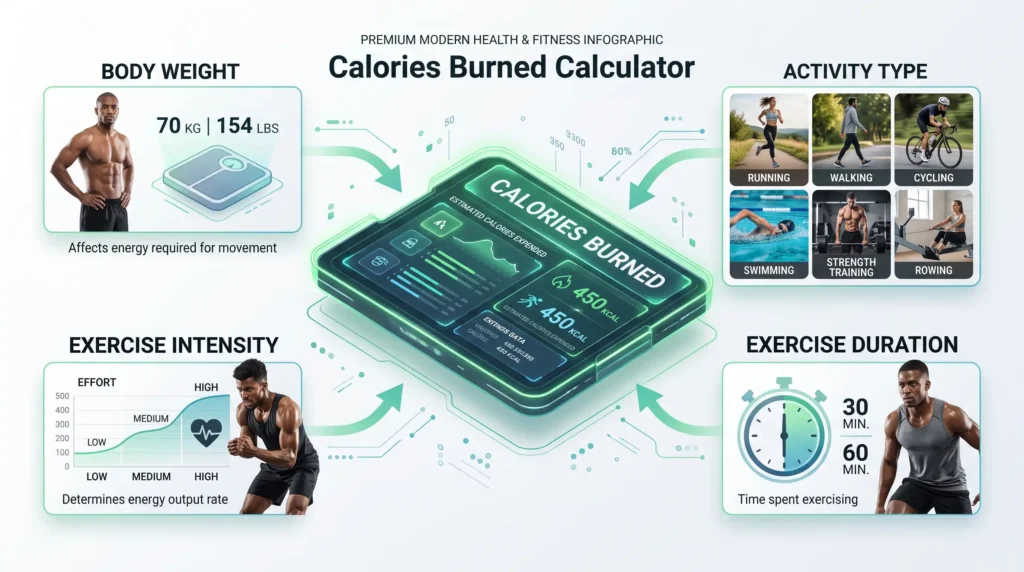
A Calories Burned Calculator estimates the calories you may burn during an activity based on factors such as your body weight, exercise type, intensity, and duration.
This guide explains how calories burned are estimated, which factors influence energy expenditure, how to use a calories burned calculator, and how exercise calories can fit into a balanced fitness and nutrition plan.
What Is a Calories Burned Calculator?
A Calories Burned Calculator is a fitness tool that estimates the amount of energy your body uses while performing a specific physical activity.
Depending on the calculator, you may enter your body weight, activity, exercise duration, and intensity. The calculator then provides an estimated number of calories burned.
You can use the Calories Burned Calculator to estimate your energy expenditure during different activities and workouts.
How Are Calories Burned During Exercise?
Your body constantly uses energy to keep you alive and perform normal functions. Physical activity adds additional energy expenditure on top of your resting needs.
Walking, running, cycling, swimming, strength training, sports, household activities, and other forms of movement can all increase calorie expenditure.
Important: Calories burned during exercise are estimates, not exact measurements. Two people performing the same activity for the same amount of time may burn different amounts of energy.
What Factors Affect Calories Burned?
Several factors influence how much energy you use during physical activity.
Body Weight
Body weight is one of the important factors used in many calorie expenditure formulas. In general, a heavier person may expend more energy performing the same activity at the same intensity and duration.
Exercise Intensity
Higher-intensity activities generally require more energy per minute than lower-intensity activities.
For example, fast running generally requires more energy than walking at a slow pace.
Duration
The longer you perform an activity, the greater your total energy expenditure is likely to be.
Activity Type
Different activities have different energy requirements. Running, cycling, swimming, rowing, walking, strength training, and sports can produce different calorie expenditure estimates.
Individual Differences
Fitness level, body composition, movement efficiency, age, sex, environmental conditions, and other individual factors can also affect actual energy expenditure.
Calories Burned vs. Total Daily Energy Expenditure
Calories burned during a workout are only one part of your total daily energy expenditure.
Your total daily energy expenditure includes energy used by your resting metabolism, physical activity, digestion, and everyday movement.
If you want to estimate your total daily calorie needs, use our TDEE Calculator Guide or visit the TDEE Calculator .
Common Activities and Calorie Expenditure
The number of calories burned varies from person to person, but different activities generally have different energy demands.
| Activity | Typical Intensity | Energy Demand |
|---|---|---|
| Walking | Low to moderate | Varies with pace and terrain |
| Running | Moderate to vigorous | Generally high |
| Cycling | Low to vigorous | Depends on speed and resistance |
| Swimming | Moderate to vigorous | Depends on stroke and intensity |
| Strength Training | Moderate to vigorous | Varies with workout structure |
| Sports | Moderate to vigorous | Depends on sport and intensity |
How to Use a Calories Burned Calculator
A calories burned calculator is generally simple to use. The exact inputs depend on the calculator, but most tools require a few basic details.
- Enter your body weight.
- Select the physical activity.
- Enter the duration of the activity.
- Select the appropriate intensity when available.
- Calculate your estimated calories burned.
For better estimates, use realistic exercise duration and choose an activity level that closely matches what you actually performed.
Why Body Weight Matters
Body weight affects the amount of energy required for many forms of movement.
Carrying more body mass generally requires more energy for activities such as walking, running, and climbing stairs.
This is one reason why two people completing the same workout may receive different calorie expenditure estimates.
Does Exercise Intensity Matter?
Yes. Exercise intensity can have a significant effect on energy expenditure.
A relaxed walk and a fast uphill walk may cover a similar distance, but the energy requirements can be very different.
Instead of focusing only on calories burned, consider the overall quality of your workout, consistency, strength, cardiovascular fitness, recovery, and long-term progress.
Calories Burned During Walking
Walking is one of the most accessible forms of physical activity. Calorie expenditure during walking depends on body weight, pace, duration, terrain, and other factors.
Walking uphill or increasing your pace can increase the energy required compared with slow walking on a flat surface.
You can use a calories burned calculator to compare different walking durations and intensities.
Calories Burned During Running
Running typically requires more energy per minute than walking because of its higher movement intensity.
Running speed, body weight, terrain, duration, and running efficiency can all influence energy expenditure.
If running is part of your training plan, you can also use our Running Pace Calculator to understand pace, distance, and running performance.
Calories Burned During Strength Training
Strength training can contribute to overall energy expenditure, although calorie estimates during resistance workouts can be more difficult to determine precisely.
Workout duration, exercise selection, rest periods, training intensity, and individual characteristics can all affect energy expenditure.
Strength training should not be evaluated only by calories burned. Building strength, maintaining muscle, improving movement quality, and supporting long-term fitness are also important benefits.
Should You Eat Back Exercise Calories?
Whether you should increase food intake after exercise depends on your overall calorie needs and fitness goal.
If your goal is weight loss, maintaining an appropriate calorie deficit may be important. If your goal is muscle gain or athletic performance, additional energy may be useful.
However, calorie estimates from watches, machines, and online calculators can have considerable uncertainty. It is usually better to look at trends over time rather than treating exercise calorie estimates as exact numbers.
Think in terms of trends: Your body weight, performance, hunger, recovery, and progress over several weeks can provide more useful information than a single estimated workout calorie number.
Calories Burned and Weight Loss
Weight loss generally occurs when average energy intake is lower than average energy expenditure over time.
Exercise can increase energy expenditure and support a calorie deficit, but nutrition also plays a major role.
You can use our Calorie Deficit Calculator to explore how calorie intake and energy expenditure relate to a weight-loss goal.
Calories Burned and Muscle Gain
People trying to build muscle may have different calorie and training requirements than people focused primarily on weight reduction.
Adequate protein, sufficient calories, progressive resistance training, and recovery are important components of a muscle-building strategy.
Our Protein Calculator can help estimate daily protein needs based on personal and fitness factors.
How Accurate Are Calories Burned Calculators?
Calories burned calculators provide estimates rather than direct measurements of your actual energy expenditure.
The accuracy of an estimate depends on the formula, activity data, body information, exercise intensity, and how closely the selected activity matches what you actually performed.
Fitness trackers and exercise machines also estimate calorie expenditure and can sometimes differ substantially from each other.
For this reason, calorie estimates are most useful as a general reference rather than an exact measurement.
How to Improve the Usefulness of Your Results
- Enter your current body weight.
- Use the actual duration of your workout.
- Select the closest activity type.
- Choose a realistic intensity level.
- Compare results over time rather than relying on one workout.
- Consider your overall calorie intake and daily activity.
Everyday Movement Also Burns Calories
Exercise is not the only form of physical activity that contributes to daily energy expenditure.
Walking around the house, cleaning, shopping, standing, taking the stairs, working, and other everyday movements can all contribute to total energy expenditure.
This everyday movement is sometimes described as non-exercise activity thermogenesis (NEAT).
Increasing everyday movement can therefore be a practical way to become more active without relying exclusively on structured workouts.
Calories Burned and Hydration
Exercise, especially in hot environments or during prolonged sessions, can increase fluid losses through sweating.
Staying adequately hydrated is important for exercise performance and general well-being.
For a more detailed estimate of water and electrolyte requirements, explore our Water & Electrolyte Calculator .
Frequently Asked Questions
What is a Calories Burned Calculator?
A Calories Burned Calculator estimates the energy you may expend during physical activity using information such as body weight, activity type, duration, and intensity.
How accurate is a calories burned calculator?
Calories burned calculators provide estimates rather than exact measurements. Actual energy expenditure can vary depending on individual characteristics and exercise conditions.
Does body weight affect calories burned?
Yes. Body weight is an important factor in many calorie expenditure formulas because moving a larger body mass can require more energy.
Does walking burn calories?
Yes. Walking uses energy, and the amount burned depends on factors such as body weight, walking speed, duration, and terrain.
Does running burn more calories than walking?
Running generally burns more calories per minute than walking because it typically requires greater intensity. Actual expenditure varies between individuals.
Should I eat the calories I burn during exercise?
It depends on your overall calorie needs and goal. Exercise calorie estimates are not exact, so it is better to consider your overall energy balance and progress over time.
Can exercise help with weight loss?
Yes. Physical activity can increase energy expenditure and support a calorie deficit when combined with an appropriate nutrition plan.
Do strength workouts burn calories?
Yes. Strength training uses energy, although the exact calorie expenditure depends on workout duration, intensity, rest periods, exercises, and individual characteristics.
What is the difference between calories burned and TDEE?
Calories burned during exercise represent energy used during an activity, while TDEE represents total daily energy expenditure from resting metabolism, activity, digestion, and everyday movement.