
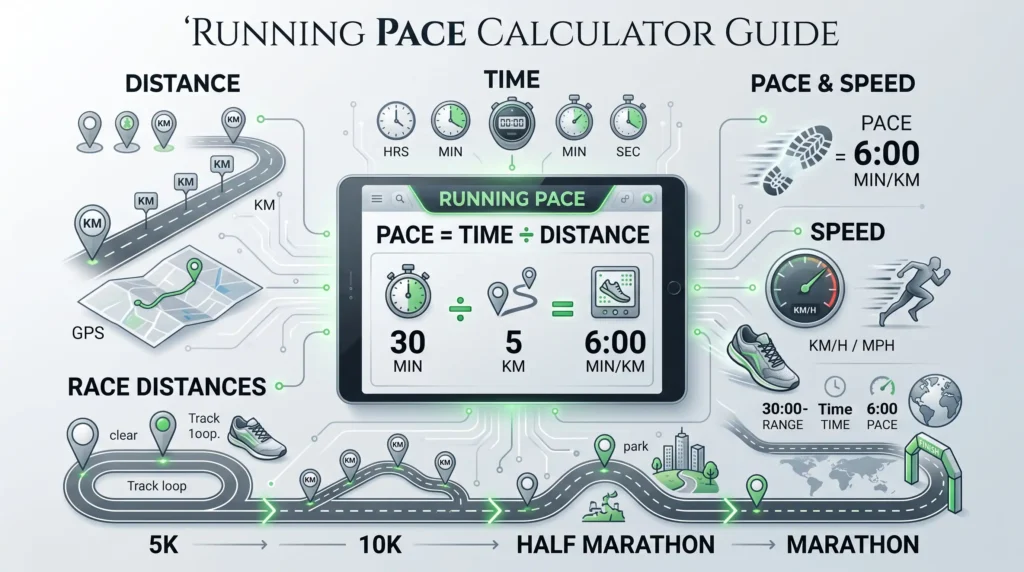
Running pace is one of the most useful measurements for runners. It tells you how quickly you are covering a specific distance and can help you plan workouts, races, and training sessions.
A Running Pace Calculator makes it easier to determine your pace from your running distance and finish time. It can also help estimate finish times for different race distances.
In this guide, you will learn how running pace works, how to calculate pace, how pace differs from speed, how to use a Running Pace Calculator, and how to use your results to structure your training.
What Is Running Pace?
Running pace describes how much time it takes you to cover a specific distance. It is usually expressed as minutes per mile or minutes per kilometer.
For example, if you run 5 kilometers in 30 minutes, your average pace is 6 minutes per kilometer.
Simple example: 30 minutes ÷ 5 kilometers = 6:00 min/km.
Pace is especially useful because it allows runners to compare performances and control the intensity of different training runs.
What Is a Running Pace Calculator?
A Running Pace Calculator is a tool that calculates your average running pace using your distance and time.
Depending on the calculator, you may also be able to calculate running time, distance, pace, speed, and estimated race finish times.
You can use the Running Pace Calculator to quickly estimate your pace without performing the calculations manually.
How to Calculate Running Pace
The basic running pace formula is simple:
Running Pace = Total Time ÷ Total Distance
For example, imagine you complete a 10 km run in 55 minutes. Dividing 55 minutes by 10 km gives an average pace of 5.5 minutes per kilometer.
Because 0.5 minute equals 30 seconds, the result is approximately 5 minutes 30 seconds per kilometer.
Running Pace vs Running Speed
Pace and speed describe the same performance from different perspectives.
Pace tells you how long it takes to cover a distance, while speed tells you how much distance you cover in a specific amount of time.
| Measurement | What It Means | Example |
|---|---|---|
| Pace | Time required to cover a distance | 5:30 min/km |
| Speed | Distance covered per unit of time | 10.9 km/h |
Runners often use pace because it is easy to understand during workouts and races.
Why Is Running Pace Important?
Knowing your pace can help you control your effort and avoid running too fast or too slowly for a particular workout.
- Helps you plan race strategies.
- Makes training intensity easier to control.
- Allows you to monitor improvements over time.
- Helps estimate future race times.
- Makes interval and tempo workouts easier to plan.
- Provides a simple way to compare running performances.
How to Use a Running Pace Calculator
Using a Running Pace Calculator is usually straightforward. Start with a known distance and your total running time.
- Enter your running distance.
- Select the distance unit, such as kilometers or miles.
- Enter your running time.
- Calculate your average pace.
- Review the estimated pace and other available results.
If your calculator supports race predictions, you can also use your pace to estimate how long it may take to complete other distances.
Common Running Distances and Pace Examples
Different race distances require different pacing strategies. Understanding your average pace can help you create realistic expectations for each distance.
| Distance | Example Pace | Approximate Finish Time |
|---|---|---|
| 1 km | 5:00 min/km | 5 minutes |
| 5 km | 6:00 min/km | 30 minutes |
| 10 km | 6:00 min/km | 60 minutes |
| Half Marathon | 6:00 min/km | About 2:06:35 |
| Marathon | 6:00 min/km | About 4:13:10 |
These examples are mathematical illustrations rather than recommendations for a specific training pace.
Easy Running Pace
Easy runs are generally performed at a comfortable intensity that allows you to maintain a conversation without excessive effort.
Easy running is an important part of many training programs because it allows runners to accumulate mileage while managing fatigue.
Your easy pace does not need to match your race pace. A slower, comfortable pace can be appropriate for recovery and aerobic development.
Tempo Running Pace
Tempo runs are typically performed at a faster controlled intensity than an easy run.
The exact pace depends on the runner, training experience, race distance, and workout purpose.
Tempo training should be challenging but controlled rather than an all-out sprint.
Interval Running Pace
Interval training involves alternating periods of faster running with recovery periods.
Intervals can be useful for improving speed, running economy, and the ability to sustain faster efforts.
Because interval sessions can be demanding, they should be incorporated into a balanced training program with adequate recovery.
How to Improve Your Running Pace
Improving pace usually requires consistent training rather than simply trying to run faster every day.
Build a Consistent Running Routine
Consistency is one of the most important factors in improving running performance. Regular training gives your body opportunities to adapt to the demands of running.
Include Easy Runs
Easy running provides aerobic training while helping manage overall fatigue.
Add Structured Faster Workouts
Tempo runs, intervals, hills, and other structured sessions can be useful additions for runners who are ready for more advanced training.
Increase Training Gradually
Avoid making large sudden increases in running volume or intensity. Gradual progression can make training more manageable and sustainable.
Running Pace for Weight Management
Running can contribute to energy expenditure, but the calories burned during a run depend on factors such as body weight, running distance, pace, terrain, and individual physiology.
If you want to estimate energy expenditure during physical activity, use the Calories Burned Calculator .
For broader daily energy needs, the TDEE Calculator can help estimate your total daily energy expenditure.
Running Pace and Calories
Running faster does not automatically mean that every run should be performed at a higher intensity. Training should consider both performance and recovery.
Your nutritional needs also depend on your total activity and goals. The Calorie Calculator can be used to estimate daily calorie requirements.
Running Pace for Beginners
Beginners often make the mistake of comparing their pace with experienced runners. A better approach is to focus on consistency, comfort, and gradual progress.
If you are new to running, a combination of running and walking may be an effective way to build fitness gradually.
- Start with manageable distances.
- Keep many runs at a comfortable intensity.
- Allow adequate recovery between harder sessions.
- Increase training gradually.
- Track your pace and distance over time.
How to Pace a 5K
A 5K is a popular running distance for beginners and experienced runners alike.
If you have a target finish time, divide the total time by 5 to determine the average pace required per kilometer.
Example: A 30-minute 5K requires an average pace of approximately 6:00 min/km.
In an actual race, factors such as hills, weather, crowds, and course layout can affect your pace.
How to Pace a 10K
The 10K requires runners to maintain a sustainable pace over a longer distance than a 5K.
If your goal is to finish a 10K in 60 minutes, your average target pace would be approximately 6:00 minutes per kilometer.
Many runners benefit from starting under control instead of running the opening kilometers too aggressively.
How to Pace a Half Marathon
A half marathon covers 21.1 kilometers, making pacing especially important.
Starting too quickly can make the second half of the race much more difficult. A controlled pace can help conserve energy for the later kilometers.
Your previous race results, training runs, fitness level, and course conditions should all be considered when choosing a realistic target.
How to Pace a Marathon
Marathon pacing is significantly different from short-distance racing because the distance is 42.195 kilometers.
Even small differences in pace can have a large effect over the full marathon distance.
Marathon runners usually need to consider hydration, fueling, weather, elevation, experience, and pacing strategy in addition to their average pace.
Factors That Affect Running Pace
Your running pace can change from one day to another. A slower pace does not necessarily mean that your fitness has declined.
- Weather and temperature.
- Humidity and wind.
- Elevation and hills.
- Running surface.
- Sleep and recovery.
- Nutrition and hydration.
- Training fatigue.
- Stress.
- Running experience.
Running Pace and Heart Rate
Pace is only one way to measure running intensity. Heart rate can provide additional information about how hard your body is working.
Two runners can run at the same pace while experiencing different levels of effort due to differences in fitness, weather, terrain, and individual physiology.
For this reason, combining pace with perceived effort and other training metrics can provide a more complete picture of your workout.
Should You Run at the Same Pace Every Day?
No. A balanced running program often includes different types of sessions performed at different intensities.
Easy runs, recovery runs, long runs, tempo sessions, and intervals each have different purposes.
Faster is not always better. The right pace depends on the purpose of the workout.
Frequently Asked Questions
What is a good running pace?
A good running pace depends on your fitness level, experience, distance, training goal, and current conditions. There is no single pace that is ideal for every runner.
How do I calculate my running pace?
Divide your total running time by the distance covered. The result gives your average time per unit of distance.
What is the difference between pace and speed?
Pace measures how long it takes to cover a distance, while speed measures how much distance you cover in a given amount of time.
What pace is a 30-minute 5K?
A 30-minute 5K requires an average pace of approximately 6:00 minutes per kilometer, or about 9:39 minutes per mile.
What pace is a 60-minute 10K?
A 60-minute 10K requires an average pace of approximately 6:00 minutes per kilometer.
Can a Running Pace Calculator predict my race time?
A pace calculator can mathematically estimate a finish time based on a selected pace. However, actual race performance can be affected by fitness, weather, terrain, fatigue, fueling, and race conditions.
Should beginners focus on running pace?
Beginners can benefit from focusing primarily on consistency and comfortable effort rather than trying to reach a specific pace immediately.
How can I improve my running pace?
Consistent training, appropriate recovery, gradual progression, easy runs, and carefully structured faster workouts can all contribute to improved running performance.