
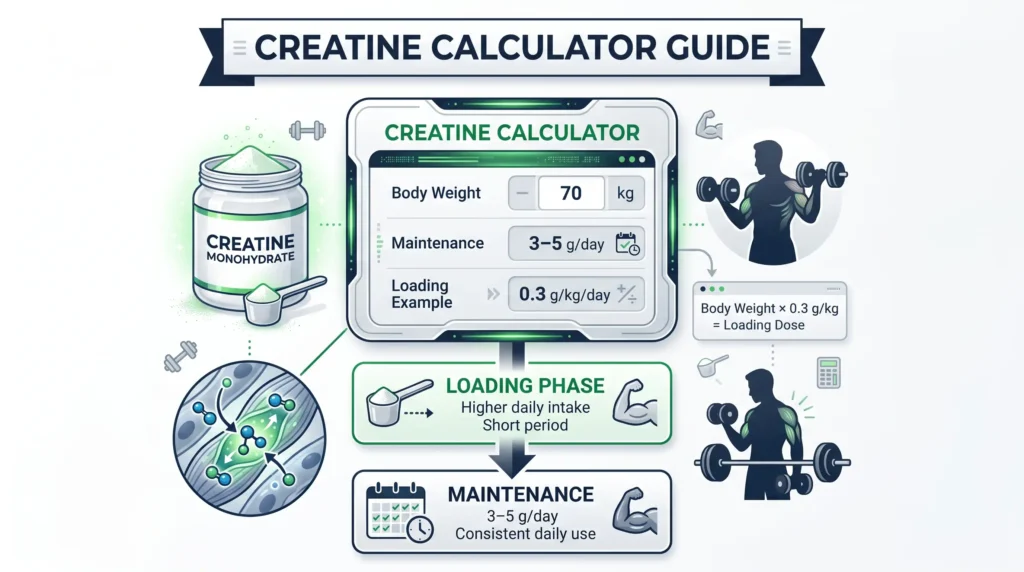
A Creatine Calculator can help you estimate a practical daily creatine intake based on your goals, body weight, and selected supplementation approach. Creatine is one of the most widely studied sports supplements and is commonly used to support strength, power, and high-intensity exercise performance.
This guide explains how creatine dosing works, how to use a creatine calculator, the difference between a daily maintenance dose and a loading phase, and what to consider when using creatine as part of a fitness routine.
What Is a Creatine Calculator?
A Creatine Calculator is a simple tool that helps estimate creatine supplementation based on information such as body weight and your preferred dosing strategy.
For many healthy adults, creatine monohydrate is commonly used at a consistent daily dose rather than being adjusted dramatically according to body weight.
A calculator can nevertheless be useful for understanding different approaches and seeing how a loading phase compares with a regular maintenance routine.
What Is Creatine?
Creatine is a naturally occurring compound found in the body and in foods such as meat and fish. The body also produces creatine and stores much of it in skeletal muscle.
During short, high-intensity activities, the creatine-phosphate system helps rapidly regenerate ATP, which is an important source of energy for muscular work.
This is one reason creatine supplementation is particularly popular among people involved in resistance training, sprinting, and other activities involving repeated high-intensity efforts.
How Does Creatine Supplementation Work?
Creatine supplementation can increase the amount of creatine stored in skeletal muscle. Once muscle creatine stores become sufficiently saturated, maintaining those stores generally requires a smaller daily amount than an initial loading protocol.
The two commonly discussed approaches are:
- Maintenance approach: take a consistent daily amount.
- Loading approach: use a higher daily intake for a short period before switching to a lower maintenance amount.
How Much Creatine Should You Take?
A commonly used daily maintenance amount of creatine monohydrate is around 3 to 5 grams per day for healthy adults.
Some protocols use body weight to estimate a loading dose, while others simply use a standard daily maintenance amount without a loading phase.
The best approach can depend on your goals, training routine, preferences, and individual circumstances.
For many people, taking creatine monohydrate consistently every day is more important than trying to find a highly precise dose based on small changes in body weight.
Creatine Loading vs. Maintenance
| Approach | Typical Strategy | Main Purpose |
|---|---|---|
| Maintenance | About 3–5 g daily | Maintain elevated muscle creatine stores |
| Loading | Higher intake for several days | Increase muscle creatine stores more quickly |
A loading phase is not considered essential for everyone. Taking a regular maintenance dose can also increase muscle creatine stores, although it may take longer to reach full saturation.
How to Use the Creatine Calculator
Using the calculator is simple. Depending on the version of the tool, you may enter your body weight and select your preferred supplementation strategy.
- Enter your current body weight.
- Select the appropriate weight unit.
- Choose a maintenance or loading approach if available.
- Calculate your estimated creatine intake.
- Use the result as a general supplementation reference.
The calculator is designed to make the calculation easier to understand rather than replace professional medical or nutrition advice.
Creatine Dose Based on Body Weight
Some creatine protocols use approximately 0.3 grams per kilogram of body weight per day during a short loading phase.
For example, a person weighing 70 kg would calculate:
70 kg × 0.3 g/kg = 21 g per day
This illustrates a loading-style calculation. It does not mean that every person needs to use this amount, and a loading phase is not required to benefit from creatine.
Why Creatine Monohydrate Is Commonly Used
Creatine monohydrate is the most extensively studied form of creatine. It is widely available, relatively inexpensive, and has substantial research supporting its use for increasing muscle creatine stores.
Other forms of creatine are marketed with various claims, but there is not necessarily a need to choose a more expensive form when creatine monohydrate is appropriate for you.
When Should You Take Creatine?
Creatine does not need to be taken immediately before a workout to be useful. Consistent daily supplementation is generally more important than choosing a specific minute of the day.
Some people prefer taking creatine with a meal or around their workout simply because it is easier to remember.
Choose a time that fits naturally into your daily routine so you can take your creatine consistently.
Does Creatine Help With Muscle Growth?
Creatine supplementation can support resistance-training performance and may contribute to improvements in strength and lean mass when combined with an appropriate training program and adequate nutrition.
Creatine itself is not a replacement for progressive resistance training, sufficient protein, calories, sleep, and recovery.
If your goal is muscle growth, you can use the Protein Calculator to estimate your daily protein needs.
Creatine and Workout Performance
Creatine is particularly relevant to activities that involve repeated short-duration, high-intensity efforts.
This can include resistance training, sprinting, jumping, and other sports where rapid energy production is important.
If you are interested in measuring strength progress, the One Rep Max (1RM) Calculator can help estimate your maximum strength from a submaximal lifting set.
Creatine and Hydration
Maintaining adequate fluid intake is important for everyone, especially people who exercise regularly.
Creatine supplementation can increase water stored within muscle cells, which may contribute to a small increase in body weight after beginning supplementation.
This change is not necessarily an increase in body fat.
For a personalized starting estimate for daily fluid intake, see the Water Intake Calculator .
Creatine and Body Weight Changes
Some people notice an increase in body weight after starting creatine. One common reason is increased water retention within muscle cells as creatine stores rise.
This should not automatically be interpreted as fat gain.
If you are monitoring your body weight as part of a fitness goal, consider looking at longer-term trends rather than reacting to individual daily changes.
The Body Weight Planner can also help you monitor weight-related goals.
Creatine and Nutrition
Supplements work best when they complement a balanced diet. If you are training for muscle growth or performance, total energy intake, protein, carbohydrates, fats, and micronutrients all matter.
Your daily calorie needs can be estimated with the TDEE Calculator .
You can also use the Macro Calculator to explore a practical distribution of protein, carbohydrates, and fats.
Common Creatine Mistakes
Taking It Only on Workout Days
Creatine supplementation is commonly used every day because the goal is to maintain elevated muscle creatine stores rather than produce an immediate pre-workout effect.
Changing the Dose Constantly
Creatine does not usually require frequent dose adjustments. A consistent routine is easier to follow and can help maintain muscle creatine stores.
Expecting Immediate Results
Creatine is not a stimulant and does not necessarily produce an immediate noticeable workout effect. Benefits are associated with increasing muscle creatine availability over time.
Ignoring Overall Nutrition
Creatine cannot compensate for inadequate calories, protein, training, recovery, or sleep.
Who Commonly Uses Creatine?
Creatine is widely used by people participating in resistance training, strength sports, sprinting, and other high-intensity activities.
It is also used by recreational gym-goers who want to support strength and training performance.
However, individual suitability can vary, particularly for people with medical conditions or those taking medications.
Is Creatine Safe?
Creatine monohydrate has been extensively studied in healthy adults and is generally considered well tolerated when used appropriately.
Some people may experience gastrointestinal discomfort, especially when taking large amounts at once.
Anyone with a medical condition, kidney concerns, or who takes medication should discuss creatine supplementation with an appropriately qualified healthcare professional before starting it.
Frequently Asked Questions
How much creatine should I take per day?
A commonly used maintenance amount for healthy adults is around 3–5 grams of creatine monohydrate per day. Individual circumstances can vary.
Do I need a creatine loading phase?
No. A loading phase is optional. A regular daily maintenance dose can also increase muscle creatine stores, although saturation may take longer.
Should I take creatine every day?
Creatine is commonly taken consistently every day, including rest days, to help maintain elevated muscle creatine stores.
What is the best type of creatine?
Creatine monohydrate is the most extensively researched form of creatine and is a common choice for supplementation.
Can creatine increase body weight?
Yes. Some people experience an increase in body weight after starting creatine, partly because of increased water stored within muscle cells.
When is the best time to take creatine?
There is no need to take creatine at one specific time. Consistent daily use is generally more important than precise timing.
Can I take creatine on rest days?
Yes. Creatine is commonly taken on rest days as part of a consistent daily supplementation routine.
Does creatine help build muscle?
Creatine can support resistance-training performance and may help contribute to increases in strength and lean mass when combined with appropriate training and nutrition.